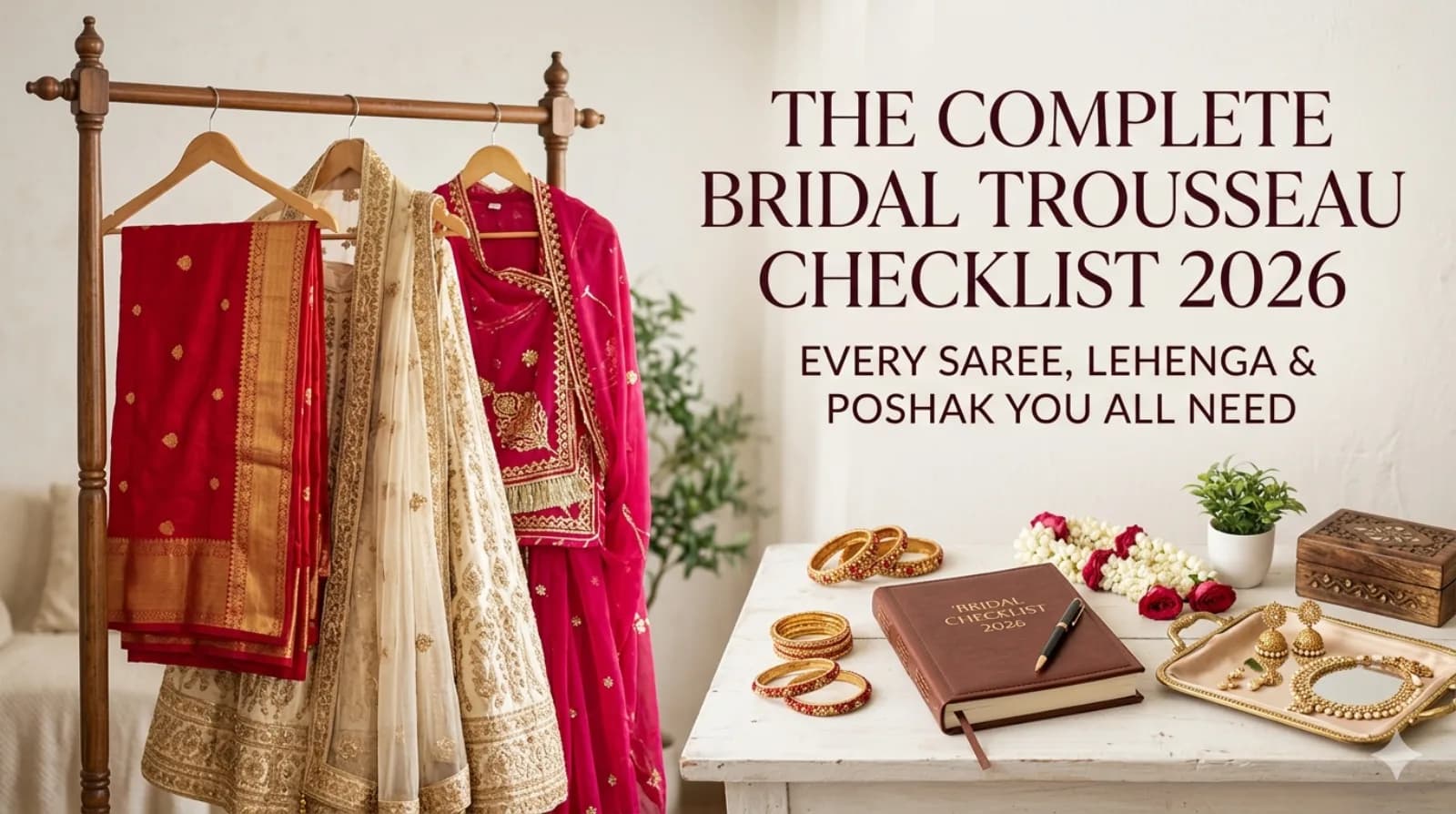
The Complete Bridal Trousseau Checklist 2026: Every Saree, Lehenga & Poshak You'll Need
A function-by-function bridal trousseau checklist for 2026 Indian weddings — how many outfits you really need, what each function demands, budget guidance, and the heirloom pieces worth investing in.
Kshitija Rana
Editor
Your bridal trousseau is not just a wardrobe — it is a record of the most meaningful week of your life, and many of its pieces will travel with you for decades. Some will be worn once and tucked away, some will be restyled for anniversaries and your own daughter's wedding, and one or two will eventually be heirlooms. This complete bridal trousseau checklist for 2026 walks you through every function of an Indian wedding, how many outfits you realistically need, where to invest, where to save, and how to plan so nothing is rushed.
Start Early: The 2026 Bridal Trousseau Timeline
The single biggest mistake modern brides make is underestimating time. Handcrafted pieces — real Banarasi silk, Rajputi poshak with genuine gota patti or zardozi, heavily embroidered bridal lehengas — cannot be rushed. Artisans work slowly because the craft demands it.
Here is the timeline Rana's recommends to every 2026 bride:
- 9–12 months before the wedding: Book bridal consultation, discuss overall trousseau vision, shortlist designers and ateliers, set budget ranges per function.
- 6–9 months before: Order the wedding-day outfit, reception outfit, and any Rajputi poshak. These require the longest lead times.
- 4–6 months before: Order pre-wedding function outfits (engagement, sangeet, mehendi, haldi). First fittings for earlier-ordered pieces.
- 2–3 months before: Finalize jewellery pairings, order custom blouses, commission any final pieces. Second fittings.
- 1 month before: Final fittings, accessory shopping, lingerie and shapewear purchases, trousseau packing.
- Wedding week: Steam, press, and pack each outfit with its jewellery and accessories in a labelled bag.
This is the rhythm that keeps bridal shopping joyful rather than panicked. For a deeper look at your first major bridal decision, read our guide on bridal lehenga vs bridal saree.
Function-by-Function Trousseau Checklist
Indian weddings have more functions than most other wedding traditions in the world. Not every bride does every function, so treat this as a menu — pick what matches your family's traditions.
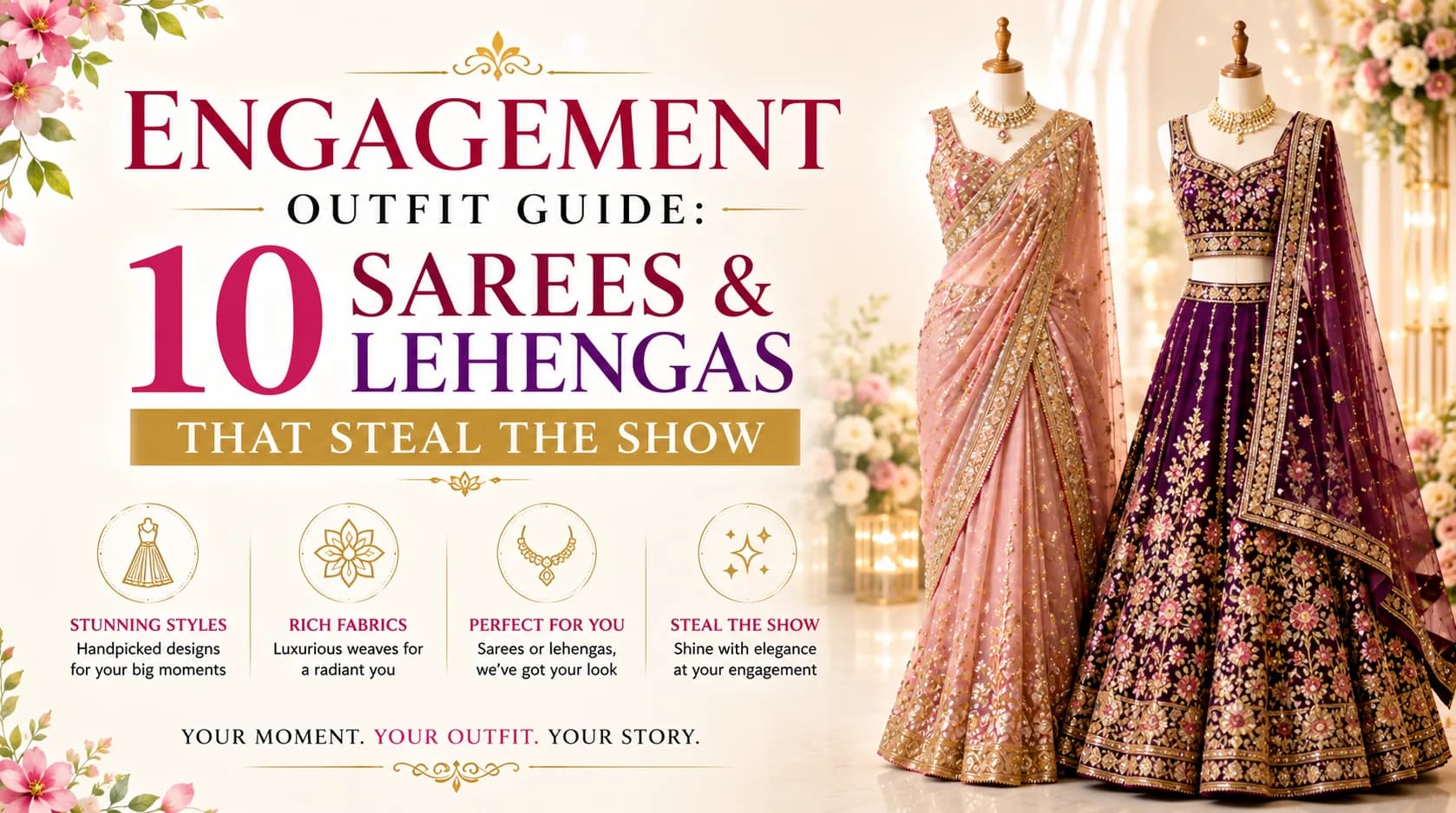
1. Engagement / Roka / Tilak
The first formal function and the first public appearance of the couple. Photographs are important.
- Recommended outfit: Silk saree or lightweight lehenga in soft festive colours — dusty pink, peach, powder blue, ivory with gold work, or sage green.
- Fabric picks: Pure silk, organza, chanderi, or a light kanjivaram.
- Budget allocation: 10–12 percent of total trousseau.
- Investment tip: Choose a piece you can genuinely wear again — engagement outfits are the most re-wearable of the entire trousseau.
2. Mayra / Bhaat
A Rajasthani tradition where the maternal uncle brings gifts for the bride. Deep cultural significance in Marwari and Rajput communities.
- Recommended outfit: Traditional Rajputi poshak or heirloom saree in red, orange, or magenta.
- Fabric picks: Silk with gota patti, Bandhani, or leheriya.
- Investment tip: This is a prime moment for a poshak — the function is rooted in Rajasthani heritage and the photographs are powerful.
Explore our complete Rajputi poshak collection for authentic handcrafted pieces.
3. Haldi
A morning ritual where turmeric paste is applied — which means your outfit will almost certainly get stained.
- Recommended outfit: Simple cotton or mulmul saree / suit in yellow, white, orange, or green.
- Fabric picks: Cotton, mulmul, or lightweight georgette. Avoid silks and heavy embroidery.
- Budget allocation: 5–7 percent of total trousseau.
- Investment tip: Save here. Haldi outfits are often unwearable afterwards.
4. Mehendi
Longer and more intimate than haldi. The bride sits still for 4–6 hours while henna is applied, so comfort matters.
- Recommended outfit: Lightweight lehenga, sharara, or saree in yellow, green, orange, or Bandhani multicolour.
- Fabric picks: Georgette, cotton-silk, mulmul, or Bandhani.
- Investment tip: Avoid full-length sleeves that interfere with henna application. A kalidar kurta with a dupatta is often most practical.
5. Sangeet
The dance and music night — high energy, full family participation, usually the most Instagram-worthy of the pre-wedding functions.
- Recommended outfit: Statement lehenga or fusion outfit — sequinned, embroidered, showstopping.
- Fabric picks: Velvet, silk, net with embroidery, or heavily embellished georgette.
- Budget allocation: 12–15 percent of total trousseau.
- Investment tip: This is the outfit guests will remember. Invest in something that lets you dance freely — avoid restrictive cholis or very heavy ghagras.
For styling inspiration across all pre-wedding events, read our sangeet and mehendi outfit guide.
6. The Wedding Ceremony
The central outfit of your life — every future photograph of your wedding will feature this piece.
- Recommended outfit: Traditional bridal lehenga or Banarasi silk saree, or for Rajasthani brides, a royal Rajputi poshak.
- Fabric picks: Heavy silk, velvet, or pure Banarasi with gota patti, zardozi, or sequinned embroidery.
- Colour picks: Classic red, deep maroon, wine, blush pink, or gold. Non-traditional brides may choose deep teal, copper, or emerald.
- Budget allocation: 30–40 percent of total trousseau.
- Investment tip: This is where you spend your peak budget. Expect 12–16 weeks of handwork for a truly handcrafted piece.
7. The Reception
A modern, more formal celebration — different in mood from the traditional wedding ceremony.
- Recommended outfit: Contemporary gown-lehenga, sleek saree, or structured silhouette. This is where Indian brides now play with modern design.
- Fabric picks: Organza, tulle, chikankari on silk, or hand-embroidered net.
- Colour picks: Pastels (blush, ivory, champagne), deep jewel tones (sapphire, emerald), or metallics.
- Budget allocation: 20–25 percent of total trousseau.
- Investment tip: Choose a silhouette radically different from your wedding day outfit — the photographs will feel like two distinct moods.
8. Pag Phera / First Visit Home
The first visit back to the bride's parental home after the wedding.
- Recommended outfit: A gifted saree from the groom's family is traditional, or a new simple silk saree you chose.
- Fabric picks: Soft silk, chanderi, or georgette.
- Budget allocation: 5–7 percent.
9. Post-Wedding Visits and Early Married Life
In the weeks immediately after the wedding, families visit, neighbours call, and you will host. You need 2–3 "special dress-up" outfits that are nicer than daily wear but not bridal.
- Recommended outfits: 2 soft silk sarees, 1 organza or chanderi, or 2 lightweight lehengas.
- Budget allocation: 8–10 percent total for this group.
How Many Outfits Do You Really Need?
Here is a realistic count for three wedding scales, based on Rana's bridal consultation data:
| Wedding Type | Total Outfits | Core Functions Covered |
|---|---|---|
| Intimate wedding (1–2 days) | 4–5 | Engagement, wedding, reception, 1 casual |
| Traditional wedding (3–4 days) | 7–8 | Add haldi, mehendi, sangeet |
| Extended Rajasthani wedding (5–7 days) | 10–12 | Add mayra, tilak, pag phera, multiple family functions |
If friends and family are giving you outfits as wedding gifts, coordinate early so you do not end up with four pink lehengas.
Budget Allocation Framework
A proven framework for bridal trousseau budget allocation:
- Wedding day outfit: 30–40 percent
- Reception outfit: 20–25 percent
- Sangeet outfit: 12–15 percent
- Engagement outfit: 10–12 percent
- Mehendi: 5–8 percent
- Haldi: 4–6 percent
- Post-wedding outfits (2–3): 8–10 percent total
For context, a full bespoke bridal trousseau from a Jaipur atelier in 2026 typically sits between ₹8 lakh and ₹25 lakh depending on function count and embroidery density. Ready-to-wear designer trousseaus begin around ₹2–3 lakh for the full calendar.
Heirloom Pieces: What to Invest In Forever
Certain bridal pieces are not outfits — they are family history. These are the pieces worth overspending on because they will outlive their first wear by decades.
- A Banarasi wedding saree: Pure tissue-gold Banarasi silk only gets more beautiful with age. Your daughter will wear this.
- A Rajputi poshak with real gota patti and mothda: Authentic poshaks appreciate in cultural value over time and become grandmother-to-granddaughter pieces. Our Rajputi poshak guide explains what makes a piece truly heirloom-grade.
- A heavily zardozi-embroidered blouse or shawl: Zardozi work is 500 years of Indian craft. Read the making of a zardozi saree to understand why these pieces are priced as they are.
- A statement dupatta for rituals: One exceptional dupatta — heavy gota or zardozi — becomes your puja and ritual dupatta for life.
Save on trendy pieces (haldi outfits, reception silhouettes that follow a moment's trend) and spend on pieces that will still feel significant in 30 years.
The Supporting Cast: What Brides Forget
Every experienced bride will tell you the same thing — the outfits are only half the trousseau. Do not forget:
- Blouses: 3–4 custom-fitted blouses, at least one strapless and one full-sleeved. Read our saree blouse designs 2026 guide for current styles.
- Petticoats / shape wear: 4–5 petticoats in matching colours, shapewear, and seamless undergarments.
- Dupattas: Extra dupattas for temple visits, rituals, and casual styling. See our designer dupatta styling guide.
- Footwear: Wedding day kolhapuris or juttis, reception heels, comfortable flats for mehendi and haldi, and one pair of emergency backup flats in your bridal bag.
- Jewellery pouches and saree covers: Proper cotton muslin saree covers protect your investment for years.
- Emergency kit: Safety pins, double-sided tape, stain pens, a sewing kit, and an extra blouse hook.
Red Flags When Shopping for Your Trousseau
- No paper trail: A reputable designer will give you itemised invoices, fabric certifications for Banarasi and pure silk, and embroidery details in writing.
- Pressure to decide same-day: Real bridal decisions take reflection. A designer who pressures you today will pressure you on alterations tomorrow.
- Prices that seem too good: A "pure" Banarasi saree at ₹15,000 is not pure Banarasi. Handcrafted gota patti under ₹40,000 is not handcrafted gota patti. Know the craft economics.
- No fittings included: Custom work without at least two fittings is not really custom.
Read our deeper bridal saree shopping checklist for the full list of questions to ask before you buy.
The Rana's Bridal Consultation
At Rana's by Kshitija, a bridal consultation is not a shopping appointment — it is a 90-minute conversation about your wedding, your personal aesthetic, your family's traditions, and the life you want these outfits to have. We then build a trousseau plan function-by-function around you. For NRI brides, we run the same consultation virtually and ship worldwide.
Book your bridal consultation →
Frequently Asked Questions
How early do I need to order a Rajputi poshak for my wedding?
A handcrafted Rajputi poshak with authentic gota patti, mothda, or zardozi embroidery requires 12–16 weeks to complete. For any poshak you want worn at the wedding ceremony or mayra, start the order at least 6 months ahead.
Can I mix Western and Indian outfits across functions?
Yes — modern Indian weddings very often include at least one Indo-Western piece, usually at the sangeet or cocktail function. The only functions where Western outfits feel out of place are the wedding ceremony itself and the mayra for Rajasthani families.
What do I do with all these outfits after the wedding?
Wear them — repeatedly. Bridal lehengas can be split: the dupatta becomes a saree pallu, the choli becomes a standalone blouse. Rajputi poshaks are styled for family weddings for years. Banarasi sarees become festival and puja outfits. The ones truly unwearable post-wedding (haldi, mehendi) can be donated or stored as photograph souvenirs.
Should I coordinate my outfits with the groom?
At minimum, coordinate colour palettes for the wedding ceremony and reception. Matching too closely can look costume-y in photographs — aim for complementary rather than identical.
Is it okay to wear the same outfit to two functions?
Yes. Many modern brides re-wear their engagement outfit as a pag phera outfit, or wear their sangeet lehenga as a guest at a friend's wedding six months later. A well-chosen piece should be re-wearable.
Your bridal trousseau is the wardrobe of a new chapter — plan it with the same care you are bringing to the wedding itself. Browse our heritage bridal collection, explore our Rajputi poshak collection, or book a bridal consultation with Kshitija and the Rana's team to begin.