What is a Rajputi Poshak? History, Significance & How to Wear One
Discover the Rajputi Poshak — Rajasthan's royal three-piece ensemble. Learn its history, key components, cultural significance, and how to style a modern Poshak.

Kshitija Rana
Editor
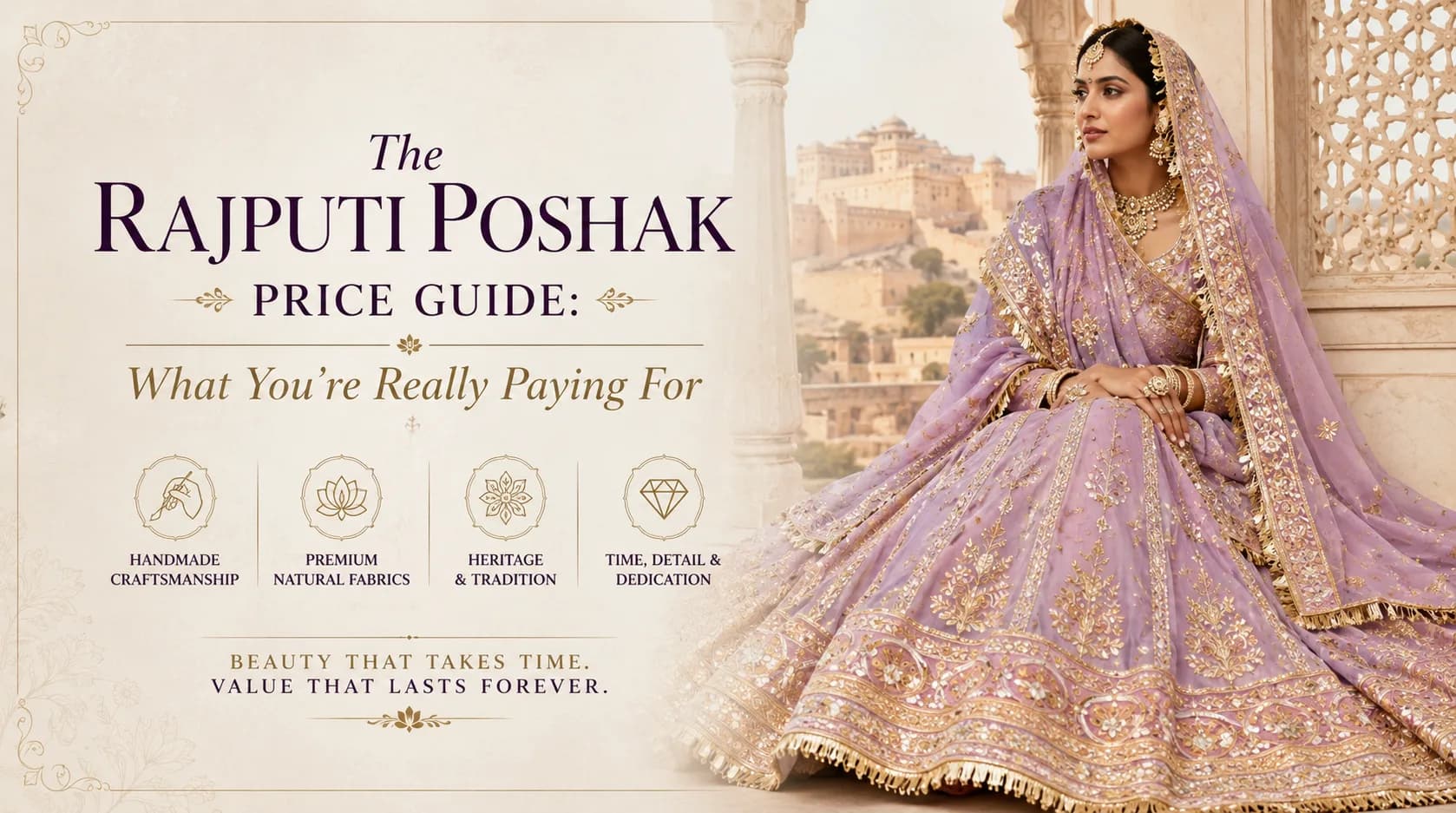
The Rajputi Poshak is one of India's most distinctive and culturally significant traditional garments — a three-piece ensemble worn by women of Rajput heritage that carries within it the history, aesthetics, and identity of Rajputana's royal culture. If you have seen a woman at a Rajasthani wedding draped in a vivid, heavily embroidered ensemble with a long skirt, fitted blouse, and a draped dupatta over her head, you have witnessed the Rajputi Poshak in its natural context. This guide explains what the Rajputi Poshak is, where it comes from, how it is structured, and how to wear one — whether you are from the Rajput community or simply captivated by its beauty. Explore our Rajputi Poshak collection to see how this royal tradition lives on today.
Origins and History: The Dress of Rajputana Royalty
The Rajputi Poshak has its origins in the royal courts of Rajputana — the constellation of kingdoms that covered what is now the state of Rajasthan. For centuries, the women of Rajput nobility wore this ensemble as their standard dress for court life, religious ceremonies, and celebrations. The word Poshak itself simply means "dress" or "garment" in Hindi and Rajasthani, but in the context of Rajasthan it is understood specifically to mean this three-piece traditional ensemble.
The aesthetic of the Poshak reflects the values of Rajput culture: richness, pride, and artisanship. The Ghagra's heavy volume conveys status through the sheer quantity of fabric and embellishment involved. The Gota Patti and mirror work on the Kanchli demonstrates the finest craft available. And the way the Odhni is worn — with one end tucked into the Ghagra at the right hip and the other draped over the head and left shoulder — is a specific cultural gesture of grace and modesty.
The Poshak remains the standard dress for Rajput community weddings and festivals across Rajasthan to this day, and has gained increasing appreciation among fashion-conscious brides and women across India who seek a uniquely Rajasthani alternative to the lehenga or saree.
The Three Components of a Rajputi Poshak
1. The Kanchli (Fitted Blouse)
The Kanchli is the upper garment — a short, very fitted blouse that typically ends just above the waist. Unlike a standard lehenga blouse, the Kanchli is:
- Shorter — often ending two to three inches above the navel
- More fitted — structured to follow the body closely
- Heavily embellished — traditionally featuring Gota Patti, mirror work (shisha), or Zardozi on the front, and elaborate back embroidery or ties
- Often backless — traditional Kanchlis have a deep back with ties rather than a covered back
The Kanchli is the most technically demanding part of the Poshak to make, as the fit must be precise and the embellishment work is concentrated.
2. The Ghagra (Flared Skirt)
The Ghagra is the centrepiece of the Poshak — a heavily flared skirt that reaches the floor and fans out dramatically when the wearer moves or turns. Key features of a bridal or festive Ghagra:
- Volume — a traditional bridal Ghagra requires between 10 and 20 metres of fabric to achieve its full flare
- Heavy hem embellishment — the bottom border (called the gher) is typically the most embroidered part, often featuring several inches of Gota Patti, sequin work, or mirror-stitch
- Pleated or gathered waistband — the fabric is pleated or gathered into a fitted waistband that ties at the back
- Lining — a heavy Ghagra is always fully lined to support the embellishment work and maintain the skirt's volume
The Ghagra in a bridal Poshak can weigh several kilograms when fully embellished. Lighter festive Ghagras are made in georgette or cotton for more comfortable daily wear.
3. The Odhni (Draped Dupatta)
The Odhni is the third component — a long rectangular piece of fabric that functions as a combined dupatta and head covering. It is typically:
- 4 to 5 metres long — longer than a standard dupatta to allow for the specific Rajasthani draping style
- Embellished at both ends — the decorative borders at each end are visible when draped
- Worn over the head — one end is tucked into the Ghagra waistband at the right hip, the fabric passes across the front, and the other end is draped over the head and left shoulder
The way the Odhni is worn is culturally specific — it is not simply thrown over the shoulder like a Punjabi dupatta. The head drape is an integral part of the Poshak's identity and signifies respect, particularly in formal and religious contexts.
Embellishment Traditions of the Rajputi Poshak
The Rajputi Poshak is not complete without its embellishment — and Rajasthani craft traditions offer a rich vocabulary of techniques:
Gota Patti
The most iconic Rajasthani embellishment — thin strips of gold or silver metallic ribbon hand-stitched into floral and geometric patterns. Gota Patti work on a bridal Poshak can involve hundreds of hours of artisan labour. See this tradition come alive in our Assi Kali Rajputi Poshak with Bandhani Odhna.
Mirror Work (Shisha)
Small pieces of reflective mirror or metallic foil are stitched into the fabric using a specific embroidery frame — creating a dazzling, light-catching surface. Mirror work is particularly traditional on the Kanchli and at the Odhni borders.
Bandhani and Leheriya
The base fabric of many festive Poshaks uses Bandhani tie-dye or Leheriya diagonal stripe dyeing — providing a patterned surface onto which further embellishment is added, or worn simply for everyday festive occasions.
Zardozi
For the most elaborate bridal Poshaks, Zardozi metallic thread embroidery covers large portions of the Ghagra and Kanchli, creating a heavy, sculptural embellishment that is the pinnacle of Rajasthani bridal embroidery.
The Rajputi Poshak for Festivals
Teej
Teej — the monsoon festival celebrating the arrival of the rains and the reunion of Parvati and Shiva — is the most important occasion for Rajasthani women's traditional dress. Green is the Teej colour: married women wear green Poshaks, Bandhani sarees, or green silk sarees to celebrate. Unmarried women wear a range of festive colours. The procession of women in green Poshaks and Leheriya is one of Rajasthan's most visually iconic cultural images.
Gangaur
Gangaur — a spring festival celebrating the goddess Gauri — follows Holi and involves women dressing in their finest traditional clothes to carry clay idols in procession. Traditional Rajasthani women wear Poshaks for Gangaur, typically in red, pink, or the colours of spring.
Navratri
During Navratri, the nine nights of the goddess, Rajasthani women wear brightly coloured Poshaks — often in the colour of the day, as each of the nine nights is associated with a specific colour in the Navratri tradition.
Styling a Modern Rajputi Poshak
The Poshak's silhouette and cultural associations make it a powerful choice for brides and occasion dressers who want something beyond the standard lehenga or saree. Modern interpretations include:
- Fusion Poshak — a shorter, less voluminous Ghagra paired with a more fitted Kanchli, in contemporary colour combinations
- Lightweight Poshak — made in georgette or cotton for summer weddings and outdoor festivals, with lighter embellishment
- Heritage Poshak — a faithful recreation of traditional Rajput wedding dress, fully embellished with Gota Patti, mirror work, and Zardozi on silk
For NRI brides and those outside Rajasthan, the Poshak is increasingly a statement of cultural pride and a distinctive alternative to the lehenga that sets the bridal look apart from the expected.
Frequently Asked Questions
How long does it take to make a Rajputi Poshak?
A fully embellished bridal Rajputi Poshak can take between four and eight weeks to make, depending on the complexity of the embroidery and the number of artisans working on it simultaneously. A lighter festive Poshak in georgette with Gota Patti borders takes two to three weeks. Custom orders should be placed at least three to four months before the occasion.
What is the correct way to drape the Odhni?
The traditional Rajasthani way to wear the Odhni is to tuck one end into the Ghagra waistband at the right hip, drape the fabric across the front of the body, and bring the remaining length up and over the head, letting it fall over the left shoulder and down the back. In formal contexts — temples, ceremonies, meeting elders — the Odhni is kept over the head; in less formal settings, it may be allowed to slip to the shoulder.
Can the Poshak be worn for non-wedding occasions?
Yes — the Poshak in lighter fabrics and with less elaborate embellishment is worn for Teej, Gangaur, Navratri, family celebrations, and cultural events. A cotton or georgette Poshak with modest Gota Patti borders is entirely appropriate for festive occasions that do not require full bridal embellishment.
What shoes are worn with a Rajputi Poshak?
Traditional footwear for a Poshak is juttis — the flat, embroidered leather slippers of Rajasthan. Bridal juttis are often in gold or silver with heavy embellishment. Because the Ghagra is floor-length, the footwear is mostly hidden — comfort matters more than height.
Is the Rajputi Poshak the same as what is worn in Bollywood films?
Bollywood films set in Rajasthan often feature versions of the Poshak, though they are frequently stylised and simplified for dramatic effect. Real traditional Poshaks are more elaborate and culturally specific than most film costumes. If you have admired a Rajasthani look in a film and want the authentic version, a proper Poshak from a Jaipur artisan is the real thing.
The Rajputi Poshak is not just a garment — it is a living cultural tradition, worn by women who connect with the heritage and artistry of Rajputana. Whether you are from the Rajput community or simply drawn to its beauty, explore our Rajputi Poshak collection and book a consultation to find your perfect ensemble.