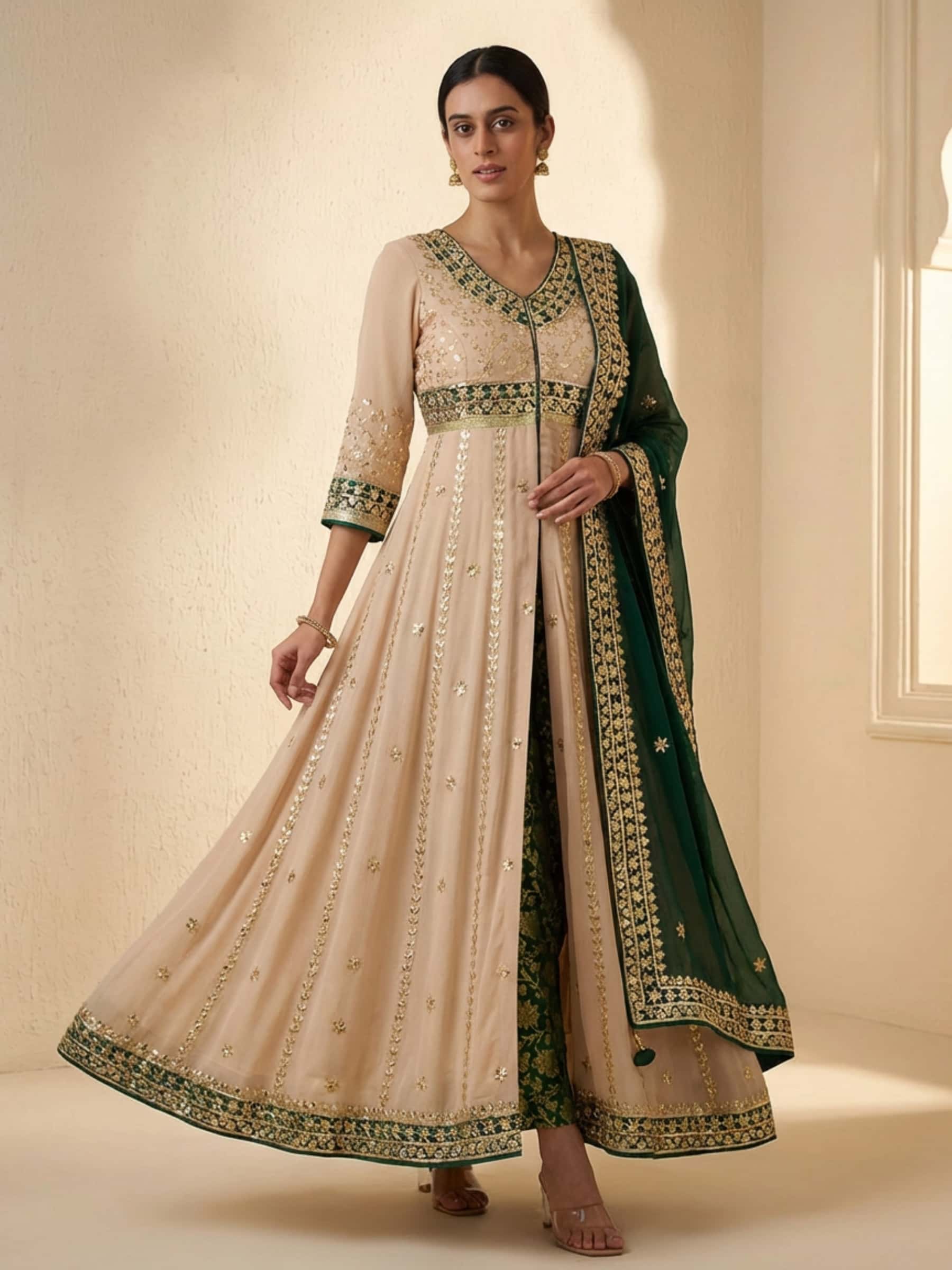
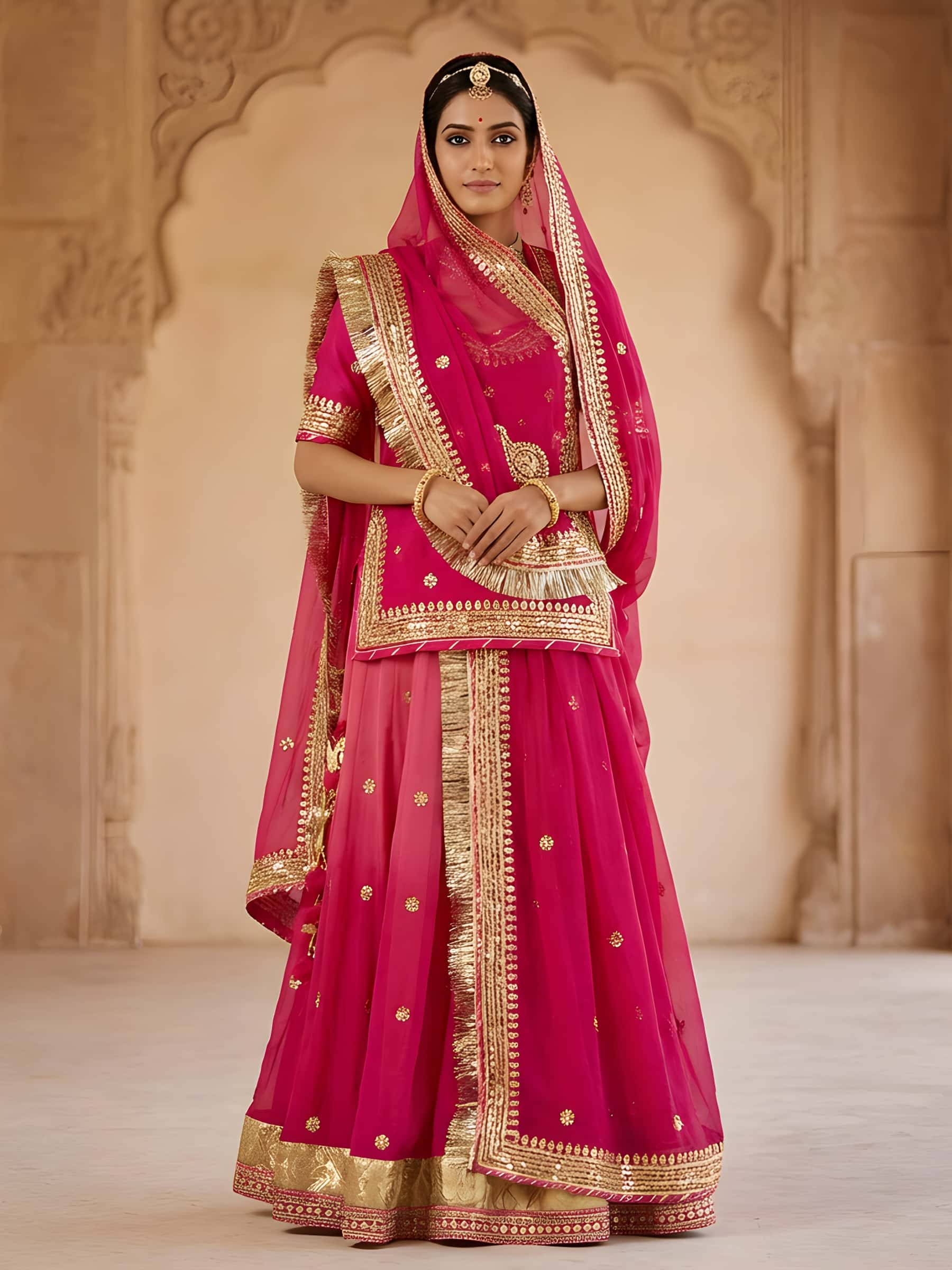
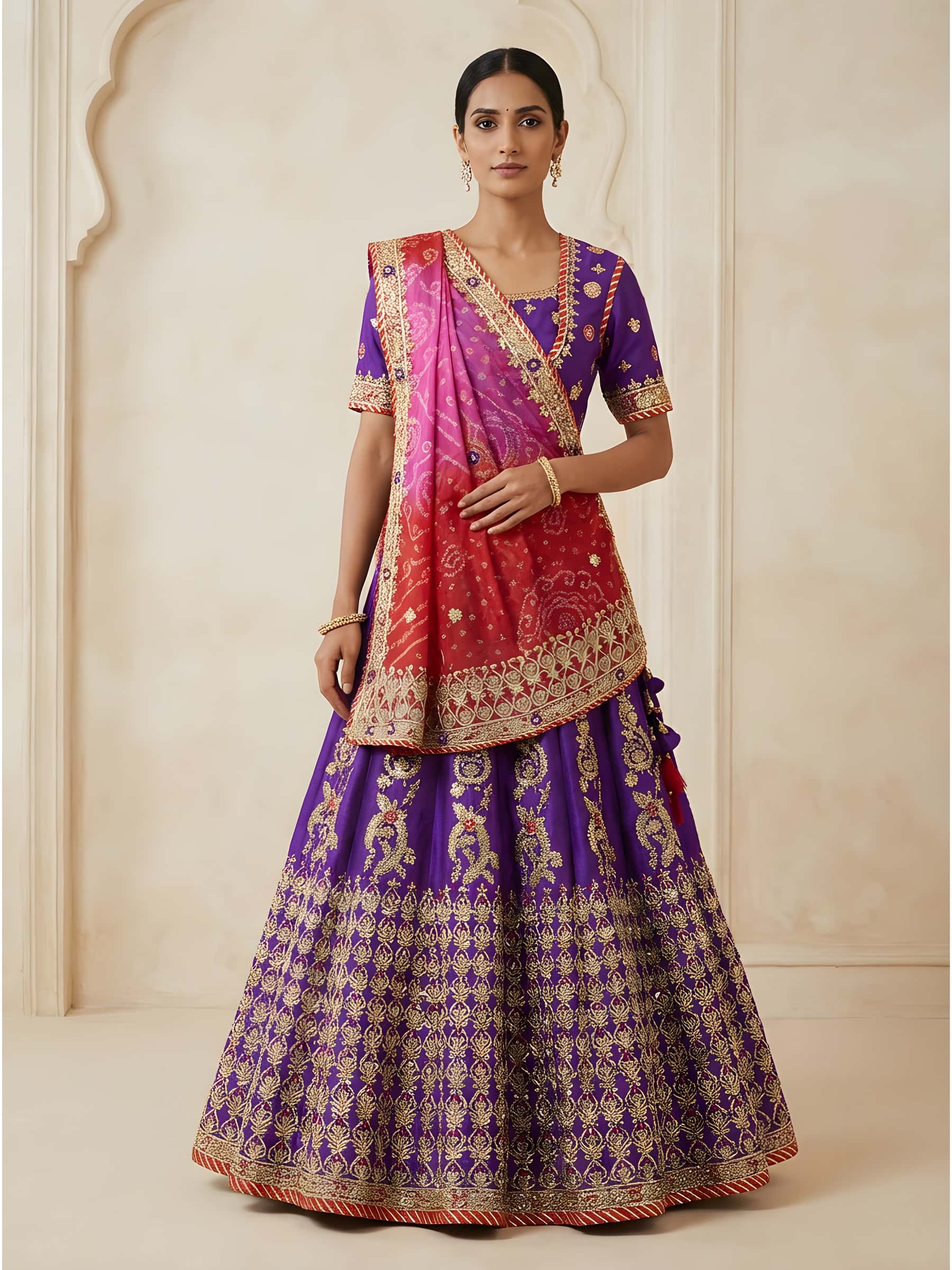
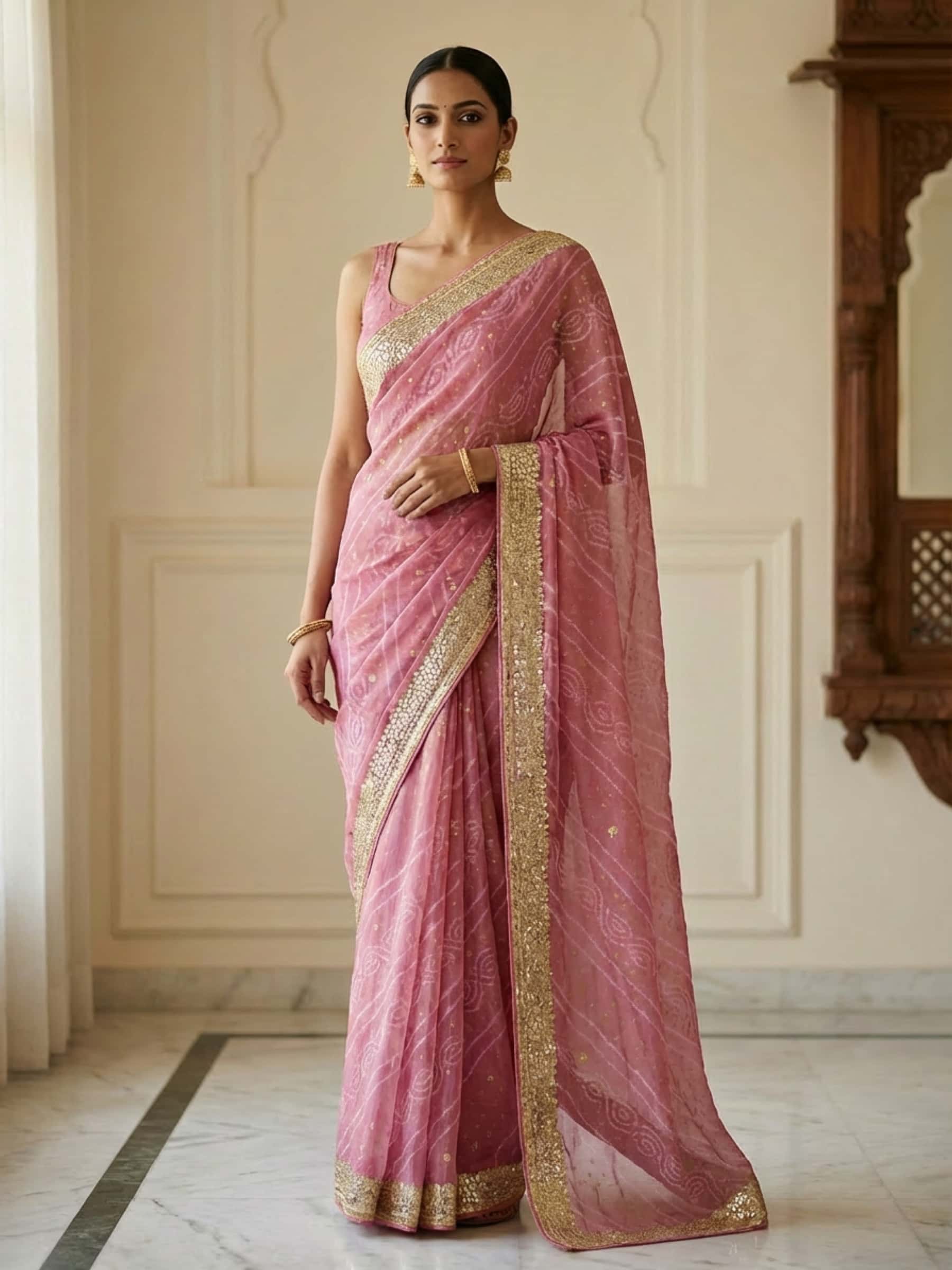
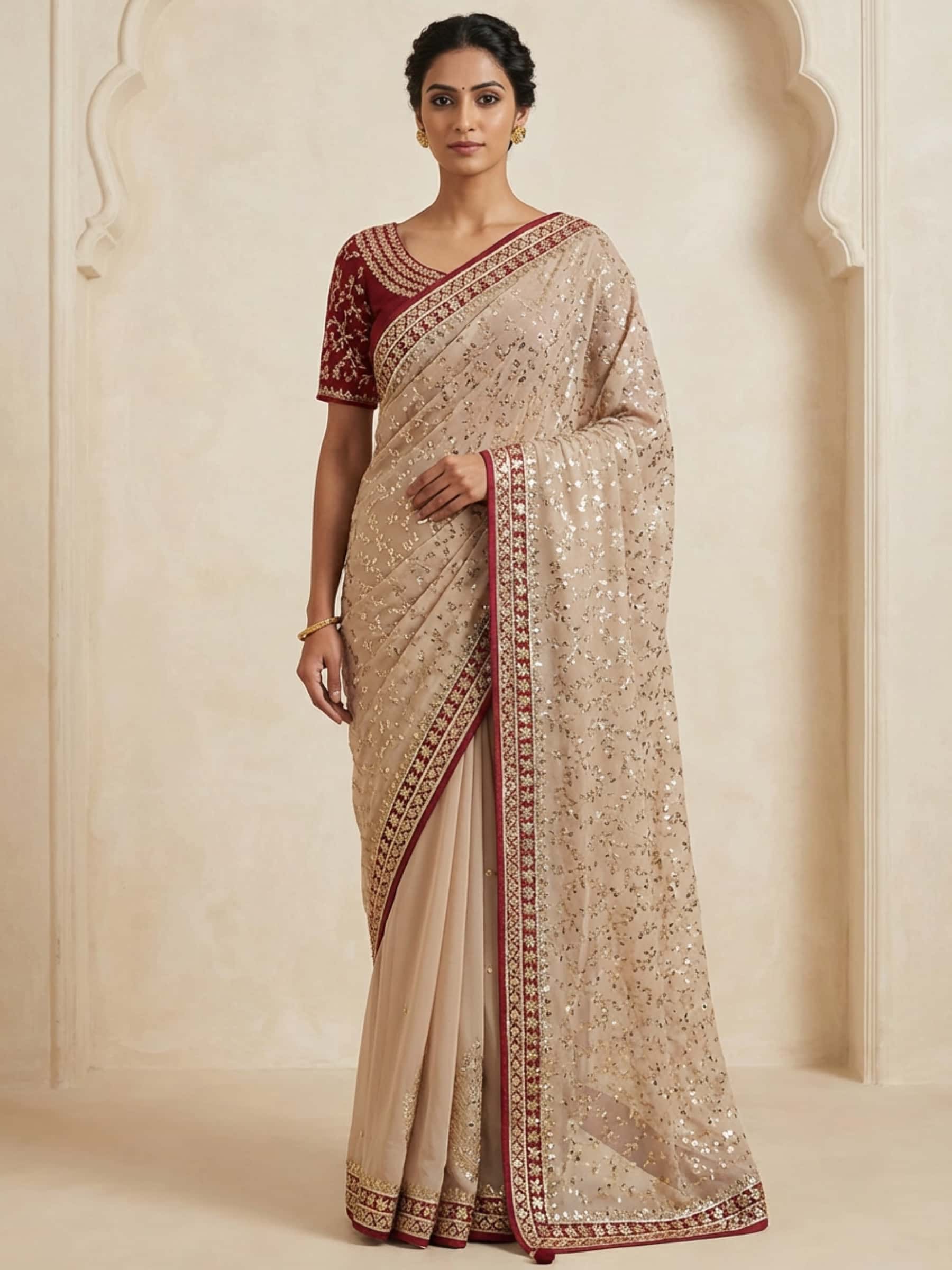
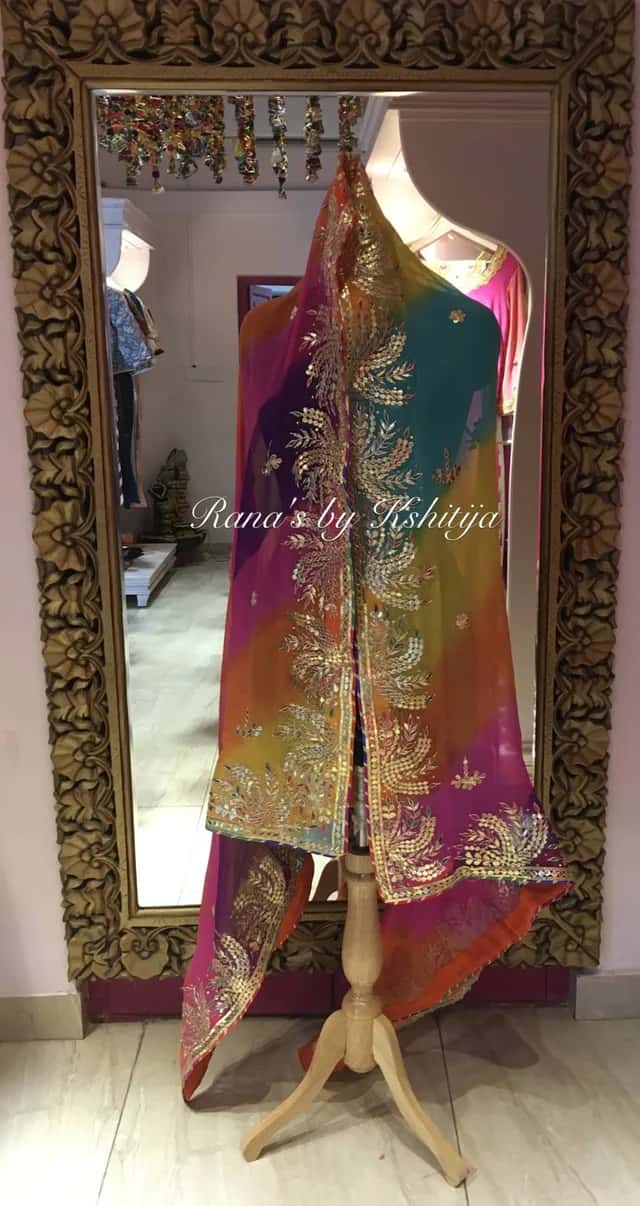
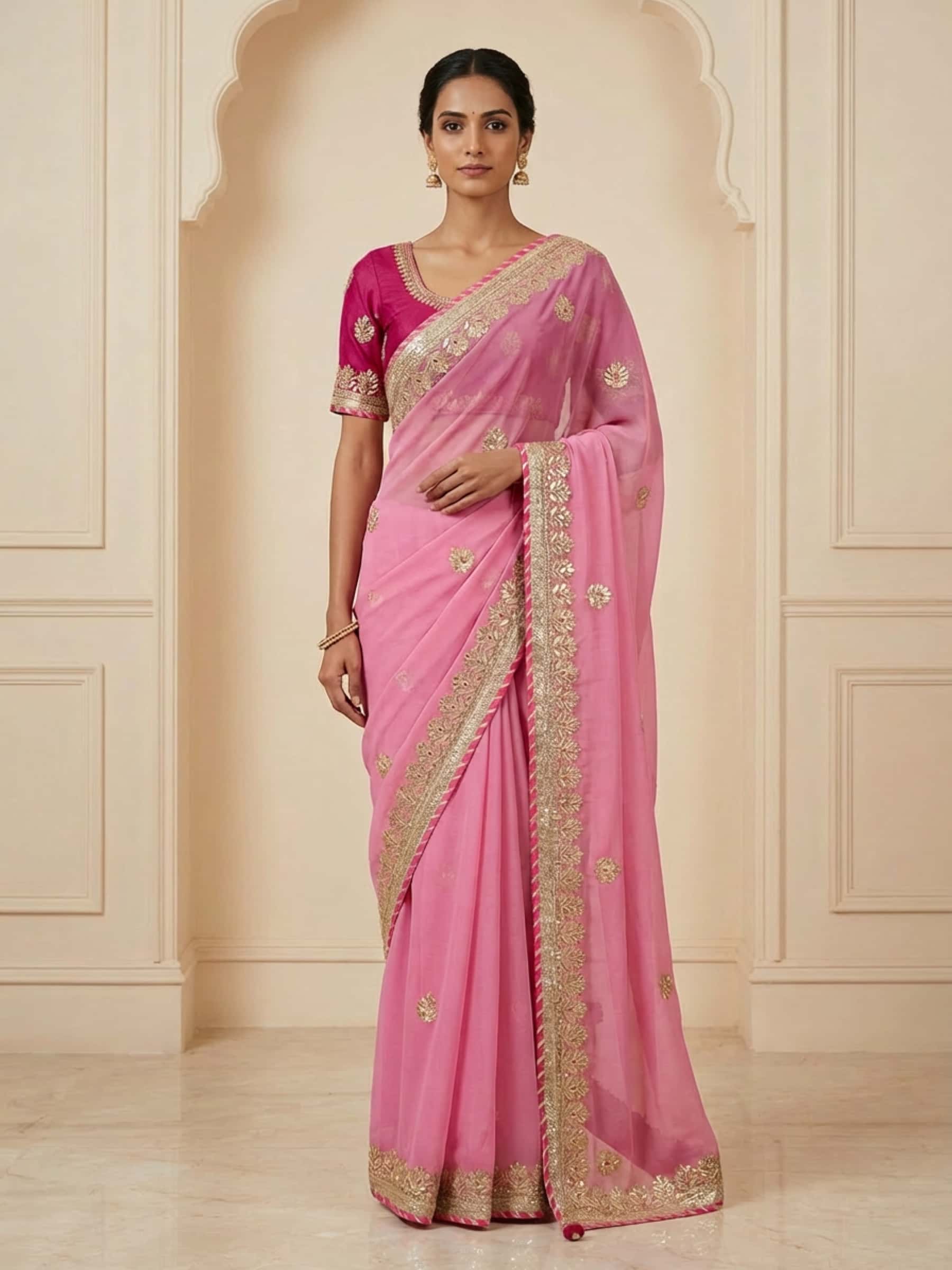
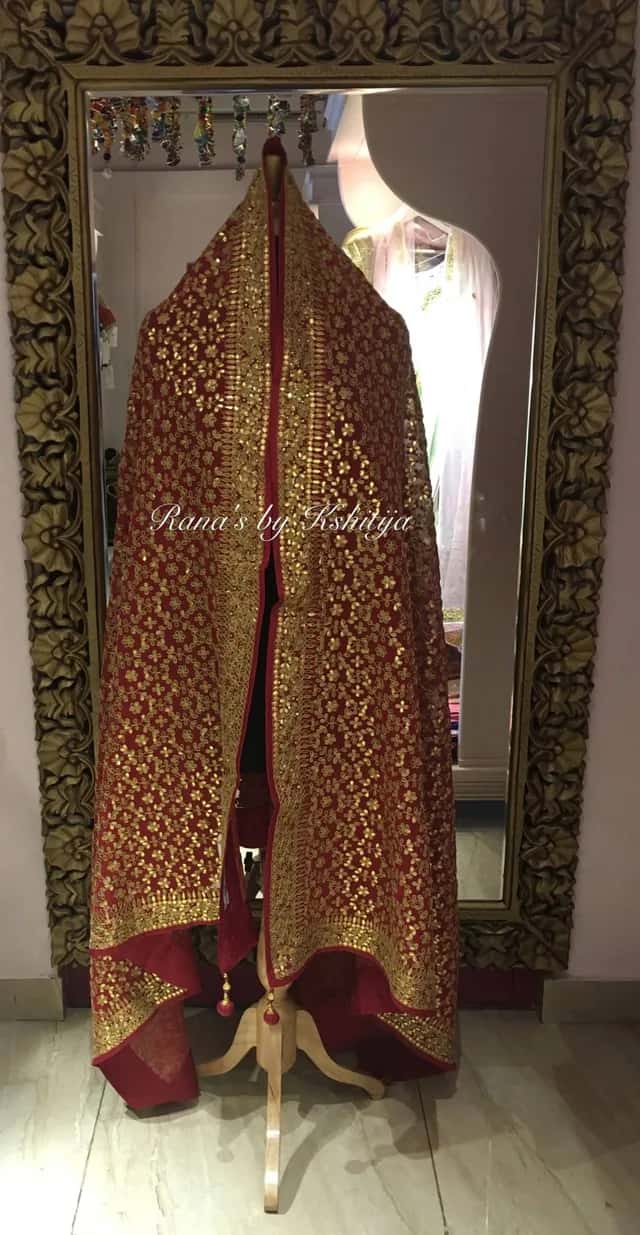
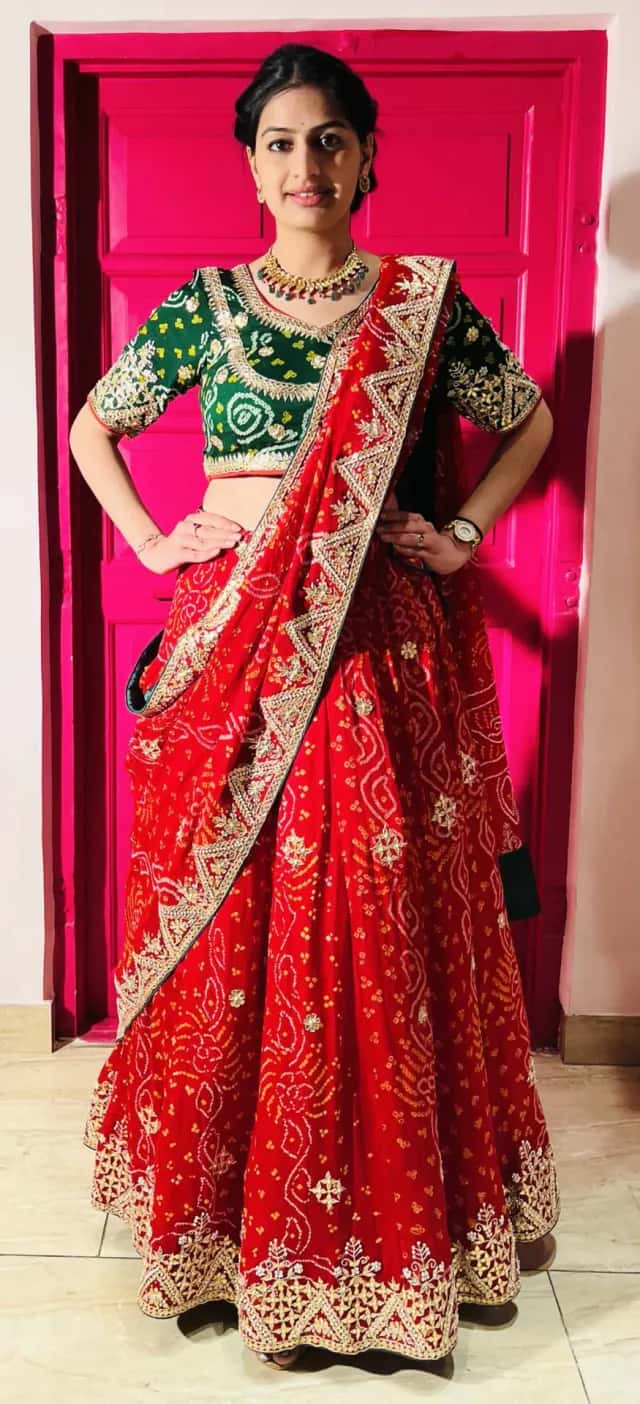
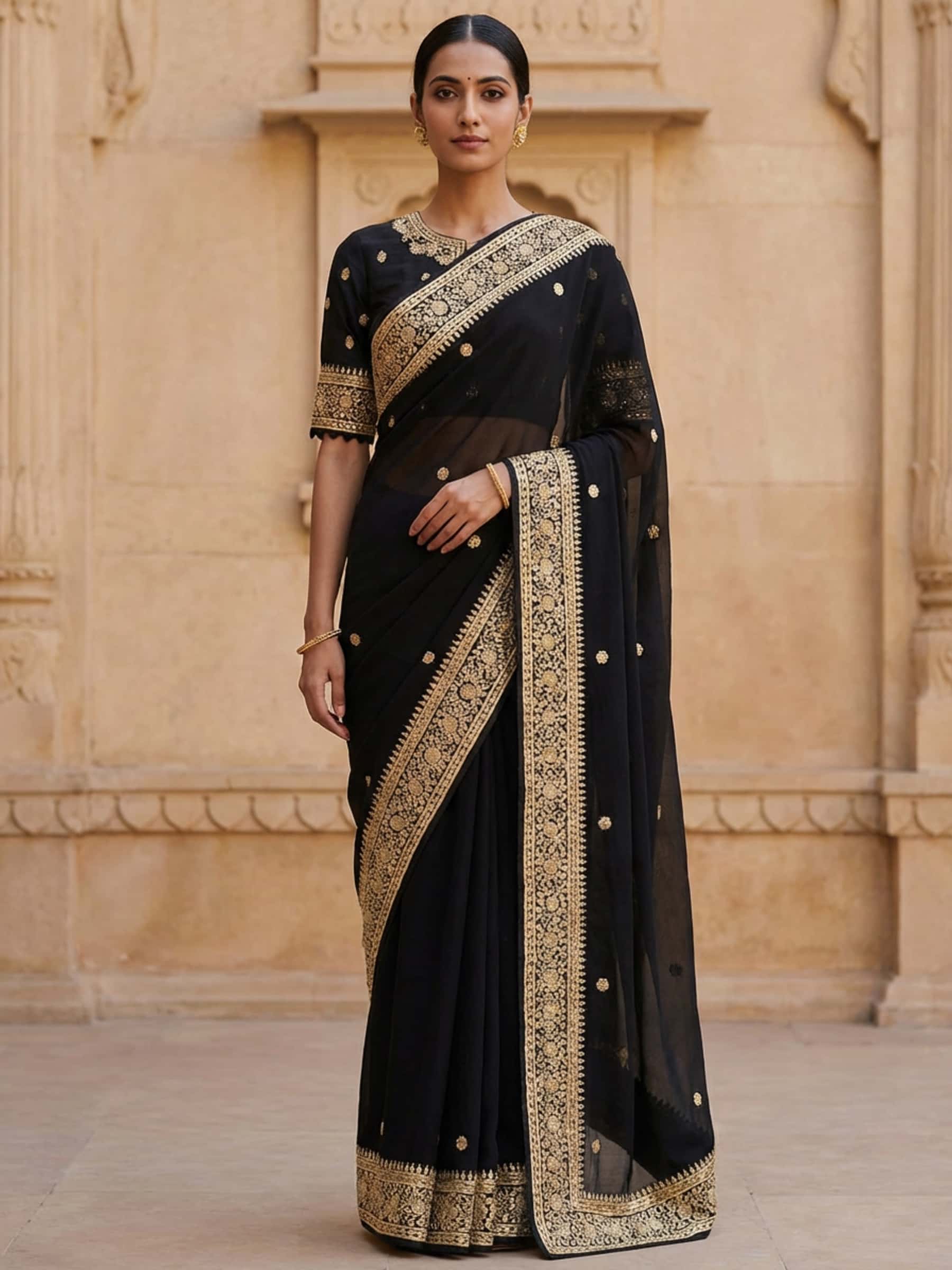
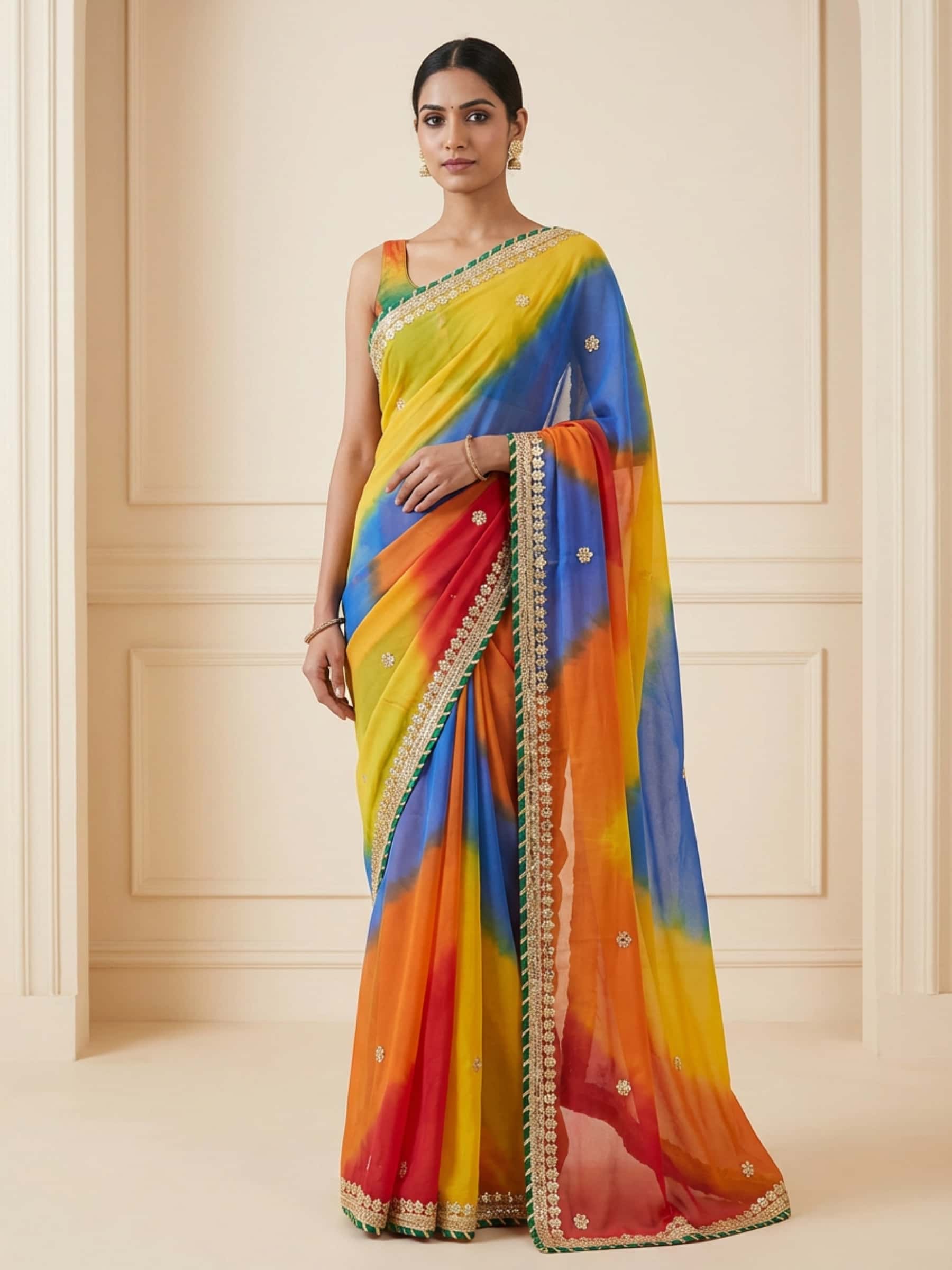
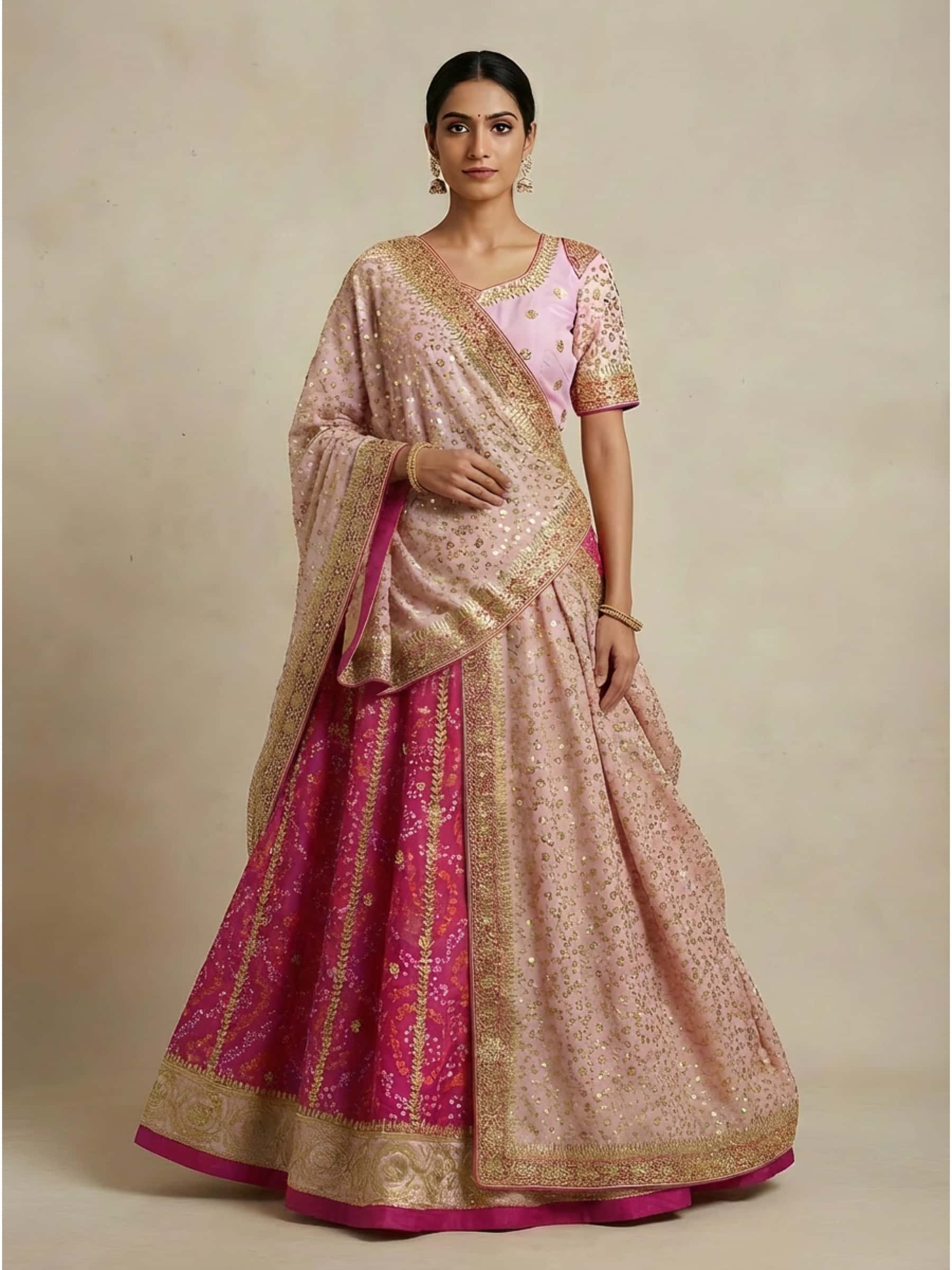
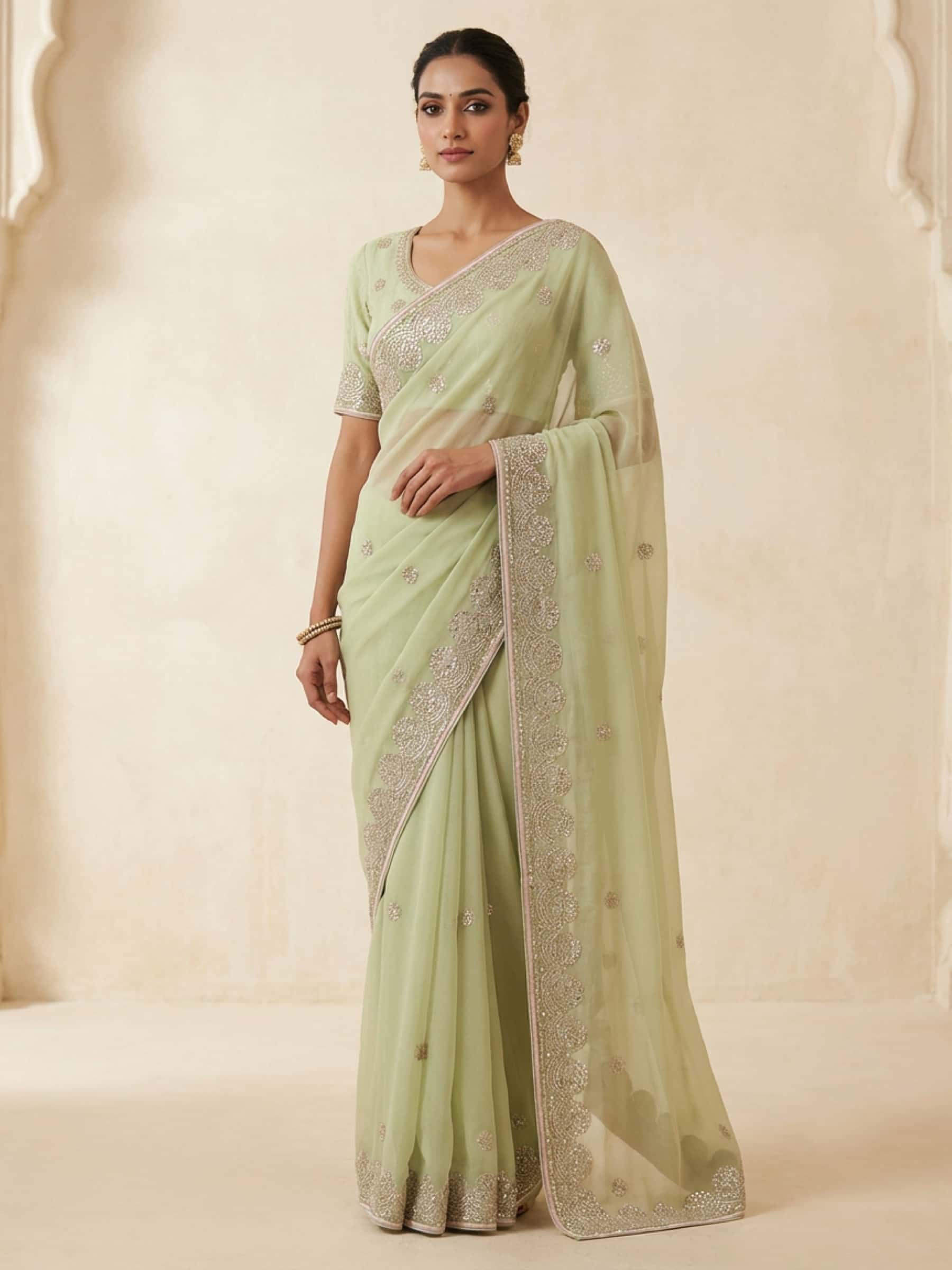
A real Gota Patti saree is not embroidery in the conventional sense. It is metal applied to fabric, by hand, one tiny folded petal at a time. Master artisans in the narrow lanes of Jaipur's old city take thin strips of metallic ribbon — historically real silver gilded with gold, today usually high-quality metal tissue — fold them into petals, leaves, butis, and geometric motifs, and stitch each piece onto the saree base with invisible thread. A single Gota Patti saree can take six to twelve weeks of artisan work; a heavy bridal piece can take six months. This is what you are paying for, and it is why our Gota Patti saree collection above does not compete on price with the printed imitations that dominate online search results.
What Gota Patti actually is
The craft has three working layers, and understanding them is the difference between buying a real Gota Patti saree and buying a piece of printed georgette with metallic foil heat-pressed onto it.
- Gota — the metallic ribbon itself. Real Gota is a flattened metal strip (originally silver, gilded with gold leaf, called kalabattu) that bends without snapping. Cheap "Gota" is plastic tape with a metallic coating that flakes off within a year.
- Patti — the technique of folding and applying the Gota in patterns. The artisan cuts the ribbon into precise lengths, folds each length into the desired shape (a tear-drop petal, a five-petal flower, a curved leaf), and stitches it down with thread that matches the base fabric so the stitching disappears.
- Variations — Gota Patti includes related sub-techniques: Bagh (mirror-image work where the same motif appears on both sides of the fabric), Kinari (just the border, no surface motifs), Champakali (specific magnolia-bud motif), and Mukaish (related craft where individual silver wire pieces are embedded, technically distinct but often combined with Gota Patti on the same piece).
How to tell real Gota Patti from a printed imitation
Most "Gota Patti" sarees sold online for under ₹3,000 are not Gota Patti at all. They are printed georgette with metallic foil glued or heat-pressed onto the surface. Three quick tests:
- Run your fingernail under the motif. Real Gota Patti is raised — you can feel the folded ribbon. Printed imitation is flat, with maybe a slight ridge from the foil edge.
- Look at the reverse of the fabric. Real Gota Patti has visible hand-stitching on the back. Printed sarees have nothing on the reverse, or a fuzzy bleed-through that mirrors the front.
- Check for irregularity. Hand-folded Gota petals are never identical — each one varies a millimetre or two. Machine-printed imitations are mathematically uniform.
A genuine Gota Patti saree from a Jaipur atelier starts around ₹15,000 for a lightly-embellished georgette and goes well past ₹2 lakh for a heavily-worked bridal piece. If you are seeing "real Gota Patti" at ₹2,500, it is not real.
Choosing the right fabric base
The fabric the Gota Patti is stitched onto changes how the saree falls, photographs, and ages.
- Pure georgette — our most popular base. Light, holds Gota Patti weight without sagging, drapes fluidly, photographs with depth. The default for receptions, sangeet, and engagement events.
- Pure silk (Banarasi, Gajji) — heavier, more formal, suits cooler weather and weddings. The Gota work tends to be denser to balance the fabric weight.
- Organza — sheer base. Gota Patti on organza is a contemporary look — the metalwork seems to float on transparent fabric. Best for evening events and cocktail-saree styling.
- Pure crepe — softer drape than georgette, good for second-day functions and lighter pieces.
A bridal Gota Patti saree is almost always georgette or silk; a daytime or office Gota Patti is georgette or crepe.
Occasion mapping
- Bridal wedding day — heavy Gota Patti with Bagh work, red or maroon base, full Zari border. Coordinates with bridal jewellery.
- Reception — medium-density Gota Patti in jewel tones (deep green, midnight blue, wine). Easier to wear for a long evening.
- Engagement / tilak — light Gota Patti with Kinari border only, pastel or sorbet base. Photographs as elegant without overwhelming the bride-to-be.
- Sangeet / mehendi — Gota Patti on Bandhani or Leheriya base; vivid colour; movement-friendly silhouette.
- Festive / Diwali / Karva Chauth — medium-weight Gota Patti georgette in red, magenta, or saffron.
- Office / cocktail — minimal Gota Kinari (border-only) on plain pastel or neutral base. The piece reads as elegant rather than ceremonial.
Care and longevity
A handcrafted Gota Patti saree is a heirloom-grade purchase. Treated correctly, it outlasts the bride who first wore it.
- Dry-clean only. Water and agitation pull the Gota petals loose from the base fabric — every Rana's Gota Patti piece is dry-clean only, with no exceptions.
- Store flat or rolled, not folded. Folding creates permanent crease lines through the Gota work that catch and damage the metal. Acid-free tissue between layers.
- Avoid hanging long-term. The weight of the metal embroidery distorts the drape over time.
- Keep away from direct sunlight. Even modern metallic tissue tarnishes slowly under UV. Store in a closed cupboard.
- Never iron directly on the Gota work. Iron the reverse, with a pressing cloth, on low heat.
Done correctly, our customers' Gota Patti sarees are still being worn at family weddings two decades later.
What to look for when buying
If you are choosing a Gota Patti saree from any seller — including us — these are the questions to ask:
- Is the Gota real metal tissue or plastic-coated tape? (Real metal does not flake.)
- Is the work hand-stitched or machine-applied? (Hand has visible stitching on the reverse.)
- What is the fabric composition? (Pure georgette, pure silk — not "premium material" or "silk-blend.")
- Where was it made and by whom? (Jaipur, with a known artisan workshop, or a vague answer?)
- What is the alteration policy and customisation timeline?
For our pieces: every Gota Patti saree at Rana's is hand-applied real metal tissue, fabric-disclosed, artisan-attributed, and customisable on request. Read the complete Gota Patti craft guide for technique depth, or meet the artisans who make these pieces.
Browse adjacent crafts: our Rajputi Poshak collection uses Gota Patti as one of its signature embellishments; the Heritage Bridal Collection pairs Gota Patti sarees with matching wedding lehengas; and our Designer Lehengas include Gota Patti work across festive and party-wear silhouettes.