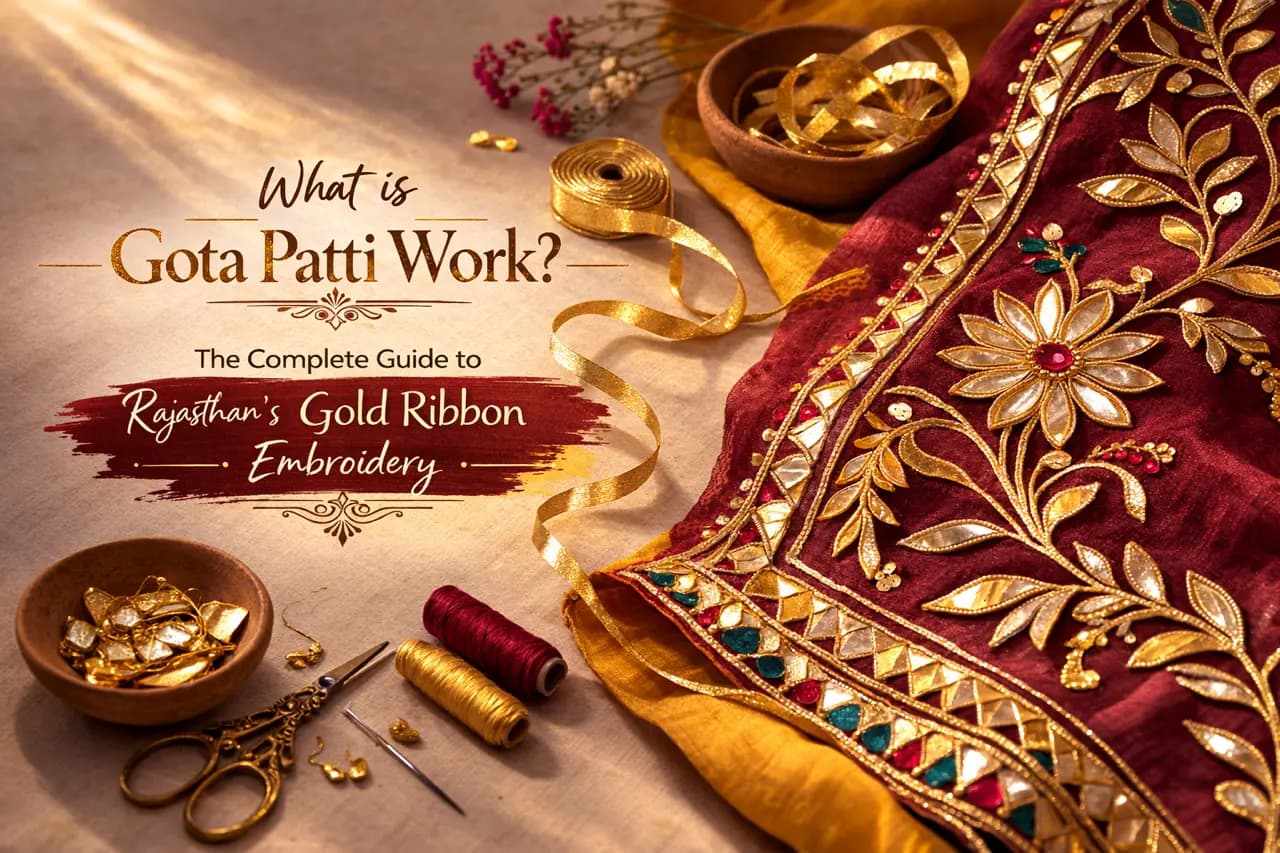
What is Gota Patti Work? The Complete Guide to Rajasthan's Gold Ribbon Embroidery
Discover Gota Patti — Jaipur's iconic gold ribbon embroidery. Learn its 500-year history, how it's made, and which sarees and lehengas feature this royal Rajasthani craft.
Kshitija Rana
Editor
Gota Patti work is one of India's most extraordinary textile traditions — a centuries-old embroidery technique from Jaipur, Rajasthan, where thin strips of real gold and silver ribbon are hand-stitched onto fabric to create luminous, three-dimensional patterns. If you have ever been captivated by the glittering gold borders on a Rajasthani bride's lehenga or the delicate floral motifs scattered across a festive saree, you have almost certainly been looking at Gota Patti work. This complete guide tells you everything you need to know about this royal craft — its history, how it is made, and why a handcrafted Gota Patti saree is unlike anything else in Indian fashion.
The History of Gota Patti: A Craft Born in the Royal Courts of Jaipur
Gota Patti has its roots in the Mughal era, when the royal courts of Rajputana were centres of artistic patronage. The craft is believed to have originated in Jaipur approximately 500 years ago, flourishing under the patronage of Rajput kings who demanded the finest embellishments for royal garments and ceremonial textiles.
The word Gota refers to the metallic ribbon itself — originally woven from real gold and silver threads — while Patti means strip or ribbon. Together, Gota Patti literally means "gold ribbon embroidery." In its earliest form, the craft used pure gold zari strips, making finished pieces extraordinarily valuable. Today, artisans use a combination of real gold-toned and silver-toned metallic ribbon along with high-quality synthetic alternatives that preserve the visual splendour while making the craft more accessible.
Jaipur remains the undisputed home of Gota Patti. The city's Ramganj Bazaar and Johari Bazaar neighbourhoods have been home to Gota Patti artisan communities for generations, with the craft passed down from fathers to sons within families of craftspeople known as karigars.
In 2013, the Government of India granted Jaipur's Gota Patti a Geographical Indication (GI) tag, officially recognising it as an authentic product of the region and protecting it from imitation.
What Makes Gota Patti Different from Other Embroidery?
Indian embroidery traditions are rich and varied — from the metallic thread work of Zardozi to the mirror-stitch of Gujarat's Kutch embroidery and the silk-thread fineness of Chikankari from Lucknow. Gota Patti stands apart for several reasons:
- It uses ribbon, not thread. Unlike Zardozi (which builds up metallic designs using thick threads and wires), Gota Patti uses flat, pre-woven metallic ribbon strips that are folded and stitched to create dimension.
- It is surface appliqué. The Gota ribbon is applied on top of the fabric rather than worked through it, giving the finished piece its characteristic raised, three-dimensional quality.
- It is entirely hand-done. Every fold, cut, and stitch of authentic Gota Patti is performed by hand without mechanical assistance.
- It catches light beautifully. The metallic surface of Gota ribbon reflects light from multiple angles, giving the embroidery a natural luminosity that cannot be replicated by printing or machine-made alternatives.
How Gota Patti is Made: The Step-by-Step Process
Understanding how Gota Patti is made deepens your appreciation for every piece that bears this craft. Here is what happens in an artisan's workshop before a finished saree or lehenga reaches you:
Step 1: Design Transfer
The artisan begins by sketching or tracing the design pattern onto the fabric using chalk or a washable pen. Traditional motifs include the lotus flower, mango (paisley), peacock, elephant, and geometric jaali (lattice) patterns. For custom orders, the designer and client work together on the layout before it is transferred to fabric.
Step 2: Cutting the Gota Ribbon
The metallic Gota ribbon comes in various widths — from very fine strips (2-3mm) used for delicate details to wider bands (1-2cm) used for broad borders and large motifs. The artisan cuts the ribbon into precise lengths according to the design requirements.
Step 3: Folding and Shaping
This is the most skill-intensive step. The artisan folds, pleats, and shapes each piece of Gota ribbon by hand to create petals, leaves, and geometric forms. The ribbon's metallic surface must face outward while the raw edges are folded neatly underneath.
Step 4: Stitching
Each shaped piece of Gota ribbon is then hand-stitched onto the fabric using fine thread in a matching colour. The stitches are kept small and precise so they remain invisible in the finished piece. Attaching a single elaborate motif — say, a peacock — can require hundreds of individual stitches and several hours of work.
Step 5: Finishing and Quality Check
Once all the embroidery is complete, the piece is inspected for loose threads, uneven edges, or misaligned motifs. It is then pressed carefully (only on the reverse side) to set the stitching without flattening the three-dimensional ribbon work.
A single heavily embroidered Gota Patti lehenga can take three to six weeks to complete. A more lightly embellished bridal saree may take one to two weeks. For example, a piece like our Amaira Zardozi Gota Handmade Saree showcases this level of intricate hand-stitching.
Types of Gota Patti Motifs
The vocabulary of Gota Patti motifs is vast, each with its own name and cultural significance:
- Bel — a continuous vine or creeper border motif, typically used along saree borders and lehenga hems
- Keri — the classic paisley or mango shape, one of the most common Gota Patti patterns
- Mor — the peacock, India's national bird and a symbol of grace, used as a central motif on dupattas and blouses
- Kamal — the lotus flower, auspicious and widely used in bridal pieces
- Jhoomar — a chandelier-shaped motif used on dupattas
- Jaali — a lattice or grid pattern, often used as a background texture
- Booti — small scattered motifs distributed across the fabric surface
The choice of motif often reflects the occasion — peacocks and lotuses for weddings, geometric booties for festive wear, and delicate vines for daywear.
Gota Patti in Sarees, Lehengas, and Poshaks
Gota Patti is used across the full range of Rajasthani ethnic wear:
Gota Patti Sarees
In sarees, Gota Patti work typically appears on the border, pallu (the draped end piece), and as scattered booties across the body of the fabric. Gota Patti sarees in georgette or silk are among the most sought-after choices for Rajasthani weddings and festive occasions. The combination of a lightweight fabric base with the weight and lustre of the metallic ribbon creates a piece that drapes beautifully and photographs exceptionally well.
Gota Patti Lehengas
Bridal lehengas with Gota Patti work are a Rajasthani tradition with deep cultural roots. Heavily embroidered bridal lehengas may feature Gota Patti on the skirt hem, the yoke of the blouse, and across the full surface of the dupatta. Lighter festive lehengas use Gota Patti selectively for borders and motif accents.
Rajputi Poshak
The Rajputi Poshak — the traditional three-piece dress of Rajputana comprising the Kanchli, Ghagra, and Odhni — is perhaps the most iconic canvas for Gota Patti work. A traditional Poshak without Gota Patti is rare; the golden ribbon embroidery is central to the garment's identity and cultural significance.
How to Identify Authentic Gota Patti
With machine-made and printed imitations widely available, knowing how to identify genuine handmade Gota Patti is valuable:
- Look for slight irregularity. Handmade Gota Patti motifs are never perfectly uniform — petals vary slightly in size, and stitching spacing is not machine-precise. This irregularity is a mark of authenticity.
- Feel the surface. Genuine Gota ribbon has a firm, slightly stiff texture with a metallic sheen. Printed or glued imitations feel flat and uniform.
- Check the reverse side. On authentic pieces, you will see neat hand-stitching on the reverse. Glued or heat-transferred imitations show no stitching.
- Ask about the karigar. Reputable brands can tell you where and by whom a piece was made.
Caring for Your Gota Patti Saree or Lehenga
Gota Patti pieces require careful maintenance to preserve both the fabric and the metallic ribbon:
- Dry clean only. Water and agitation can loosen the stitching that holds the ribbon in place.
- Store wrapped in muslin. Avoid plastic bags, which trap moisture. Soft muslin or cotton fabric is ideal.
- Avoid direct sunlight. Prolonged exposure can fade the metallic sheen of the ribbon.
- Never iron on the embroidered side. Always iron on the reverse using a pressing cloth, with the iron on a low setting.
- Handle the Gota ribbon gently. Avoid catching the ribbon on jewellery or rough surfaces.
Frequently Asked Questions
What is the difference between Gota Patti and Zardozi?
Gota Patti uses pre-woven metallic ribbon strips that are folded and stitched onto fabric, creating flat or lightly raised surface patterns. Zardozi uses metallic threads, wires, and beads worked through the fabric to build up heavy, three-dimensional raised embroidery. Both are from the Indian royal court tradition but have distinct visual textures — Gota Patti is brighter and more geometric, while Zardozi is heavier and more sculptural.
How much does a Gota Patti saree cost?
Handcrafted Gota Patti sarees range from approximately ₹4,000 for lightly embellished pieces to ₹25,000 and above for heavily worked bridal sarees. The price reflects the complexity of the design, the quality of the Gota ribbon, the base fabric, and the number of hours of artisan work involved. Machine-made imitations are available at much lower prices but lack the craftsmanship and longevity of genuine handmade pieces.
Can Gota Patti work be done on any fabric?
Gota Patti work can be applied to most woven fabrics, though some work better than others. Georgette, silk, and organza are the most popular choices because their smooth surfaces allow the ribbon to sit cleanly. Very textured or stretchy fabrics are not suitable for Gota Patti as they make it difficult to secure the ribbon stitching neatly.
How long does it take to make a Gota Patti saree?
A lightly embellished Gota Patti saree with border and pallu work typically takes one to two weeks. A heavily worked bridal saree or lehenga with full-surface embroidery can take four to eight weeks, with multiple artisans working simultaneously on different sections.
Is Gota Patti only from Jaipur?
While Gota Patti is also practised in parts of Gujarat and Madhya Pradesh, Jaipur is universally recognised as its home and holds a Geographical Indication (GI) tag for the craft. The specific quality, motif vocabulary, and technique of Jaipur Gota Patti is distinct — the craft has been practiced here continuously for over 500 years.
At Rana's by Kshitija, every piece of Gota Patti work in our collection is handcrafted by skilled artisans in Jaipur using authentic techniques. Explore our Gota Patti saree collection or browse our full range of handcrafted designer sarees to find your next heirloom piece. Among our customers' favourites is the Beautiful Bale Vine Work Gota Saree — a perfect example of the craft at its finest.