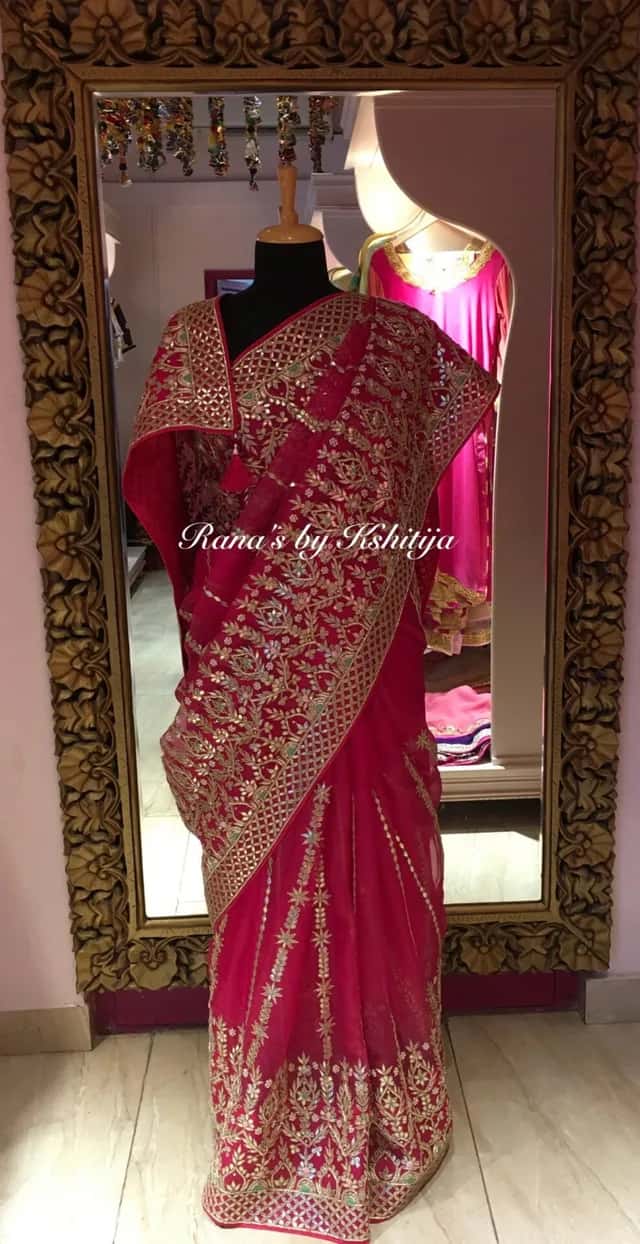
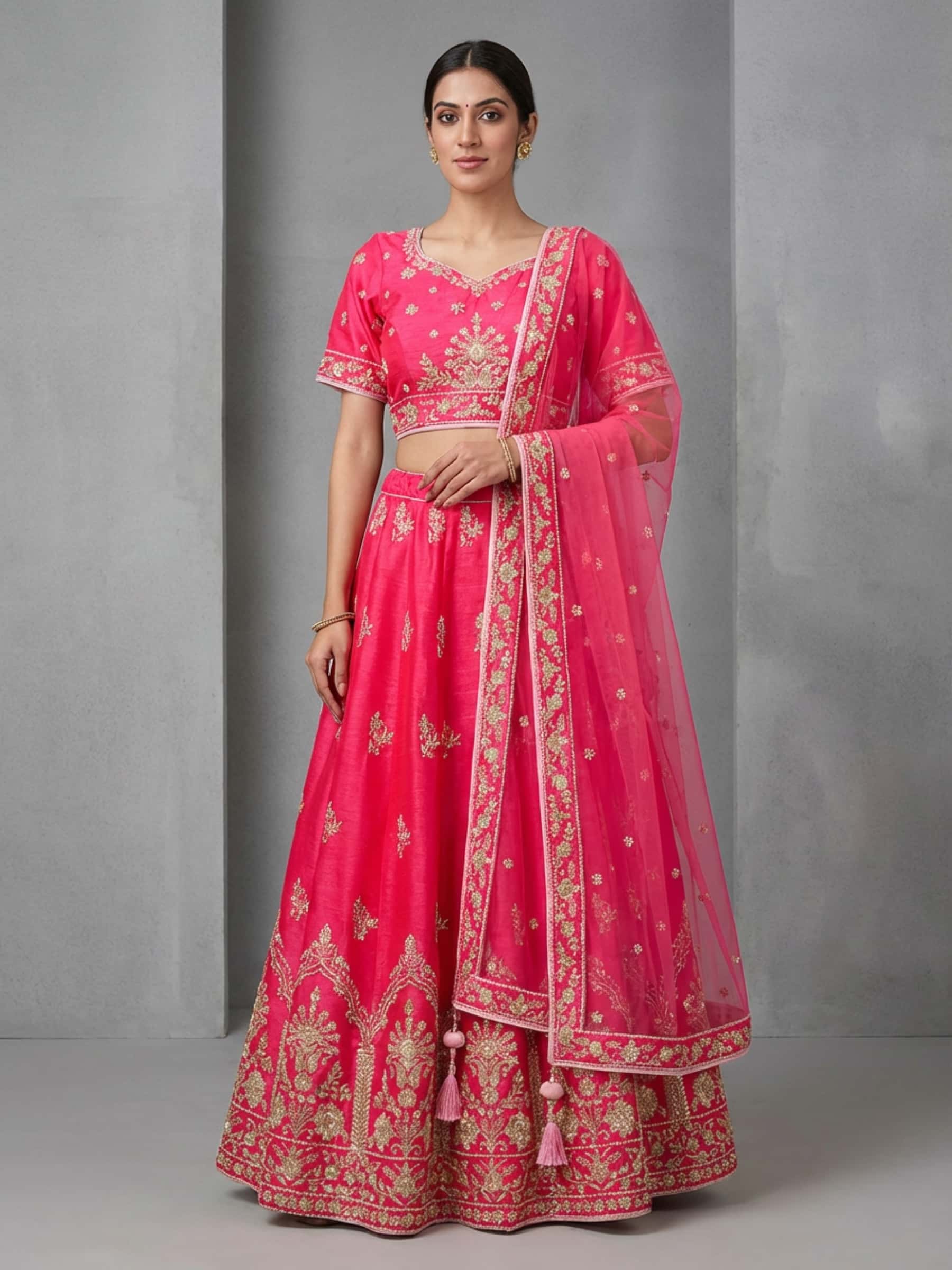
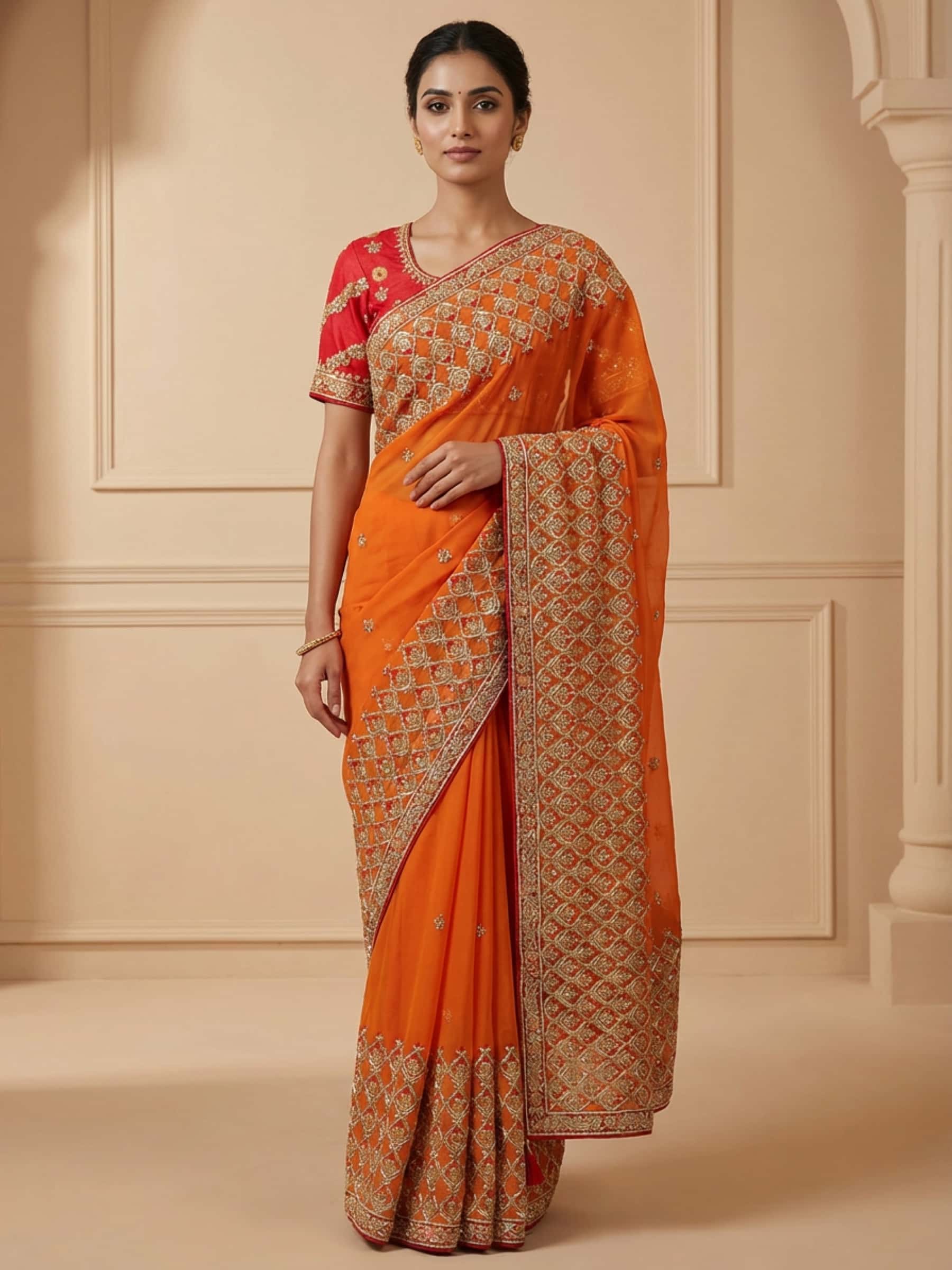
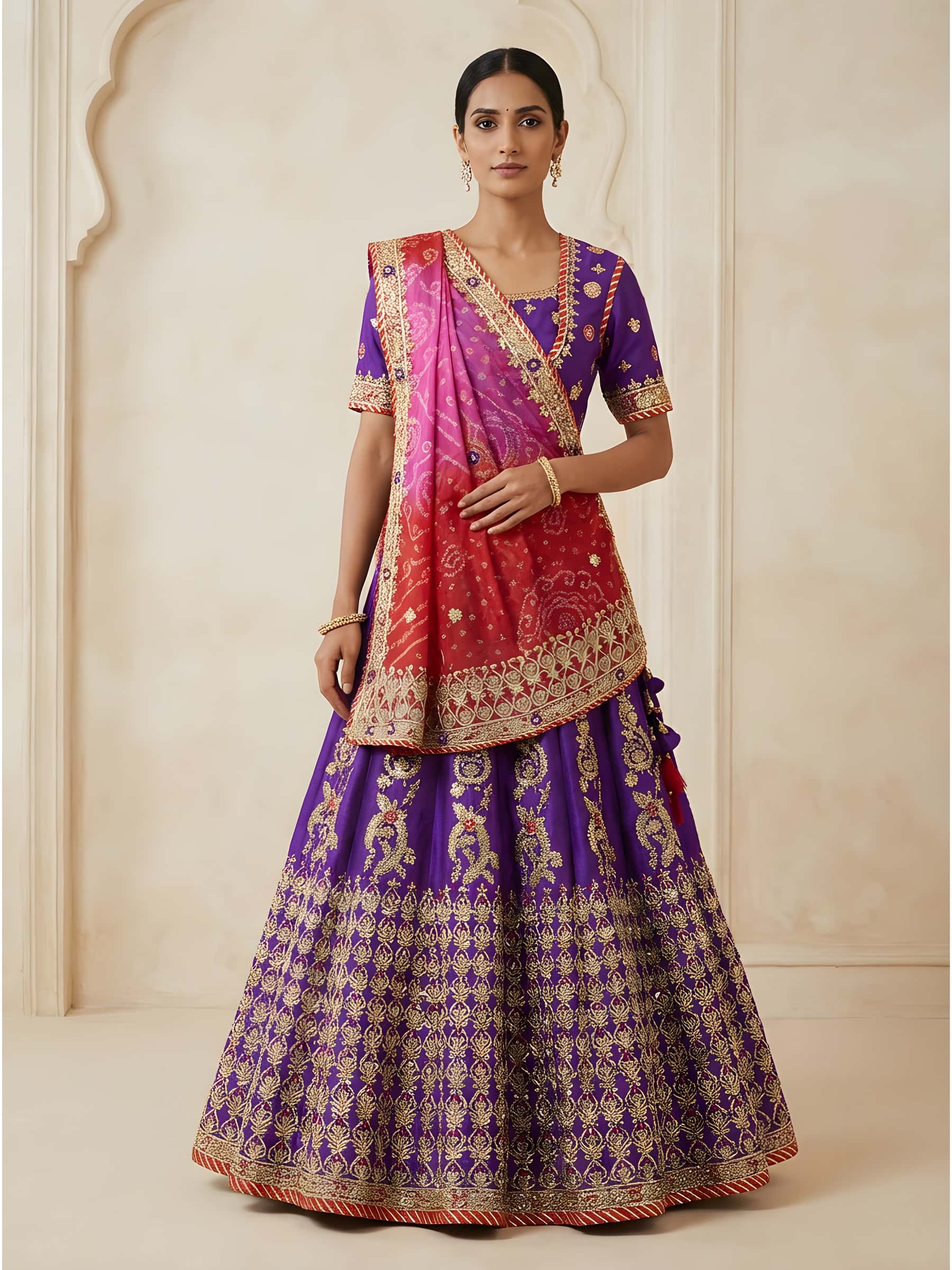
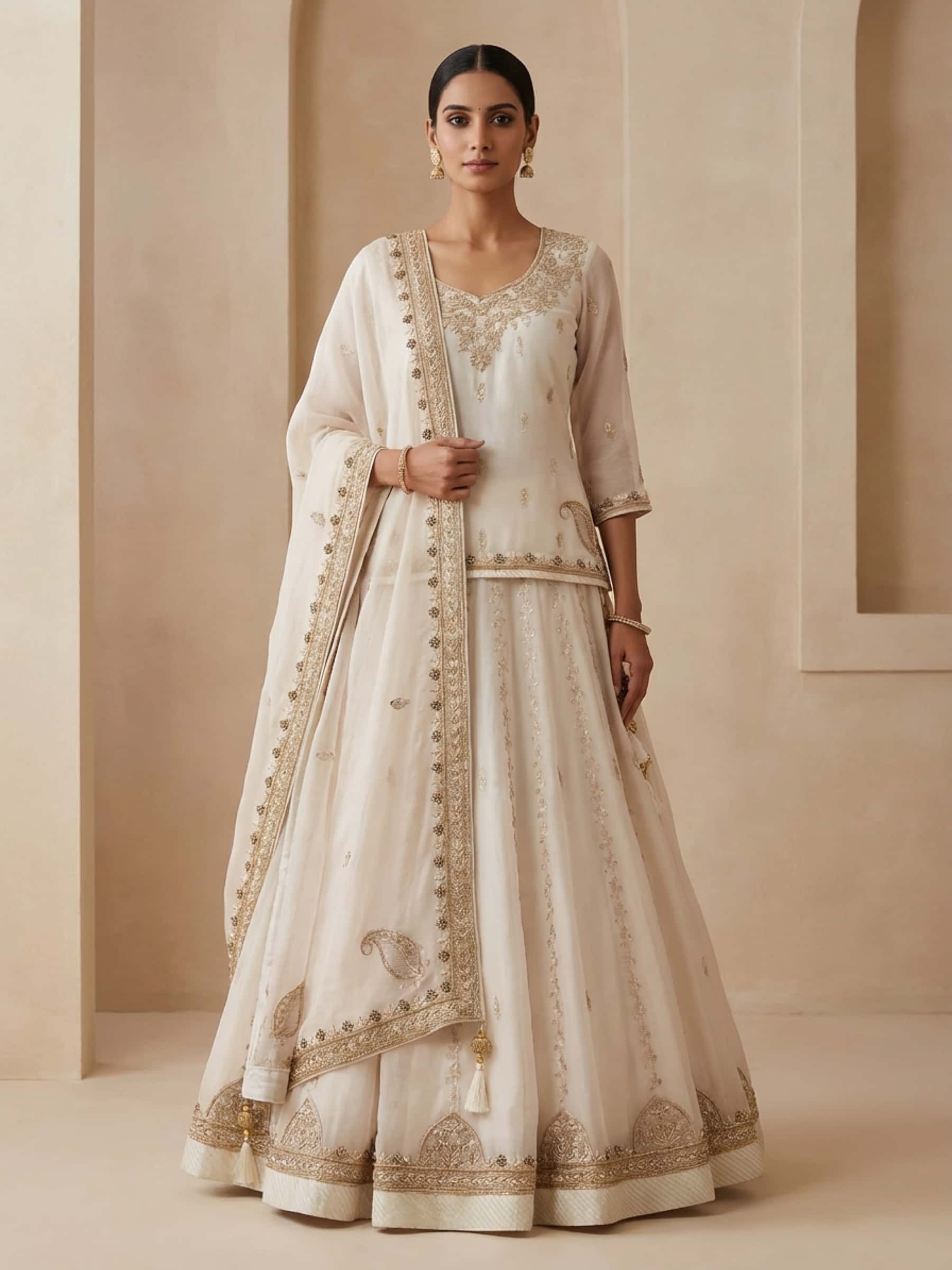
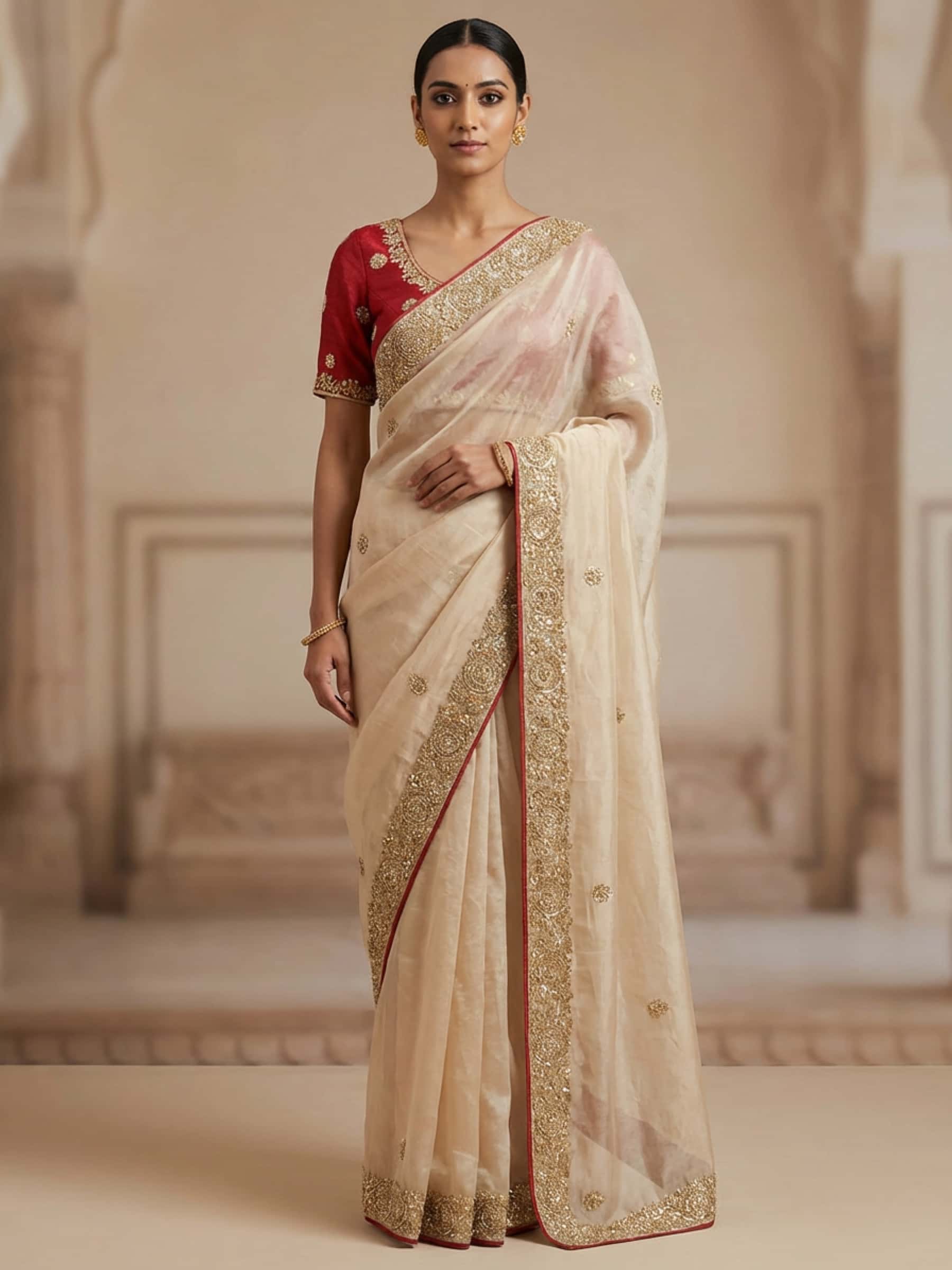
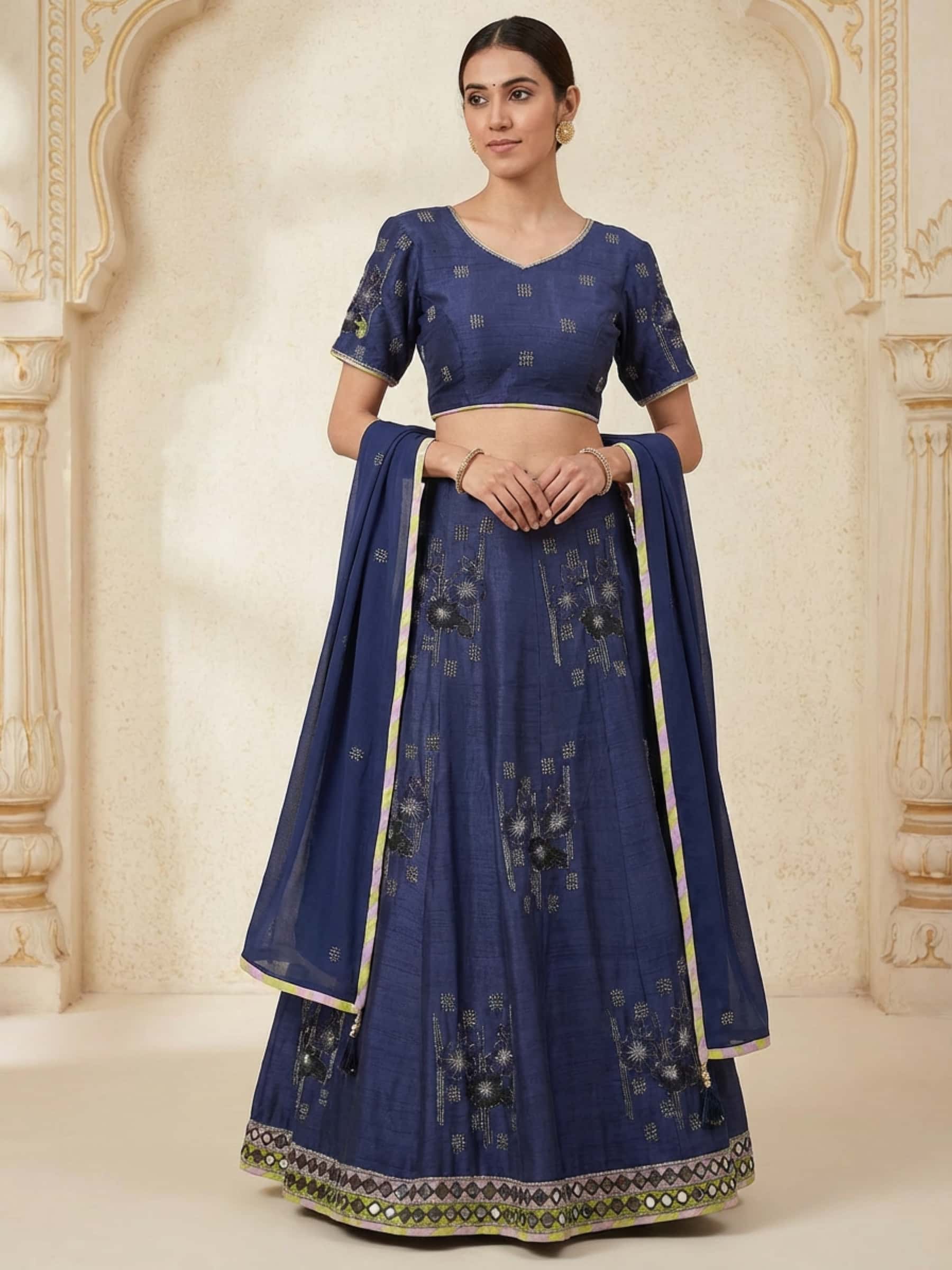
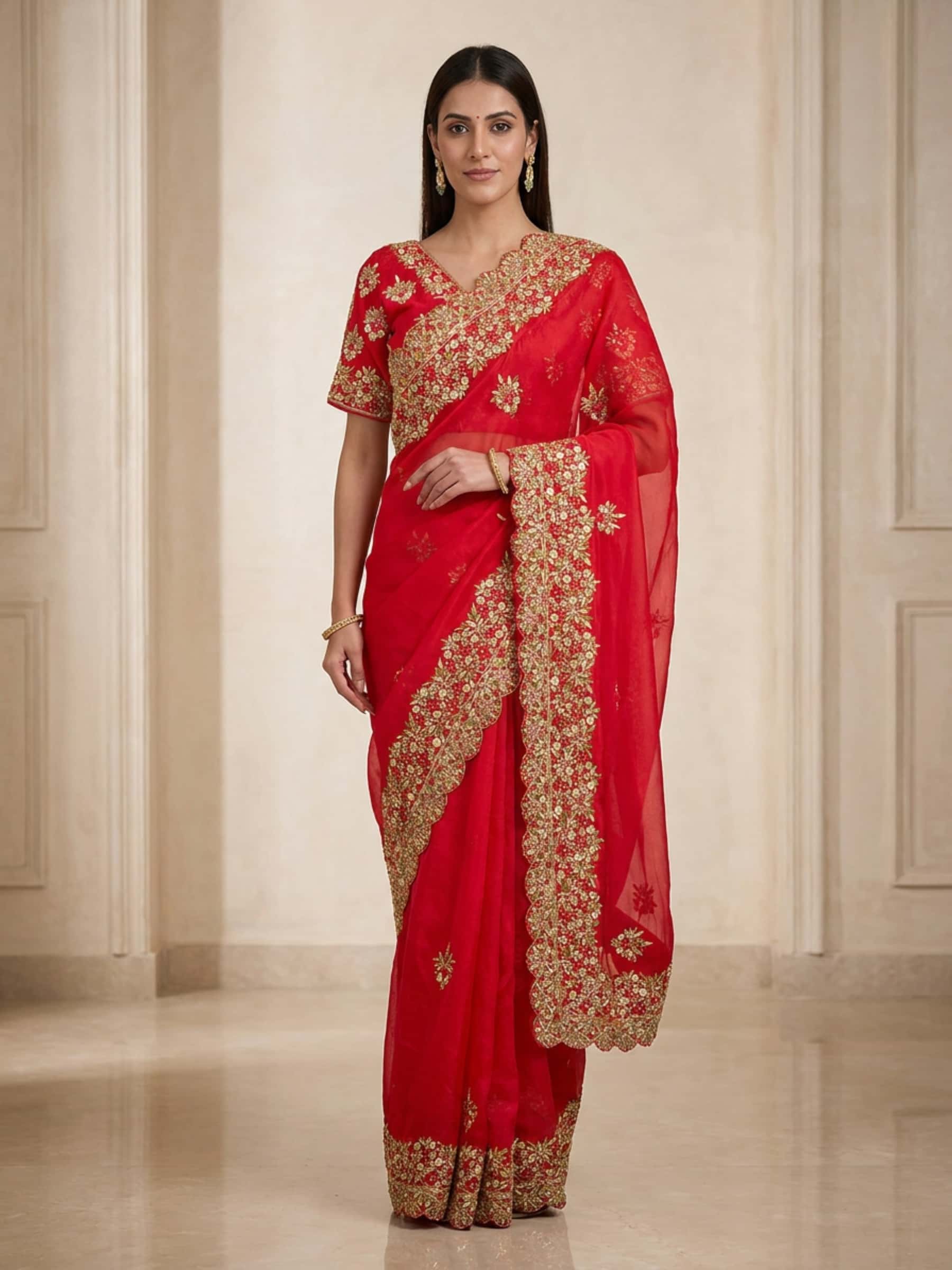
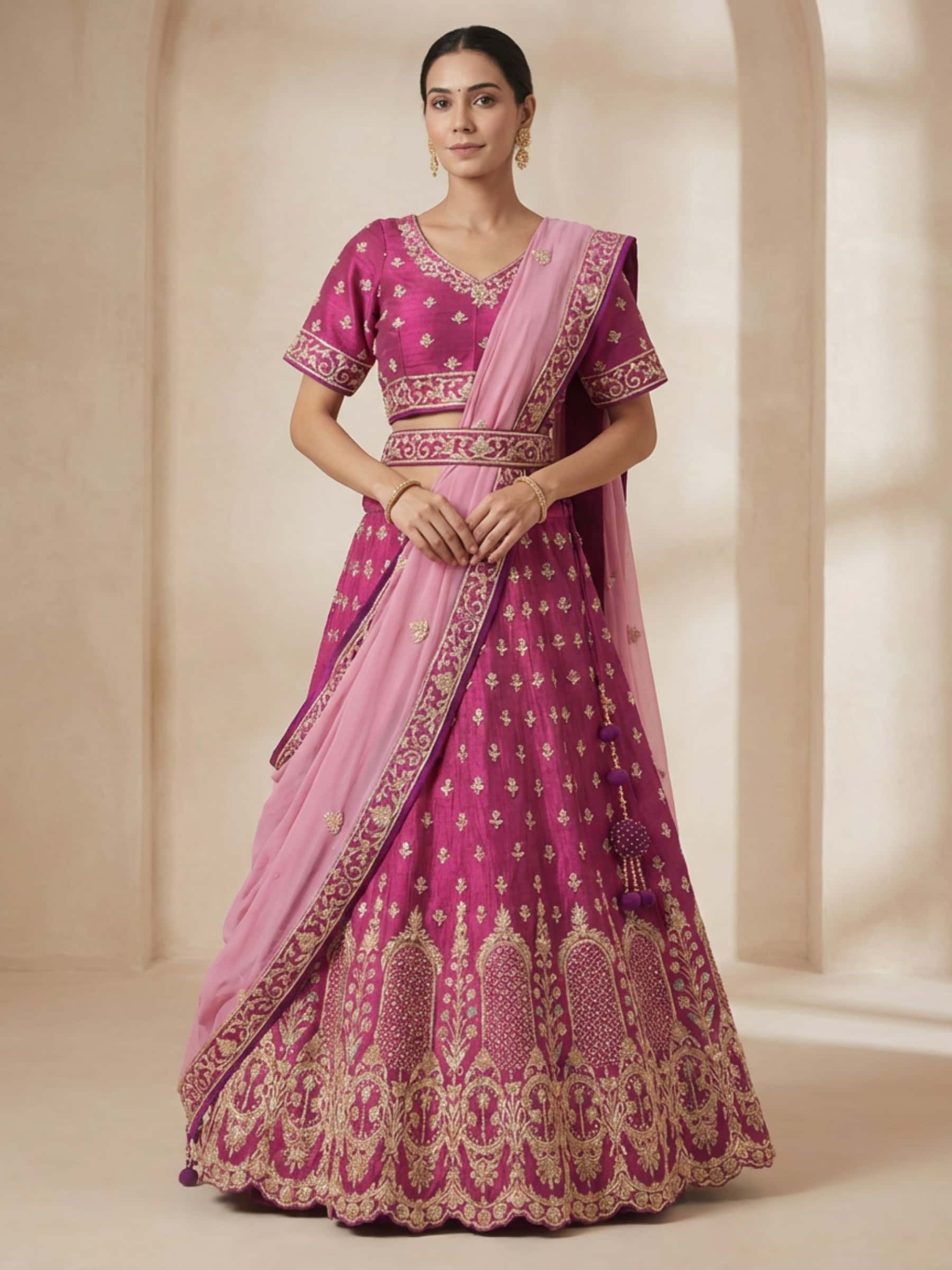
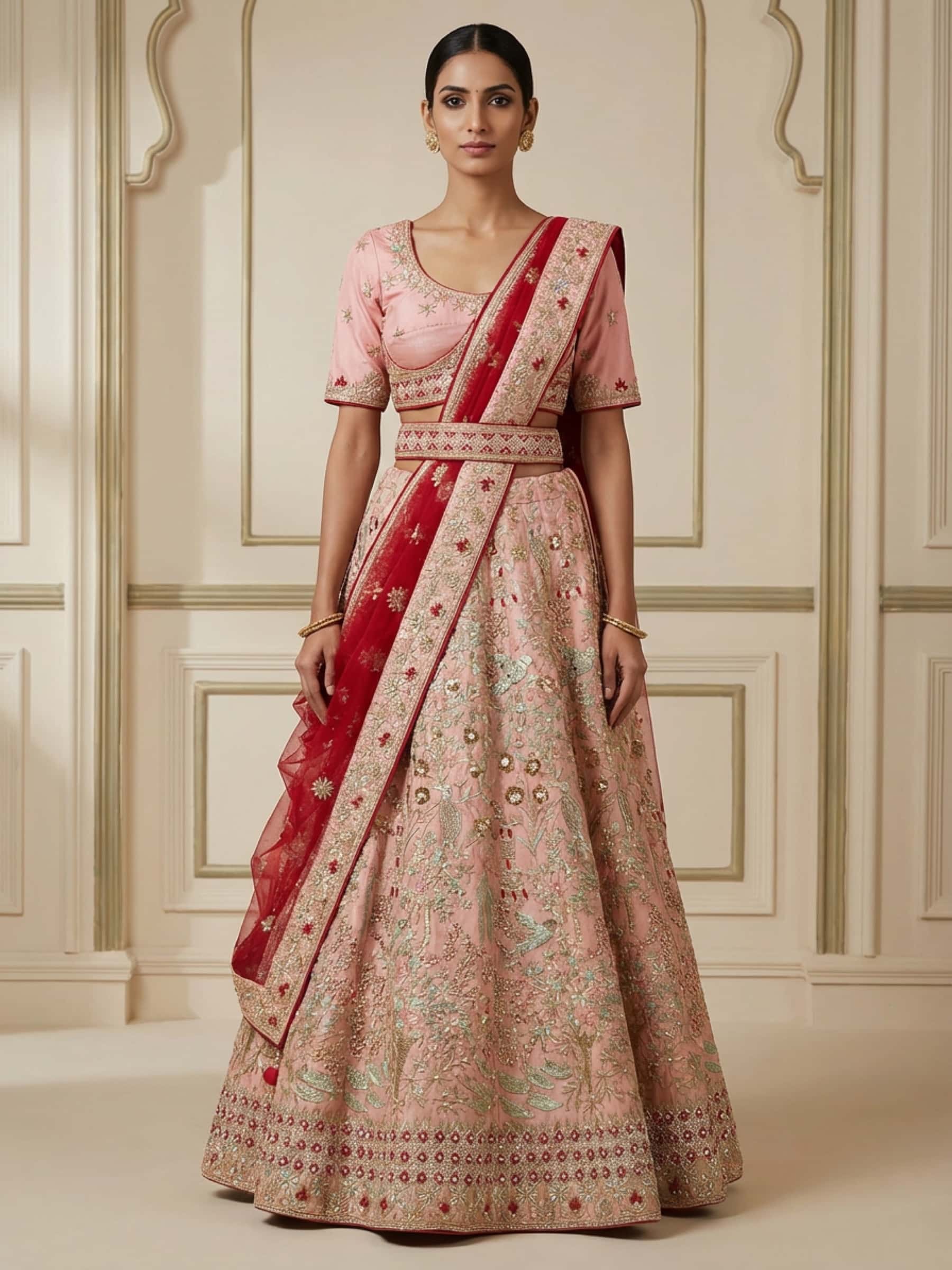
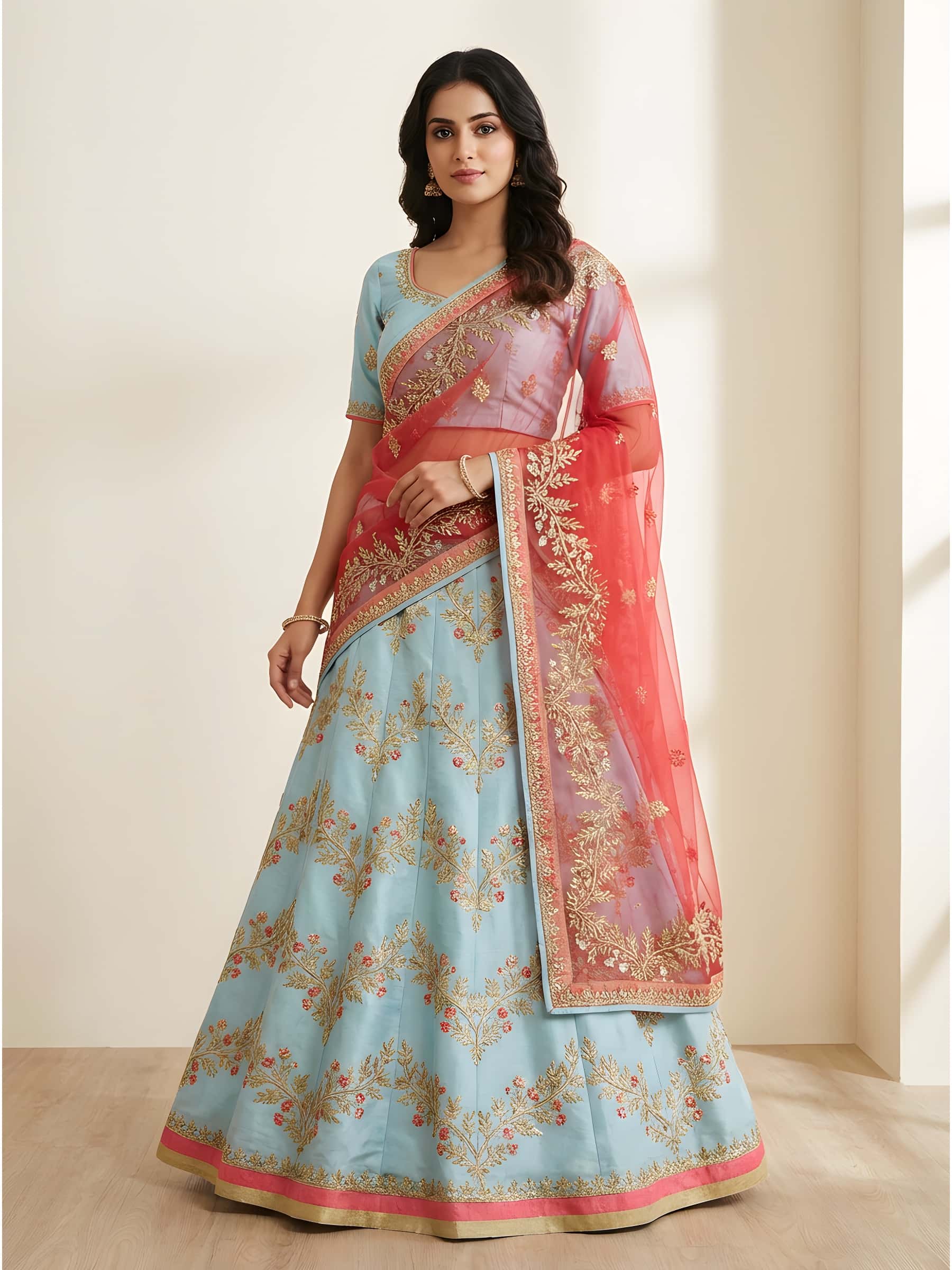
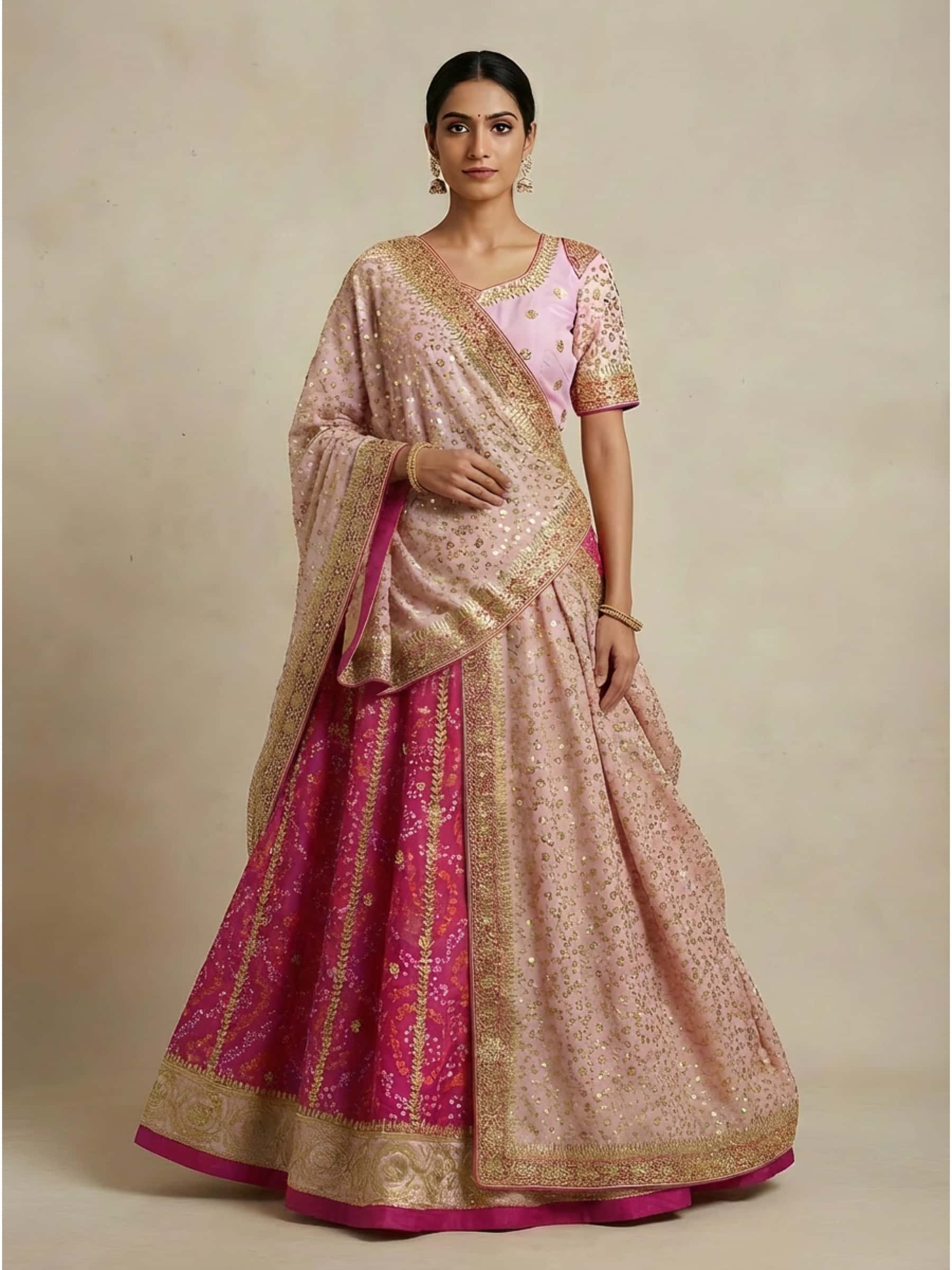
For most of Indian history, the wedding saree was the wedding outfit. The choice between a bridal saree and a bridal lehenga is a relatively modern question — across South India, Bengal, Maharashtra, and most of traditional North Indian Hindu practice until the late 1980s, the bride wore a saree, the family women wore sarees, and the wedding wardrobe was structured around a series of carefully-chosen sarees from engagement through reception. Our wedding saree collection above is built for two kinds of customer: the bride who chooses a saree over a lehenga for her own wedding day, and the family — mother, sister, aunt, mother-in-law — who anchors her wedding-attendance wardrobe around sarees. Every piece is handcrafted in our Jaipur atelier and customisable to your measurements, fabric, and embellishment density.
When a bride chooses a saree over a lehenga
This is a culturally and personally significant decision, and one most brides resolve through family tradition before they reach our atelier.
The saree is the traditional bridal garment across:
- South Indian Hindu weddings — universally the saree, almost always Kanjivaram silk or a regional equivalent.
- Bengali weddings — the red Banarasi or Tussar wedding saree is the default; the lehenga is unusual.
- Maharashtrian weddings — the 9-yard nauvari saree or 6-yard silk saree.
- Tamil-Brahmin and Iyengar weddings — the 9-yard madisar or Kanjivaram silk.
- Most Hindu communities in Uttar Pradesh, Bihar, Odisha, Karnataka — the bridal saree is the dominant choice over the lehenga.
The lehenga has become the dominant bridal garment in Punjabi, Marwari, Sindhi, and most modern urban North Indian Hindu weddings. Gujarati and Rajasthani weddings split based on family tradition.
For brides whose families do not have a strong saree-vs-lehenga tradition — increasingly common in inter-community and second-generation NRI weddings — the choice comes down to preference. A saree carries deeper symbolic weight, is a single uncut nine-yard garment, and can be re-worn at family weddings for fifty years. A lehenga is easier to walk in and offers more silhouette flexibility. For a structured comparison, read our guide to bridal lehenga vs bridal saree.
Structuring a bride's saree wardrobe
A bride who chooses sarees over lehengas for her wedding will typically plan five to eight sarees across functions:
- Engagement / sagai — light Banarasi or Chanderi silk in pastels; the "elegant bride-to-be" piece. Photographs as celebratory without anticipating the wedding-day weight.
- Mehendi — vivid daytime saree (yellow, green, magenta); usually pure georgette or light silk for movement and comfort during the multi-hour mehendi session.
- Haldi — yellow or saffron; often a piece the bride does not plan to wear again, as turmeric stains are difficult to remove even with professional dry-cleaning.
- Sangeet — evening, photographs heavily; jewel-tone Banarasi or pure georgette with medium-to-heavy embellishment. The most fashion-forward saree in the wardrobe.
- Wedding day — the heaviest piece. Traditional red, maroon, or community-specific palette (Kanjivaram red, Banarasi maroon, Bengali red-and-white). Heavy Banarasi, Kanjivaram, or full hand-embellished bridal Banarasi.
- Reception — second-heaviest; deliberately contrasting the wedding-day red. Champagne, gold, deep teal, wine, or jewel-tone Banarasi/Kanjivaram with medium-to-heavy embellishment.
- Post-wedding family ceremonies — milestone visits and Pag-phera/Mooh-dikhai functions. Trousseau-grade sarees; see bridal trousseau sarees.
For a function-by-function planning template, see the complete bridal trousseau checklist.
Structuring family wedding-saree wardrobes
For non-brides — mother, sister, aunt, mother-in-law, close family friends — the wedding-saree wardrobe is just as important and often more complex than the bride's, because there are more functions and more "second-saree" requirements.
- Mother of the bride / groom — usually three to five sarees across mehendi, sangeet, wedding day, and reception. Tradition is to wear a saree at least one weight tier below the bride. See mother-of-the-bride saree guide.
- Sister of the bride — two to four sarees across sangeet, wedding, and reception. The sister-of-the-bride saree must coordinate with the bridal palette without competing. See sister-of-the-bride outfit guide.
- Wedding guest (close family) — two sarees minimum (sangeet + wedding day) for multi-day weddings; one if only attending the main ceremony.
- Wedding guest (extended family / friends) — one saree, deliberately medium-weight, in a palette that reads as celebratory without competing with the wedding-party tones.
The rule across all these wardrobes: read the bride's palette and her colour weight before choosing, and dress one tier below.
Choosing fabric by season and ceremony
The most common wedding-saree mistake is choosing fabric by photograph rather than by wedding date and function timing.
- November–February weddings (peak Indian wedding season) — heavy silk holds up beautifully. Banarasi, Kanjivaram, Gajji silk, and pure silk Tussar are all suitable, including for outdoor ceremonies.
- March–April weddings — pure georgette or Chanderi silk for the heavier functions; avoid heavy Banarasi for outdoor or daytime functions. Pure organza is increasingly popular for daytime ceremonies.
- Summer weddings (May–June) — pure georgette or organza only; avoid heavy silk entirely.
- Monsoon weddings (July–September) — pure georgette and pure organza. Plan for humidity affecting both the bride and the embellishment work.
- Outdoor / destination weddings — drop one weight tier from what you would normally wear indoors.
Colour beyond the traditional red
Traditional red, maroon, and rani pink remain the most-chosen wedding saree colours across most Indian Hindu communities. But the modern bridal saree palette has expanded substantially, and so has the wedding-attendance palette:
- Traditional red, maroon, rani pink — anchoring family tradition.
- South Indian Kanjivaram colours — Kanchi red, Kanchi green, mustard, kumkum red with contrast borders. The signature South Indian bridal palette.
- Bengali whites and reds — the Banarasi red-and-white wedding saree, or the Lal-Paar (red-border on white) daily wear of married Bengali women.
- Soft pastels (blush, ivory, mint, sorbet) — increasingly popular for daytime weddings, destination ceremonies, and intimate civil weddings.
- Jewel tones (emerald, royal blue, wine, plum) — reception and sangeet alternatives to traditional red.
- Champagne and gold — read as ceremonial without leaning on red; popular reception choice.
When planning a multi-saree wardrobe, the rule is deliberate contrast across functions rather than colour repetition.
Customisation, sizing, and timeline
Every wedding saree in our atelier is made to measure and customisable across fabric, embellishment, colour, and border-pallu design. Production timelines for sarees:
- Light wedding sarees (engagement, mehendi, sangeet-light) — 4–6 weeks production.
- Heavy wedding sarees (sangeet-heavy, reception, standard bridal silk) — 12–24 weeks production.
- Add 1 week for domestic shipping or 3 weeks for international shipping.
For the heaviest intricate Banarasi or Kanjivaram custom weaves with substantial real-Zari content, production can extend further — these are heritage commissions where the weaver's loom is dedicated to your saree for months. Custom colour orders add 2–3 weeks. Saree blouse stitching is a separate workflow; we recommend stitching with our atelier rather than locally, as bridal blouse fit is the single most common alteration request after delivery.
Sizing is taken across bust, waist, hip, blouse length, and saree fall length. Bring or specify the bridal shoe heel-height at first fitting — the saree fall is finished accordingly.
Care and longevity
Every saree in our wedding collection is dry-clean only — no exceptions.
- Dry-clean only. Send to a professional cleaner experienced with heavy bridal handwork.
- Store folded with acid-free tissue between layers. Refold every 3–6 months to prevent permanent crease lines.
- Plastic bags tarnish Zari — cotton or muslin storage covers only.
- Keep away from direct sunlight. UV both fades the dyes and tarnishes Zari.
- Air briefly in shade twice a year. Bridal pieces stored long-term need to breathe.
- Iron on the reverse only, low heat, with a pressing cloth. Never iron directly on Gota Patti, Zardozi, or sequin work.
A correctly stored bridal Banarasi or Kanjivaram saree lasts 60–80 years. The wedding sarees worn at many Indian weddings today were woven for the bride's mother or grandmother.
What to look for when buying
- Is the saree composition disclosed? (Pure Banarasi silk, pure Kanjivaram silk, pure georgette — not "designer silk".)
- Is the Zari type stated? (Real, tested, or polyester — see our silk sarees guide.)
- Is the embellishment hand-done or machine-applied?
- For Kanjivaram and Banarasi specifically, is there a GI (Geographical Indication) certificate available?
- Is the blouse stitched, blouse-fabric-piece-only, or pre-cut for your tailor?
Every wedding saree at Rana's is composition-disclosed, weave-origin-attributed, Zari-type-specified, and (where applicable) GI-certified. Read the bridal saree shopping checklist for the diagnostic questions to ask at every atelier; the how to choose the perfect wedding saree guide for decision frameworks; and the traditional Indian wedding sarees overview for community-specific bridal saree traditions.
Browse adjacent collections: the Heritage Bridal Collection includes our heaviest wedding sarees alongside coordinating lehengas; the silk saree collection covers Banarasi, Kanjivaram, and Gajji silks across non-bridal price tiers; the bridal trousseau sarees anchor the post-wedding saree wardrobe; and the Rajputi Poshak collection is the Rajasthani and Marwari alternative to a bridal saree.