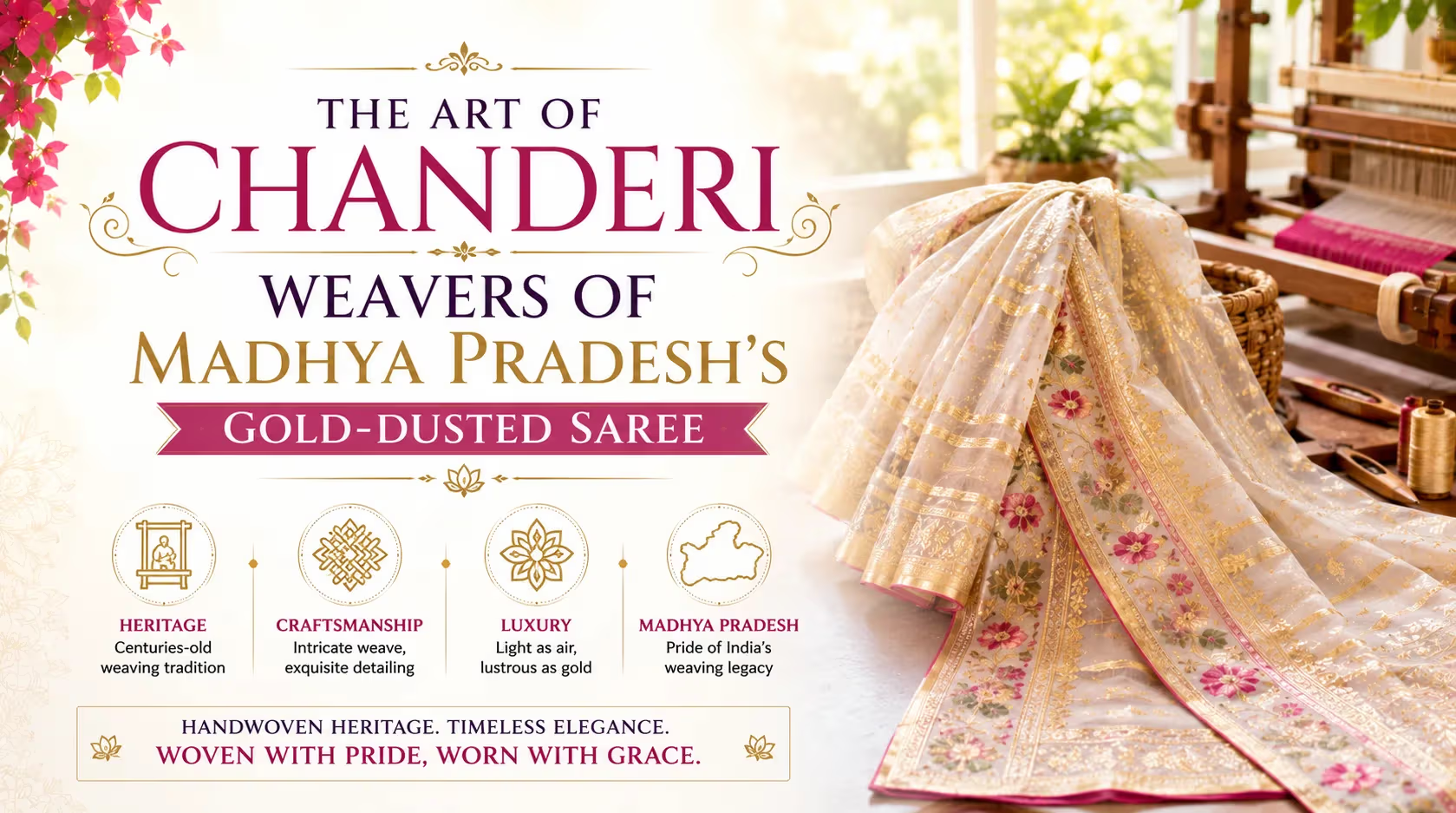
Meet Jaipur's Mukaish Artisans: The Silver Thread Masters of Rajasthan
Inside Jaipur's Mukaish workshops — the centuries-old craft of embedding silver and gold thread into fabric. How Mukaish (Badla) is made, how to identify authentic Mukaish, and why this endangered craft needs today's buyers.
Kshitija Rana
Editor
In a small workshop in the old city of Jaipur, a man named Iqbal sits cross-legged on the floor, bent over a wooden frame that holds a piece of Chanderi silk stretched tight. He is threading a tiny piece of silver wire through the fabric with a needle, pulling it through, and then — with a small iron — flattening the back end with a single, practiced tap. Then he moves his hand one millimetre across the fabric and does it again. He will do this four thousand times today. He has been doing this for forty-one years.
This is Mukaish — also called Badla or Fardi — one of India's oldest and most delicate textile crafts. It is also one of its most endangered. This is the story of the Mukaish artisans of Jaipur, what they make, how they make it, and why the craft is fighting for survival.
What Mukaish Actually Is
Mukaish is a form of metal embellishment where individual pieces of metallic wire are embedded directly into fabric. Each piece of wire is threaded through the weave with a needle, pulled to the front of the fabric, cut to a precise length (usually 2–4 millimetres), and then hammered flat from behind with a small iron called a kalam.
The result is a fabric that appears to have thousands of tiny, irregular silver or gold points scattered across its surface. In daylight, the effect is subtle shimmer. In candlelight — which is how Mukaish was historically designed to be seen — the fabric looks like it has been dusted with stars.
The craft has two regional traditions: Lucknow, where Mukaish originated in the Mughal era and is called Badla, and Jaipur, where it arrived later and evolved with Rajasthani design sensibilities. Jaipur Mukaish is typically more intricate, uses smaller metal pieces, and is often combined with other Rajasthani crafts like Gota Patti or Bandhani.
The Four-Hundred-Year History
Mukaish emerged in the Mughal courts of the 17th century as a refinement of earlier metal-embellishment traditions from Persia. Mughal queens and noblewomen commissioned Mukaish-embellished Anarkalis, dupattas, and bedcovers. The craft required both precision embroidery skill and metal-working knowledge — rare combined skills that made Mukaish artisans highly paid in their time.
When Mughal patronage declined in the 18th and 19th centuries, the Mukaish tradition survived through Muslim artisan families in Lucknow. The Jaipur Mukaish tradition developed slightly later, through artisans who migrated from Lucknow to the Rajput courts and adapted their craft to Rajasthani aesthetics.
By the mid-20th century, Mukaish was on a precipice — machine-made imitation sequins flooded the market, real Mukaish became economically non-viable for most families, and skilled artisans aged out without successors. The craft was saved by a small network of designers and direct-to-consumer ateliers who understood that some crafts cannot survive on mass-market terms and began paying Mukaish artisans viable per-piece rates for high-end commissions.
How Mukaish Is Made
The process is entirely manual:
Step 1: Fabric preparation. The base fabric (usually Chanderi, Georgette, pure silk, or fine cotton) is stretched on a wooden frame called an adda. The pattern is lightly marked on the fabric with a washable blue or yellow marker.
Step 2: Wire preparation. Small coils of silver or silver-plated wire are kept ready. Modern Mukaish uses silver wire with a silver content of 60–80 percent; historical Mukaish used higher silver content or actual gold.
Step 3: Insertion. The artisan threads a small piece of wire through the eye of a specialised needle, pushes the needle through the fabric from front to back, and pulls the wire through until only a short length remains on the front side.
Step 4: Cutting. The wire is cut on the reverse side of the fabric with a small precision tool.
Step 5: Hammering. The cut end is hammered flat from behind with the kalam. This is what secures the wire in place — the flattened back end is wider than the fabric's weave, so it cannot pull through.
Step 6: Repeat. The artisan moves to the next pattern point and repeats. A skilled Mukaish artisan completes 500–800 dots per hour for a simple scatter; 300–400 per hour for intricate cluster patterns.
A Mukaish saree with a medium scatter pattern on the pallu and borders contains 300,000–500,000 individual metal-wire insertions. It requires 4–8 weeks of artisan work.
The Economics of Mukaish in 2026
A Mukaish-embellished saree from a Jaipur atelier typically retails at ₹35,000–₹1,50,000 depending on fabric, design complexity, and design density. Of that price, the Mukaish artisan typically receives ₹6,000–₹25,000.
That sounds like reasonable pay until you do the math: a ₹15,000 artisan payment divided by 320 hours of work is ₹47 per hour. And this is skilled, precision craft that takes decades to master.
The Mukaish community in Jaipur today numbers approximately 150–200 active artisans. Lucknow has perhaps 300 more. These are the last skilled practitioners of a four-century craft. Without serious economic intervention — higher per-piece rates, direct-to-consumer selling, and formal craft protection — the craft is likely to disappear within one generation.
Recognising Authentic Mukaish
Before buying Mukaish, verify authenticity. Three signs:
- Irregular placement. Authentic handwork has slight variations in spacing. Perfectly uniform dot placement indicates machine stamping.
- Matte silver sheen. Authentic Mukaish has a soft, slightly dull silver or gold colour. Bright, highly reflective "Mukaish" is usually plastic sequin imitation.
- Hammered reverse. Turn the fabric over. Authentic Mukaish shows the flat hammered ends of wire pieces on the reverse. Sequin imitation shows glue residue or thread stitching.
If possible, ask the seller which artisan community the Mukaish work came from. Legitimate sellers can name specific workshops and artisan families. Mass-market sellers cannot, because they are purchasing from anonymous supply chains.
Caring for Mukaish Sarees
- Dry clean only. Water tarnishes silver Mukaish and can loosen the hammered back ends.
- Store in pure muslin cloth — not plastic, which accelerates silver tarnishing.
- Dark, dry place. Humidity and light both damage the embellishment.
- Refold every 6 months to prevent permanent crease lines through the Mukaish pattern.
- Handle gently. Do not pull or snag fabric — dislodged wire pieces cannot easily be replaced.
With careful handling, a Mukaish saree lasts 40–60 years. Many families pass Mukaish sarees down for generations.
Where to Shop Mukaish
Browse our designer handmade saree collection for Mukaish-embellished pieces, or explore our Heritage Bridal Collection for Mukaish-on-silk bridal sarees. For the wider world of Jaipur craft, read our companion artisan stories on Gota Patti craftsmen, Zardozi embroiderers, and the Bandhani knot-tyers of Jaipur. Every Mukaish saree at Rana's is sourced directly from Jaipur-based artisan workshops with known family names — not from anonymous wholesale channels. We can tell you who made your saree.
Mukaish is not the saree you buy to wear once to a wedding. It is the saree you buy knowing it will be worn by your daughter, your niece, and your granddaughter after you. It is craft that rewards intention — and intention is what keeps the craft alive.
Every authentic Mukaish you buy is one more commission that lets Iqbal and his workshop continue what their families have done for four centuries. That is not a marketing promise. That is the actual survival math of the craft.