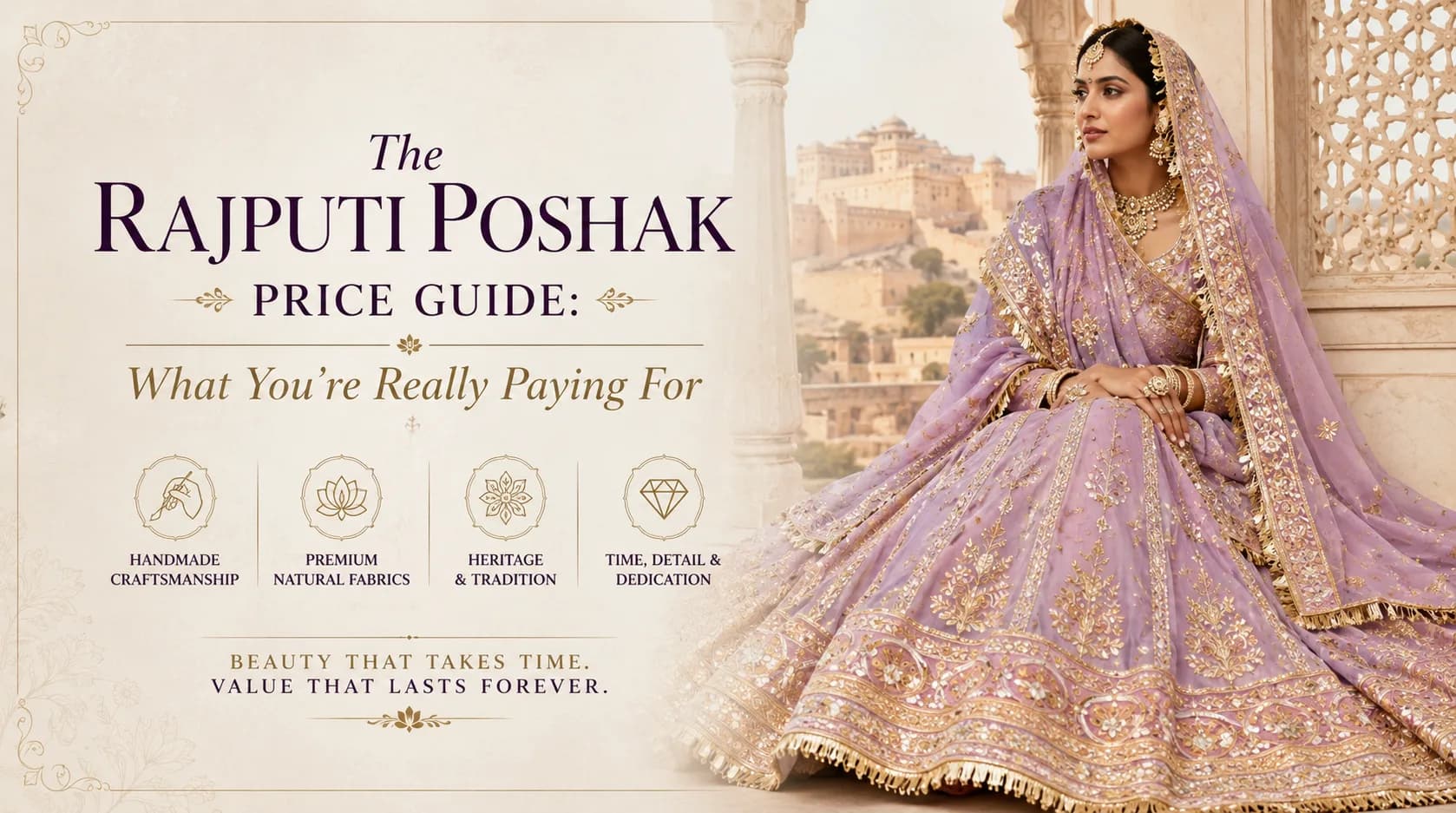
The Rajputi Poshak Price Guide: What You're Really Paying For
A transparent breakdown of Rajputi poshak pricing — the real cost drivers, fabric, embellishment density, artisan hours, and what a ₹50,000 vs ₹5 lakh poshak actually delivers.
Kshitija Rana
Editor
A Rajputi poshak can cost ₹35,000. Or it can cost ₹6 lakh. Or ₹15 lakh. These are not arbitrary numbers — they reflect real differences in fabric, artisan hours, metal content, and design complexity. But walk into any showroom and those differences are rarely explained. Brides end up comparing two poshaks that look superficially similar and concluding that one atelier is "cheaper" when in reality the cheaper piece is made from different materials, with different labour inputs, for different purposes. This guide is the honest breakdown — what you are actually paying for when you buy a Rajputi poshak. If you are still deciding which poshak style suits your wedding, start with the complete Rajputi Poshak buying guide.
The Five Cost Drivers
Every poshak price is composed of five cost dimensions. Understanding these lets you compare apples to apples.
1. Fabric. Ranging from synthetic blends (₹400–₹800 per metre) to pure Georgette (₹1,500–₹3,000) to pure silk (₹3,000–₹8,000) to velvet (₹4,000–₹10,000). A poshak uses 8–15 metres of fabric in the ghagra alone. Fabric alone can account for ₹10,000 to ₹1,00,000+ of the total price.
2. Embellishment density. The amount of hand-done work on the garment. Light Gota Patti on a kanchli takes 20–30 hours. Heavy Zardozi with Kundan and Moti across a full wedding ghagra can take 400+ hours of skilled artisan labour.
3. Metal thread content. Copper-plated "Zari" (cheapest) vs silver-plated Zari (mid) vs real Zari with actual gold content (highest). Real gold-wash Zari in a heavy poshak can add ₹50,000 to ₹2,00,000 to the price.
4. Artisan hours and skill level. Entry-level artisans earn ₹200–₹400 per day. Master artisans in specialist techniques like real-Zari Gota Patti or fine Zardozi earn ₹800–₹2,000+ per day. A poshak with 300 hours of master-artisan work carries ₹30,000–₹75,000 in labour costs alone.
5. Design complexity. Template poshaks (slightly customised versions of existing designs) are cheaper. Fully custom design work, consultations with a lead designer, unique colour and pattern development, and bespoke embellishment combinations add meaningful cost — typically ₹20,000–₹1,00,000 in design fees, depending on atelier.
When you see two poshaks at different price points, the difference is typically in these five dimensions combined. A poshak is not "expensive" in the abstract; it is expensive because of specific, identifiable reasons.
What ₹50,000 Buys
At the ₹35,000–₹60,000 tier, you can expect:
- Fabric: Georgette base, often with synthetic blend component. Not pure silk.
- Embellishment: Moderate hand Gota Patti or machine-assisted embroidery. Light sequin and Moti work.
- Metal content: Copper-plated Gota, sometimes silver-plated for better pieces.
- Artisan hours: 40–80 hours total.
- Design: Standard template with some colour customisation.
- Fittings: Usually one fitting round, often no muslin mockup.
Appropriate for: Wedding guest poshak, pre-wedding functions (engagement, tilak), mid-level family wedding functions. Not heavy enough for the wedding ceremony itself or for major family events.
What ₹1,00,000 Buys
At the ₹80,000–₹1,50,000 tier, you can expect:
- Fabric: Pure Georgette or Chanderi, sometimes light silk blend.
- Embellishment: Substantial hand Gota Patti covering the ghagra hemline, kanchli front, and odhni pallu. Moderate Zardozi. Moti and sequin work throughout.
- Metal content: Silver-plated Zari, sometimes semi-real Zari with small gold content.
- Artisan hours: 100–180 hours total.
- Design: Semi-custom with some bespoke design elements. Choice of colour, some embellishment variation.
- Fittings: Two fitting rounds, sometimes with a muslin mockup for the kanchli.
Appropriate for: Engagement, tilak, mayra (for less formal families), sangeet, reception. Wedding guest for closest family. Not recommended for the bride's wedding-ceremony poshak unless the family is intentionally choosing a lighter wedding-day look.
What ₹2,50,000 Buys
At the ₹2,00,000–₹3,50,000 tier, you can expect:
- Fabric: Pure silk, silk-Georgette blend, or pure Georgette of very high quality. Velvet for winter/cooler climate weddings.
- Embellishment: Heavy hand-done Gota Patti, Zardozi, Kundan stone work, and Moti across the kanchli, ghagra, and odhni. Full Jaal (all-over pattern) on at least part of the ghagra.
- Metal content: Silver-plated or semi-real Zari. Better pieces include some real gold thread.
- Artisan hours: 250–400 hours total across multiple specialists (Gota Patti, Zardozi, Kundan setting).
- Design: Fully custom — colour story, pattern, embellishment combination all designed for the specific bride.
- Fittings: Three rounds including a full muslin mockup. Remote fitting support for NRI brides.
- Finishing: Hand-stitched seams, lined kanchli, properly weighted ghagra for dramatic drape, professionally finished odhni.
Appropriate for: Wedding ceremony poshak for a standard-to-premium Indian wedding. Mayra or bhaat for traditional families. Wedding guest for very close family (sister of the bride in a major wedding).
What ₹5,00,000+ Buys
At the ₹4,50,000–₹8,00,000+ tier (and up to ₹15,00,000 for couture heirloom pieces), you can expect:
- Fabric: Pure silk, premium Banarasi, handloom-woven fabrics. Sometimes antique or vintage fabric reworked into new construction.
- Embellishment: Extreme density of hand-done work. Heavy Zardozi with real gold thread. Kundan stones with silver or gold settings. Polki work. Full-length Jaal patterns across the ghagra. Heavy pallu work on the odhni.
- Metal content: Real gold Zari with 2–3 percent actual gold content. Sometimes 24-carat gold thread in limited quantity.
- Artisan hours: 500–1,200 hours total across 4–8 specialist artisans.
- Design: Fully bespoke design developed over multiple consultations. Custom pattern development. Unique colour dyeing.
- Fittings: Four or more fitting rounds. Multiple muslin mockups. Designer consultation throughout.
- Heirloom construction: Reinforced seams, heritage-grade finishing, restorable by future generations.
Appropriate for: Heirloom wedding-ceremony poshaks for families preserving the piece across generations. Major royal-family or legacy-wedding commissions. Museum-quality heritage ceremonial wear.
Comparison Table: What's Actually Different
| Dimension | ₹50K Poshak | ₹1L Poshak | ₹2.5L Poshak | ₹5L+ Poshak |
|---|---|---|---|---|
| Fabric | Georgette blend | Pure Georgette | Pure silk | Premium/antique silk |
| Ghagra embellishment | Border only | Substantial | Heavy Jaal | Full heavy Jaal |
| Kanchli work | Light | Medium | Heavy | Extreme |
| Odhni work | Pallu only | Borders + pallu | Full borders + Jaal | Full Jaal + heavy pallu |
| Metal thread | Copper-plated | Silver-plated | Silver/semi-real | Real gold Zari |
| Artisan hours | 40-80 | 100-180 | 250-400 | 500-1200+ |
| Total weight | 3-4 kg | 5-6 kg | 7-9 kg | 10-14 kg |
| Fittings | 1 round | 2 rounds | 3 rounds + muslin | 4+ rounds + multiple mockups |
| Design | Template | Semi-custom | Fully custom | Bespoke heritage |
How to Read an Atelier's Pricing
When discussing a poshak price with an atelier, ask for transparency on each cost dimension:
- "What is the fabric composition?" — Pure Georgette, pure silk, or blended?
- "What percentage of the embellishment is hand-done?" — vs machine-assisted?
- "What is the metal thread?" — Copper-plated, silver-plated, semi-real, or real Zari?
- "Approximately how many artisan hours go into this piece?" — A rough number gives you cost benchmark.
- "How many fittings are included?" — One round vs three plus a muslin mockup.
- "How customised is the design?" — Template variant, semi-custom, or fully bespoke.
Reputable ateliers answer these questions directly. Ateliers that deflect or are vague about cost structure are typically compressing one or more of the cost dimensions without disclosure.
Where to Invest, Where to Save
For brides building a full poshak wardrobe across functions:
Invest most in: Wedding-ceremony poshak (this is the heirloom piece), mayra or bhaat poshak (second-most culturally weighted).
Mid-tier appropriate: Engagement poshak, reception poshak, sangeet poshak.
Light-tier appropriate: Haldi or mehendi poshak (will be stained), guest wedding poshaks.
Many brides spend disproportionately on the engagement or sangeet poshak and under-invest in the wedding-ceremony piece. This is a common mistake — the wedding-ceremony poshak is the one that lasts.
Avoiding Price Traps
Two patterns to watch:
1. Machine embroidery sold as handwork. Many mid-market sellers at ₹40,000–₹70,000 claim hand-done Gota Patti but deliver machine-stitched work with hand-applied finishing details. Look for irregularities in the embroidery pattern — machine work is perfectly uniform. Authentic hand Gota Patti has visible artisan variation.
2. Synthetic fabric sold as pure. "Pure Georgette" is a loose term in the Indian market. Many "pure Georgette" poshaks contain 20–40 percent synthetic blend. Ask for fabric composition disclosure. Reputable ateliers provide it in writing.
Shop Rajputi Poshak at Rana's
Browse our Rajputi poshak collection across price tiers. Every poshak on Rana's is fabric-disclosed and artisan-attributed — you will know exactly what you are paying for. For fully custom poshaks with detailed cost breakdown across all five dimensions, book a consultation.
Read our companion guides on Rajputi poshak buyer's guide by occasion, modern Rajputi poshak styling, and Rajputi poshak for NRI brides for the full poshak purchase-planning series.
A poshak is not a simple product. It is five dimensions of craft, fabric, and labour coming together in one ceremonial garment. Knowing what you are paying for is the first step toward buying well.