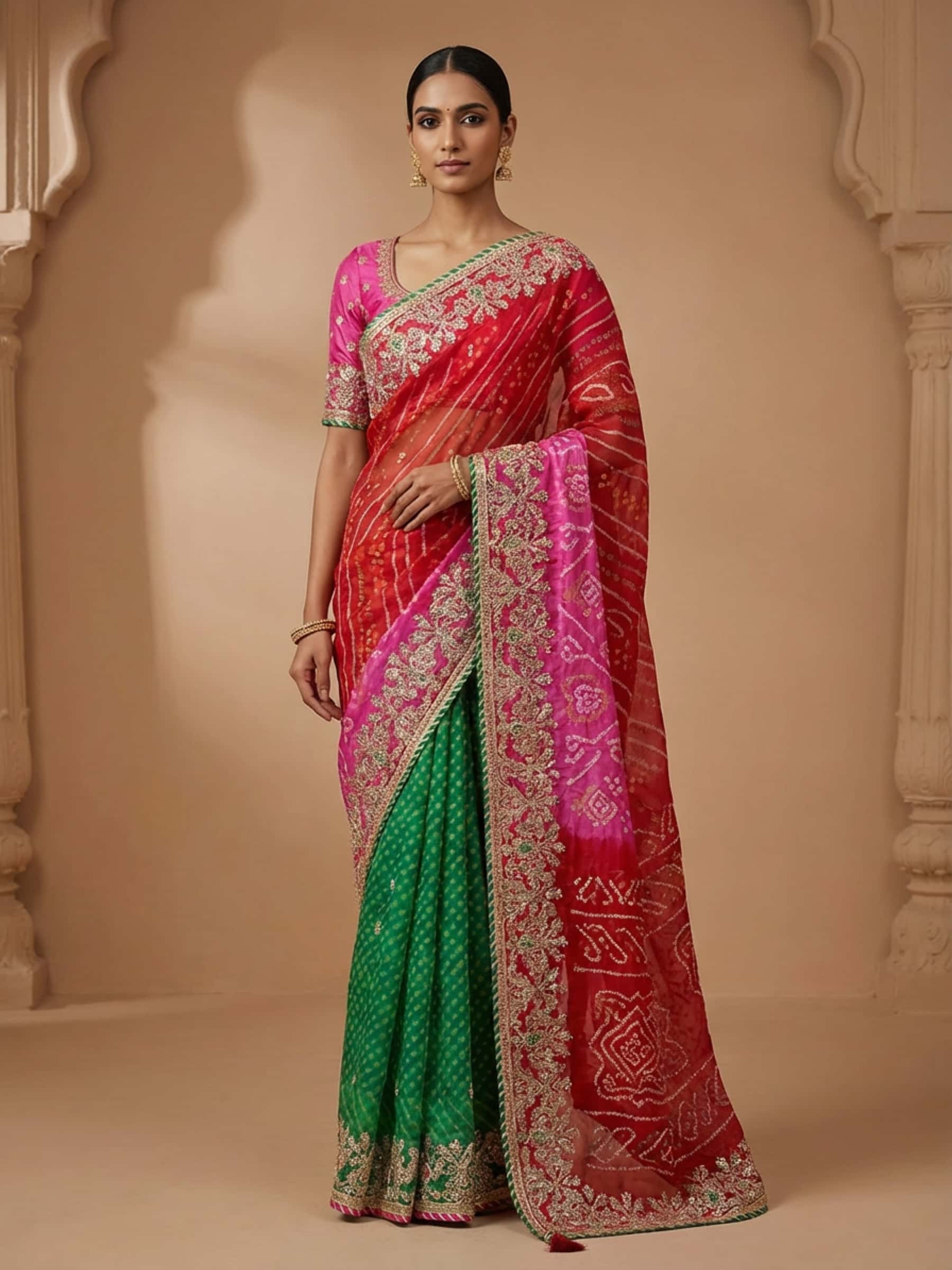
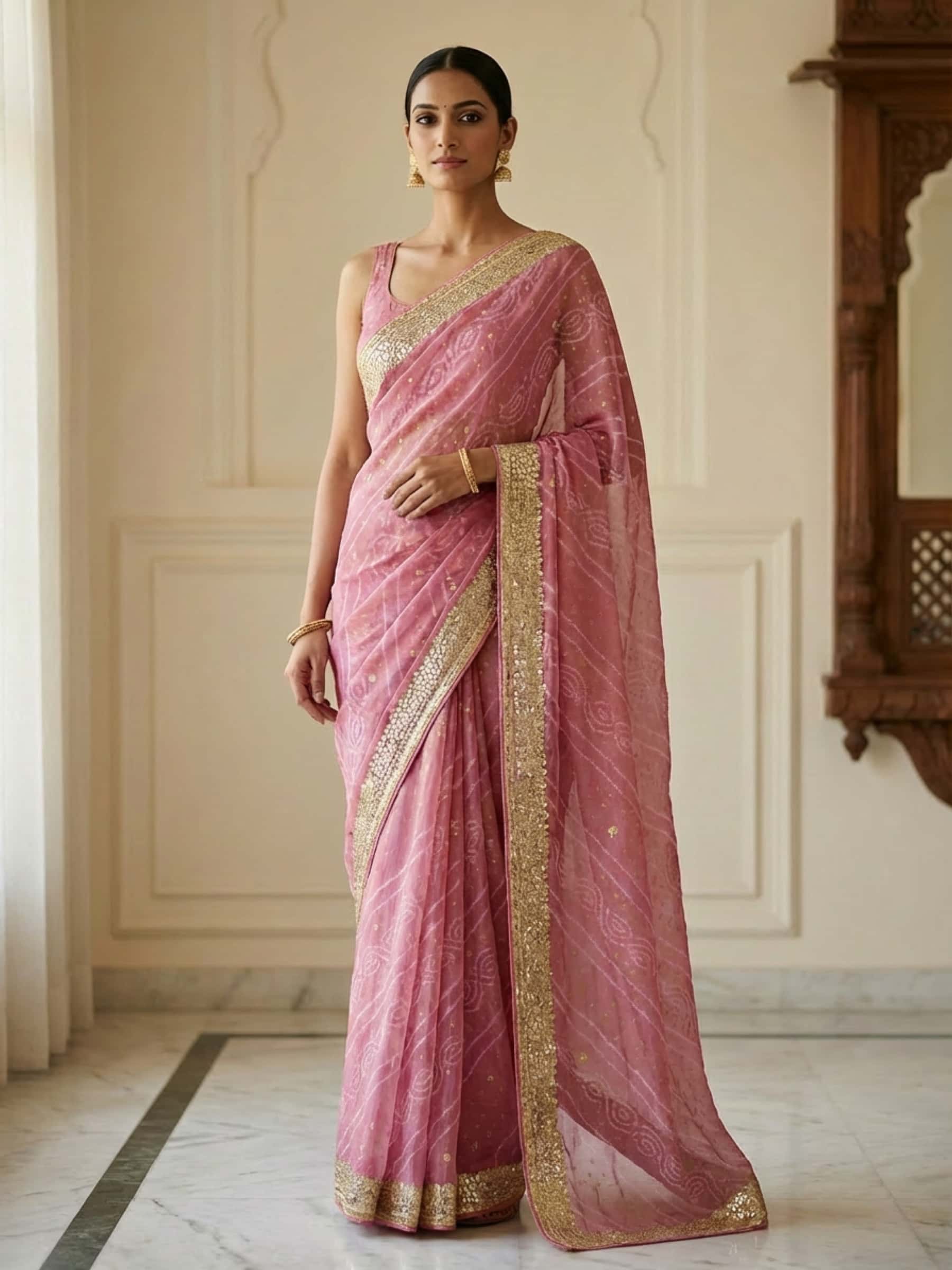
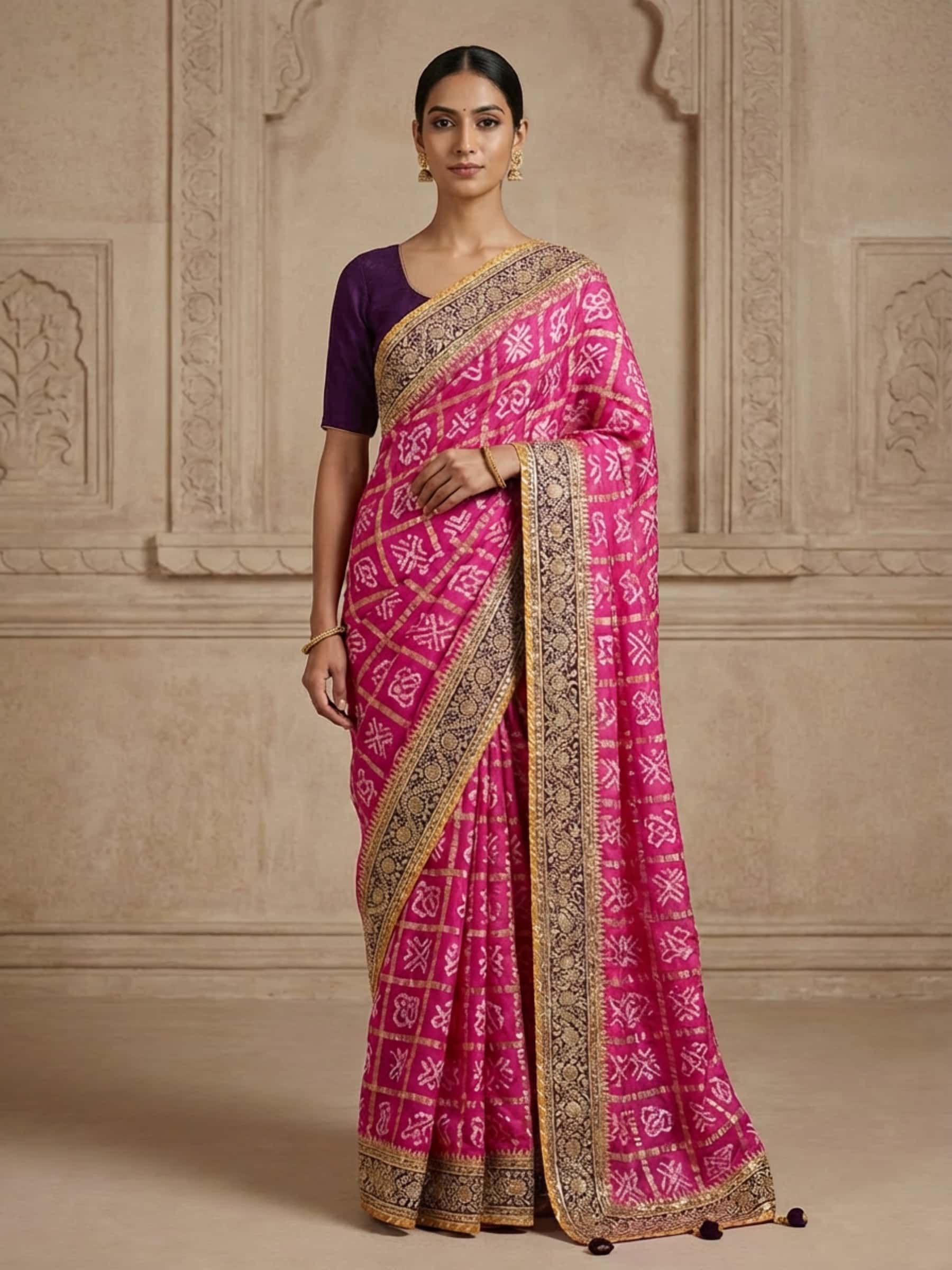
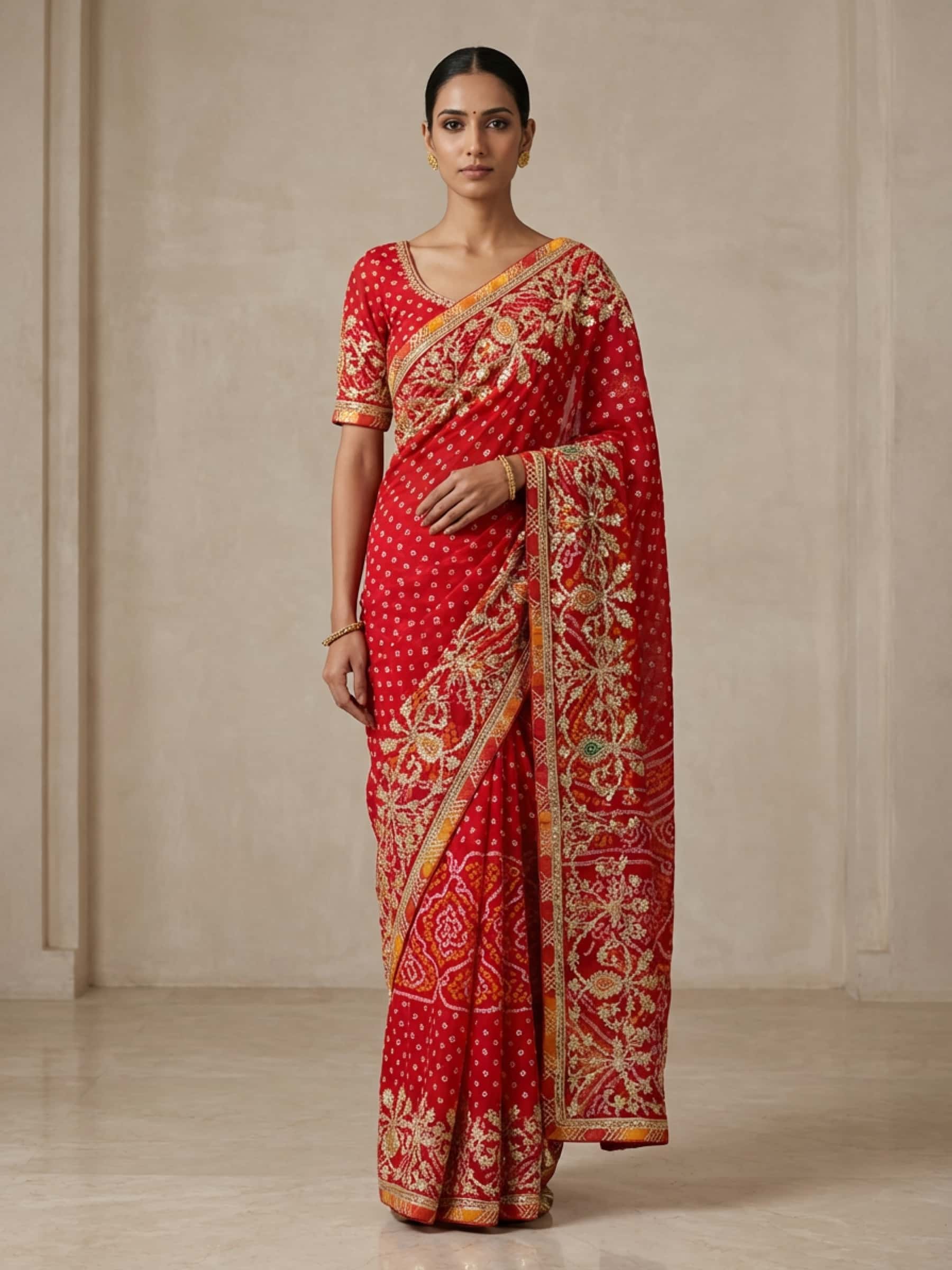
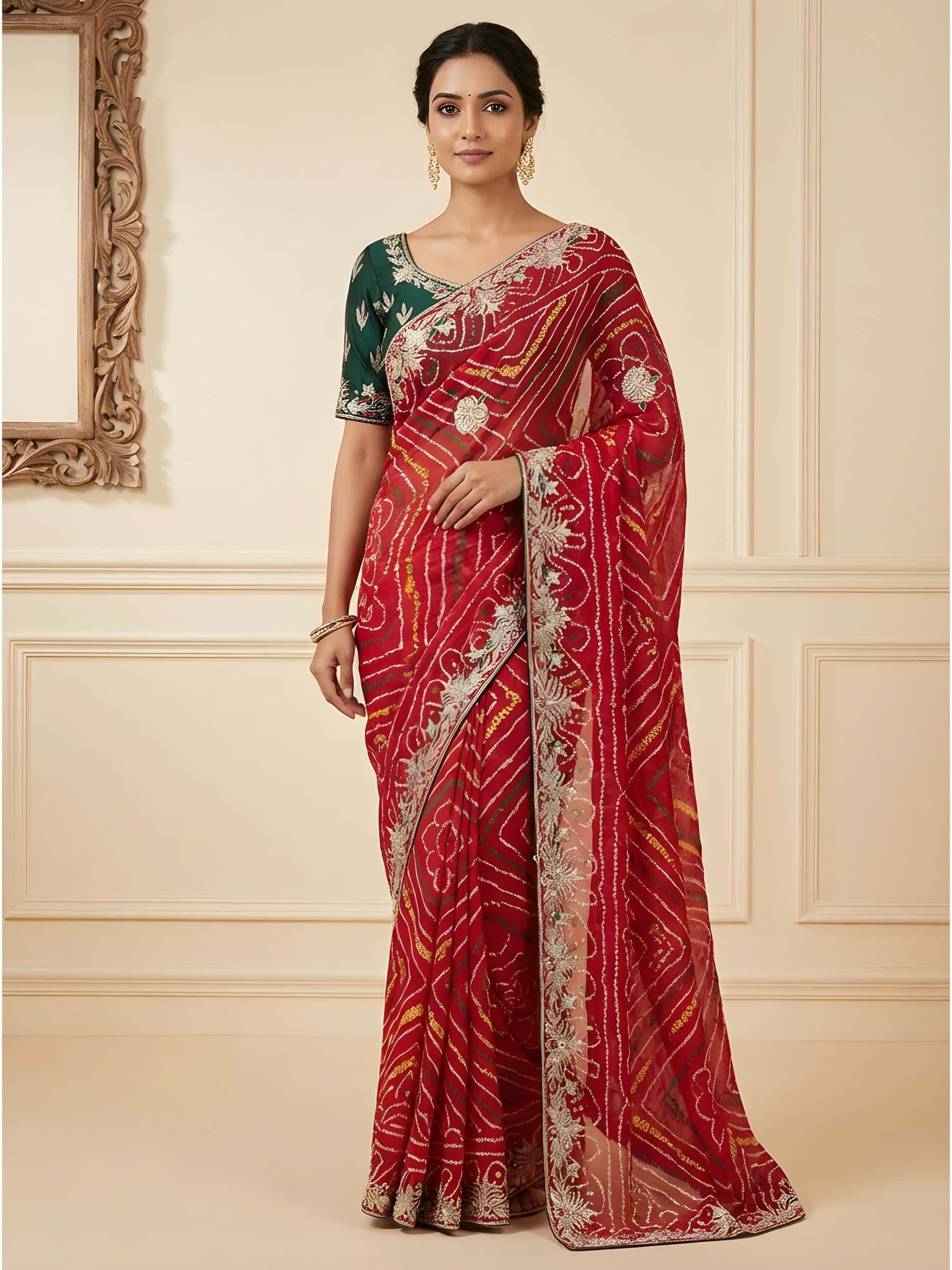
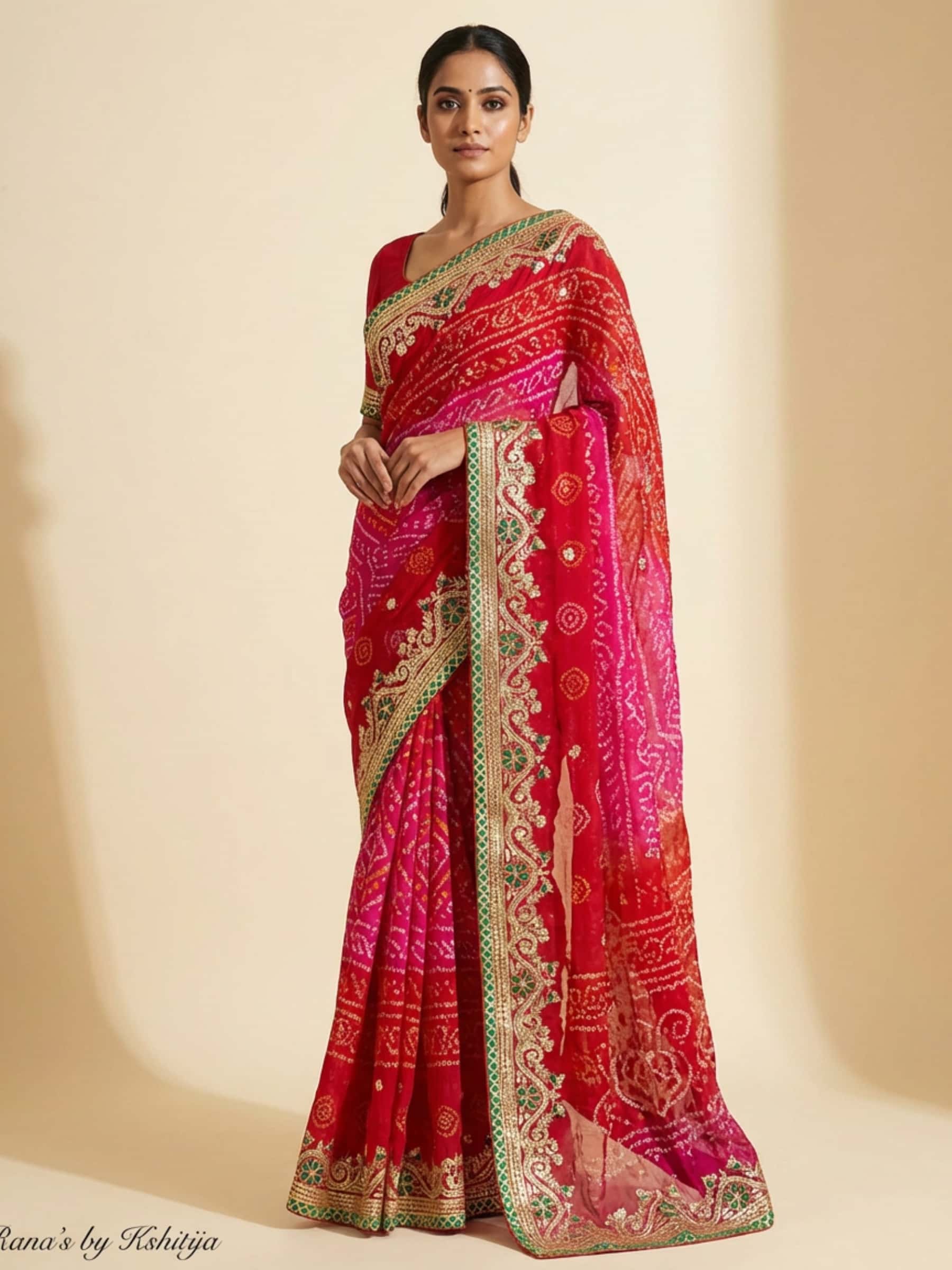
A real Bandhani saree is a mathematical artefact disguised as a textile. Before the dye touches the fabric, a master artisan in Rajasthan or Gujarat will have tied between three thousand and a hundred thousand individual knots into the cloth, by hand, each knot creating a tiny resist that the dye cannot penetrate. When the knots are untied after dyeing, the pattern emerges as a constellation of perfect dots — boond, leheriya, shikari, gharchola — each dot the negative space of a knot tied a week earlier. This is one of the oldest continuously-practised crafts in human history. The Indus Valley civilisation was making Bandhani four thousand years ago. The technique has not fundamentally changed since.
Bandhani and Bandhej are the same craft
The first thing to clarify: Bandhani and Bandhej refer to the same craft, just by different regional names. Bandhani is the term used across Gujarat and most of India; Bandhej is the Rajasthani variant of the name, used interchangeably with Bandhani in Jaipur, Jodhpur, and the broader Marwar region. Both come from the Sanskrit root bandh (to tie). When you see a saree marketed as "Bandhej" it is not a different craft from Bandhani — it is the same tie-dye tradition, often with regional pattern preferences. Our Bandhani saree collection above includes both Rajasthani Bandhej and Gujarati Bandhani styles.
How real Bandhani is made
The making is patient and unforgiving:
- Stage 1 — Cloth preparation. The undyed fabric (georgette, cotton, silk, or chiffon) is stretched flat and pre-marked with the pattern using a temporary impression — historically by pressing a perforated card dipped in fugitive ink onto the fabric.
- Stage 2 — Knot tying. The artisan uses fingernails kept long for the purpose (some artisans grow one or two nails to a length suitable for pinching the fabric) to pinch tiny circles of cloth and bind each with thread. A simple saree has 3,000–10,000 knots; a complex bridal Bandhani can have over 100,000.
- Stage 3 — Dyeing. The tied fabric is dipped in dye. The knots resist the dye, leaving white circles where the fabric was bound.
- Stage 4 — Multiple-colour dyeing. For multi-coloured Bandhani, knots are added between dye baths to protect previously-dyed sections. A panchrangi (five-coloured) Bandhani goes through five rounds of tie-and-dye in sequence.
- Stage 5 — Untying. The knots are loosened (never fully untied — the puckered texture is part of the Bandhani aesthetic) to reveal the pattern. A genuine Bandhani saree retains visible puckering across the surface.
A simple cotton Bandhani saree takes 7–14 days of artisan work. A bridal Bandhani with 100,000+ knots takes 6–12 months.
How to tell real Bandhani from a printed imitation
Most "Bandhani" sarees sold online for under ₹2,500 are not Bandhani at all. They are screen-printed georgette or polyester with the dot pattern printed flat onto the surface. Three tests:
- Look at the fabric texture. Real Bandhani has visible puckering — small, irregular bumps across the entire fabric where the knots were tied. Printed Bandhani is mathematically flat.
- Check the reverse. Real Bandhani is dyed all the way through the fabric — the pattern appears on both sides with similar clarity. Printed Bandhani is faded or absent on the reverse.
- Examine the dots up close. Hand-tied Bandhani dots are slightly irregular — varying in size, occasionally double-tied, with imperfect spacing. Printed dots are mathematically uniform.
A genuine Bandhani saree from a Jaipur or Kutch artisan starts around ₹6,000 for a simple cotton piece and goes past ₹1.5 lakh for a heavy bridal gharchola Bandhani in pure silk with Zari grid.
Pattern vocabulary
The pattern in a Bandhani saree carries meaning. Specific motifs are associated with specific occasions, communities, and regions.
- Boond — single dots arranged in geometric patterns. The base Bandhani motif.
- Leheriya in Bandhani — diagonal waves formed by tying knots in diagonal lines. (Distinct from pure Leheriya saree craft, which uses a different resist technique.)
- Shikari — hunting scenes with animal silhouettes formed in the knot pattern. Royal and ceremonial.
- Gharchola — grid-pattern Bandhani with woven Zari squares, traditionally the Gujarati bridal saree. Each square contains its own Bandhani pattern.
- Chandrokhani — moon-and-stars pattern, often associated with Marwari communities.
- Trikundi / Saakhi — three- and four-dot clusters arranged in larger geometric patterns.
For a primer on the distinction between Bandhani and the closely-related Leheriya craft, read our guide to Bandhani vs Leheriya.
Choosing the right Bandhani
The fabric base determines wear-ability and price tier:
- Pure cotton Bandhani — daytime, festive, summer. Most affordable. Easy to drape.
- Pure georgette Bandhani — our most popular choice for receptions and engagement events. Light, drapes fluidly, photographs beautifully.
- Pure silk Bandhani (Gajji silk, Banarasi silk) — bridal and ceremonial. Heavier, more formal.
- Chiffon Bandhani — light evening wear, ideal for warm-weather formal events.
Avoid synthetic-blend Bandhani. The dye penetration is poor and the puckering flattens within months.
Occasion mapping
- Bridal / wedding — Gharchola Bandhani in red or maroon silk, with woven Zari grid. The traditional Gujarati and Marwari bridal saree.
- Reception / engagement — Panchrangi (5-colour) Bandhani georgette in vivid jewel tones.
- Navratri / Teej / Gangaur — Bandhani in vibrant traditional colours — saffron, magenta, peacock green.
- Festive / Diwali — Bandhani georgette in red, magenta, or saffron with light Gota Patti border.
- Daily festive — Simple cotton Bandhani in two-colour combinations.
Care and longevity
Bandhani is sensitive to direct sunlight. Treated correctly, a Bandhani saree retains its colour and puckering for decades.
- Dry-clean only. Every Rana's Bandhani piece is dry-clean only — water and detergent flatten the puckering and can cause the dyes to bleed.
- Dry in shade between dry-cleans. If a piece needs airing between professional cleans, hang in shade only; direct sunlight fades the dyes.
- Iron on the reverse. Direct iron flattens the puckering.
- Store folded with acid-free tissue. Avoid plastic bags — Bandhani needs to breathe.
What to look for when buying
- Is the puckering visible across the entire fabric (real) or only at borders (suspicious)?
- Does the pattern appear on both sides of the fabric (real) or only one side (printed)?
- What is the fabric composition? Pure cotton, pure silk, pure georgette — not "Bandhani-style fabric."
- Where was it tied? (Kutch, Jodhpur, Sikar, Jaipur — or vague?)
- How many knots? (A real artisan will know the approximate count.)
Every Bandhani saree at Rana's is artisan-attributed, fabric-disclosed, and tied in either Rajasthan or Kutch by known workshops. Read the full Bandhani and Bandhej tie-dye guide for deeper craft history, or meet the Bandhani artisans of Jaipur.
Browse adjacent crafts: our pure Leheriya sarees are the closest sister craft to Bandhani; the Gota Patti sarees often use Bandhani as a base fabric with Gota borders; and the Heritage Bridal Collection includes traditional Gharchola bridal Bandhani sarees.