
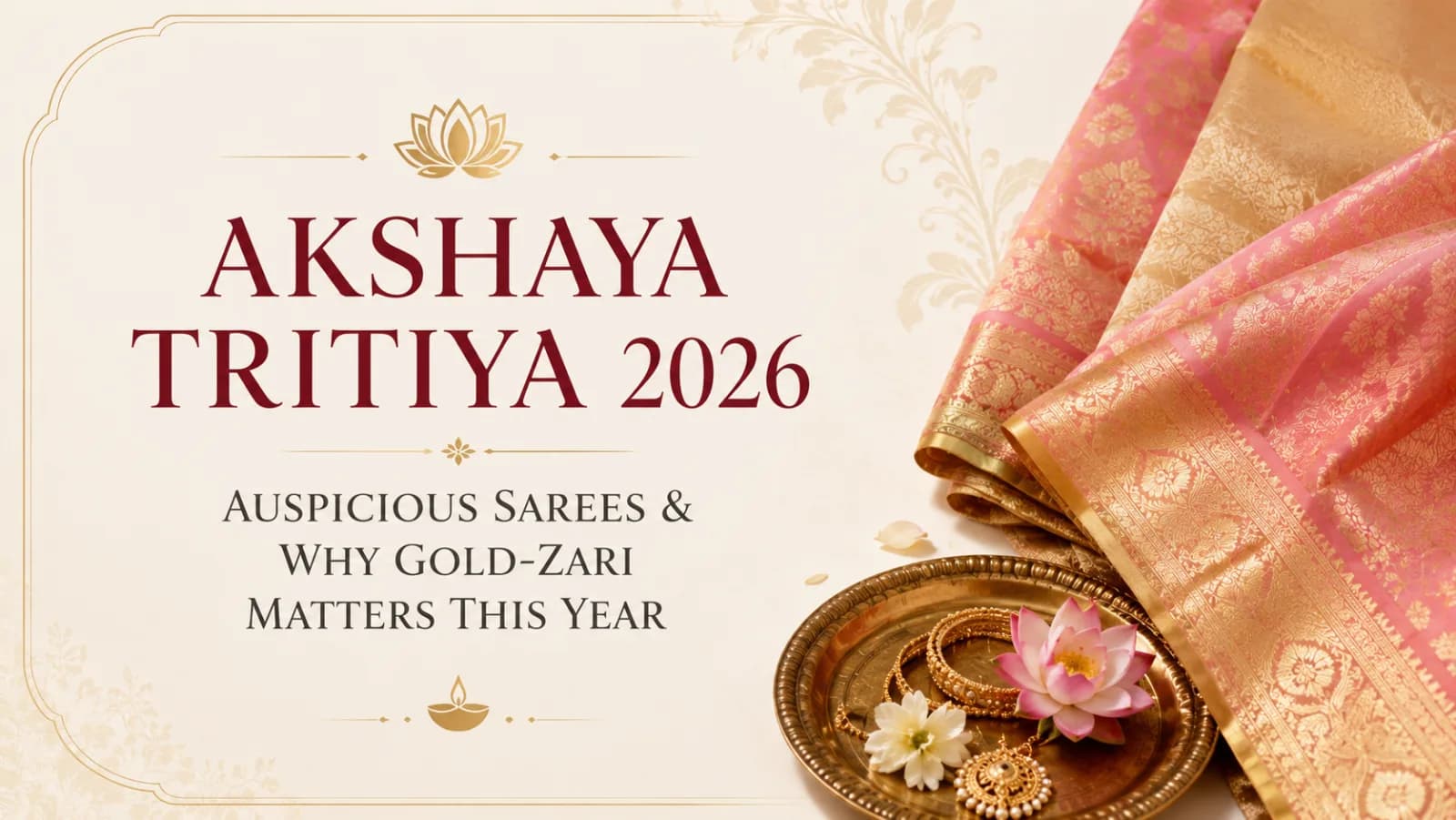
Akshaya Tritiya 2026: Auspicious Sarees & Why Gold-Zari Matters This Year
A complete saree guide for Akshaya Tritiya 2026 — the auspicious colours, why gold-Zari is traditionally chosen, and six saree recommendations for the most sacred shopping day of the Indian calendar.
Kshitija Rana
Editor
Akshaya Tritiya — falling on Sunday, May 10 in 2026 — is one of the most sacred days in the Hindu and Jain calendar. The word "Akshaya" means eternal, imperishable, undying. Any purchase, investment, or new beginning made on this day is believed to bring permanent good fortune to the household. For centuries, Indian families have marked Akshaya Tritiya by buying gold, silver, sarees, and property — each item carrying both its intrinsic value and the spiritual weight of the day itself. This guide covers the auspicious saree choices for Akshaya Tritiya 2026, why gold-Zari sarees hold particular significance, and six specific recommendations.
Why Akshaya Tritiya Matters
Akshaya Tritiya falls on the third lunar day of the Shukla Paksha (bright half) of Vaishakha — typically in late April or early May. The day commemorates several significant events in Hindu tradition: the birth of Parshuram, the sixth avatar of Vishnu; the descent of the Ganga from the heavens; and the start of the Tretayuga. For Jains, it is the day Lord Adinath ended his year-long fast.
The spiritual principle behind the day is simple: any positive action taken on Akshaya Tritiya — a purchase, an investment, a charitable donation, the start of a new business or relationship — carries forward with undiminished force. The energy of the day is believed to make every action's effect permanent.
This is why Indian families have traditionally treated Akshaya Tritiya as the single most important shopping day of the year. Gold jewellers do record business. Property registrations spike. And sarees — particularly heritage silk sarees with gold Zari — are purchased with the intention that their auspicious energy will accompany the wearer for decades.
Why Gold Zari Matters This Year
Gold Zari — the thin gold-wrapped thread woven into silk sarees — is symbolically connected to Lakshmi, the goddess of wealth. A saree woven with authentic gold Zari is believed to carry the goddess's presence in its very threads.
In 2026, gold prices have reached new highs. Authentic gold Zari sarees have become even more significant as luxury heritage purchases — they are not just beautiful objects but also stores of value. For families who have delayed purchasing a heritage silk saree, Akshaya Tritiya 2026 is considered a particularly meaningful time to commit.
Three things define authentic gold Zari:
- Real gold content. Traditional Zari thread contained 2–3 percent real gold. Modern "pure Zari" is typically silver thread with a gold wash; "tested Zari" uses copper with gold plating.
- Hand-wound thread. Authentic Zari is wound around a silk or cotton core thread by hand.
- Woven, not embroidered. Zari in Kanjivaram, Banarasi, and Paithani is woven directly into the fabric during the loom process — not embroidered on afterwards.
A Kanjivaram or Banarasi silk saree with authentic gold Zari is the most traditional Akshaya Tritiya purchase. Pricing reflects the gold content — expect ₹30,000 for a mid-range piece, ₹80,000 for a fine handwoven Zari saree, and ₹2 lakh or more for a pure Zari Banarasi with heavy Jaal work.
Six Auspicious Saree Recommendations for Akshaya Tritiya 2026
1. Red Kanjivaram Silk with Traditional Gold Zari Border
The classical Akshaya Tritiya saree. Rich red silk, heavy gold Zari border, traditional temple-motif pallu. This is the saree your grandmother would have bought and the one you could pass to your granddaughter. Appropriate for festivals, family weddings, and significant religious occasions.
2. Maroon Banarasi Silk with Gold Zari Jaal
A maroon Banarasi with an all-over Zari Jaal (net) pattern is dramatic, substantial, and carries the full cultural weight of the Banarasi weaving tradition. Particularly auspicious for married women because maroon is associated with Sumangali (the state of being a married woman in good standing).
3. Yellow Kanjivaram Silk with Gold Border
Yellow is the colour of Vishnu, of auspicious beginnings, and of spiritual knowledge. A yellow Kanjivaram with gold Zari is particularly appropriate for Akshaya Tritiya and for festivals like Vasant Panchami and Janmashtami. It photographs magnificently in temple light.
4. Green Silk Saree with Gold Zari and Gota Patti
Green symbolises growth, fertility, and renewal. A green silk saree — Kanjivaram, Banarasi, or handwoven Rajasthani silk — with gold Zari and additional Gota Patti handwork is an excellent Akshaya Tritiya choice for new brides and expecting mothers. Particularly auspicious if you are planning major life transitions.
5. Pink Silk Saree with Heavy Gold Zari Work
Rani pink (deep pink) with heavy gold Zari is the traditional Rajasthani auspicious-day saree. The colour is associated with Parvati and marital prosperity. Ideal for women marking their first Akshaya Tritiya after marriage or planning a first child.
6. Ivory Silk Saree with Gold Zari
For a more modern interpretation of the tradition, an ivory or cream silk saree with heavy gold Zari is elegant, contemporary, and still ceremonially appropriate. (Note: avoid pure white — ivory and cream are ritually distinct and acceptable.) Particularly fitting for women who want a saree that crosses easily between religious and modern-formal wear.
What to Pair with Your Akshaya Tritiya Saree
The saree is the primary purchase — jewellery should support rather than compete.
- Gold jewellery is the natural pairing. Traditional temple jewellery (South Indian gold sets in classical motifs) is particularly appropriate. A single substantial piece — either a necklace set or statement earrings with a mangalsutra — reads as auspicious without excess.
- Silver is acceptable for daytime religious observances and for families whose tradition prefers silver over gold.
- Avoid costume jewellery on Akshaya Tritiya. The day honours permanence — choose pieces with real metal content.
Shopping Guidelines for Akshaya Tritiya
- Shop in the morning muhurat. Most traditional families consider the morning hours of Akshaya Tritiya the most auspicious for major purchases.
- Prefer handwoven over machine-made. Handwoven sarees carry greater spiritual significance and support the artisan tradition.
- Authenticate the Zari. Ask for thread composition disclosure and, where available, fabric certification.
- Buy with intention. Many families choose an Akshaya Tritiya saree specifically for a future event — a child's wedding, a milestone anniversary, or a religious ceremony. Buying with a clear intended use strengthens the association.
Shop Auspicious Sarees at Rana's
Browse our designer handmade saree collection for Kanjivaram silk, Banarasi silk, and heritage Rajasthani silk sarees with authentic gold Zari work. For the 2026 Akshaya Tritiya window, we have curated a special selection of handwoven pieces in the auspicious colour palette.
If you are planning a major saree purchase for Akshaya Tritiya and unsure which piece will carry forward across occasions, book a consultation — we will help you choose a saree that is both culturally appropriate for the day and practical for the life it will have afterwards. For longer-horizon wardrobe planning, see our complete bridal trousseau checklist 2026, and read the Gota Patti craft guide and Zardozi embroidery guide to understand the heritage handwork on Akshaya Tritiya sarees.
Akshaya Tritiya is the rare Indian tradition where shopping and spirituality fully align. Choose a saree that honours both.