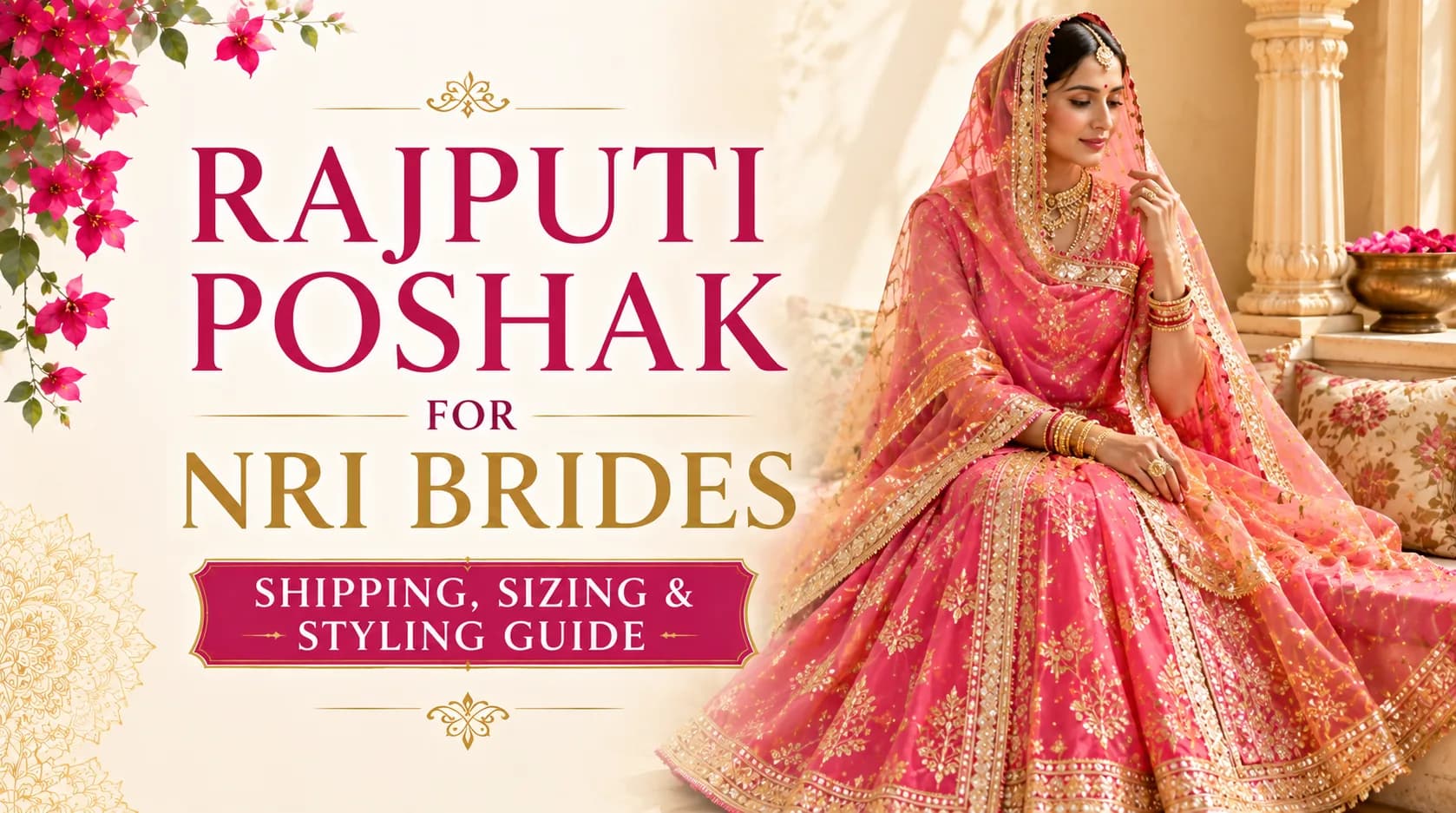
Rajputi Poshak for NRI Brides: Shipping, Sizing & Styling Guide
A practical guide for NRI brides commissioning a Rajputi poshak from India — remote consultations, detailed sizing, international shipping, customs handling, climate considerations, and fitting logistics.
Kshitija Rana
Editor
Every year, Rana's ships custom Rajputi poshaks to brides in New York, London, Toronto, Sydney, Dubai, and Singapore. NRI brides — whether Indian-born and living abroad, or second-generation Indian daughters — are a significant and growing part of the Rajputi poshak market. But commissioning an 8–12 kilogram handcrafted ceremonial outfit from 7,000 miles away is a genuinely complicated logistical project. This guide walks through the full process — from first consultation to final fitting — so NRI brides can plan their poshak with confidence. If you are new to the Rajputi poshak itself, start with the complete buying guide; for function-by-function styling, see the wedding buyer's guide by occasion.
Start 8–10 Months Before the Wedding
The single most important rule for NRI brides: start early.
A fully custom Rajputi poshak takes 10–16 weeks of production. Add 2 weeks for international shipping. Add 2–3 weeks for a first fitting round and feedback. Add another 2–3 weeks for corrections. Add another week for final shipping. Add 1–2 weeks of buffer for customs delays.
Total: 22–30 weeks from order confirmation to wedding-ready poshak. That is 5–7 months of process. Beginning 8–10 months before the wedding gives you comfort on both sides.
Rush orders are possible but always compromise something — either handwork density (cutting artisan hours), shipping speed (doubling costs), or fitting rigour (single-iteration fitting with risk). Reputable ateliers will decline rush orders on wedding-day poshaks for this reason.
Step 1: Initial Consultation
Most ateliers offer video consultations over WhatsApp, Zoom, or Google Meet. A good initial consultation lasts 45–90 minutes and covers:
- Wedding details — date, venue, function list, climate, dress code.
- Inspiration discussion — the bride shares reference images and the designer shares existing work.
- Fabric and embellishment preferences — silk vs velvet, heavy Gota Patti vs Zardozi, colour palette.
- Budget range — honest conversation about what the bride's budget can actually deliver.
- Timeline mapping — working backwards from the wedding date to ensure feasibility.
- Process walkthrough — the atelier explains their specific measurement, fitting, and shipping workflow.
Take notes. Record the call if both parties consent. The clearer the initial alignment, the smoother the subsequent process.
For a preview of what traditional and modern poshak options look like, read our Rajputi poshak buyer's guide by occasion and our modern Rajputi poshak styling guide.
Step 2: Measurement Kit
The atelier ships a measurement kit to the bride's address. The kit typically includes:
- A measurement tape (soft tailor's tape, marked in centimetres and inches).
- A printed or digital measurement form.
- A video measurement guide specific to poshak sizing.
- A muslin ribbon for torso length marking.
- Sometimes a test-fit blouse for upper-body verification.
The bride takes measurements at home, ideally with help from a family member. Key measurements include:
- Full bust at fullest point
- Under-bust for blouse fitting
- Natural waist
- Hip at fullest point
- Shoulder to shoulder across the back
- Shoulder to waist (torso length)
- Waist to floor (ghagra length)
- Arm length shoulder to wrist
- Sleeve circumference at upper arm
- Neck circumference
- Back width and neck depth
For critical pieces, many ateliers also request:
- A full-length video of the bride walking and turning, for silhouette reference.
- Photos of the bride in well-fitting existing clothes.
- Measurements of an existing blouse that fits well (as a cross-check).
Measurements are returned to the atelier via email or WhatsApp. The atelier reviews, flags any unusual measurements, and requests remeasurement if anything looks off.
Step 3: Muslin Mockup for Wedding-Day Poshak
For wedding-day poshaks, most ateliers create a muslin (unbleached cotton) mockup of the kanchli and ghagra. Photographs are shared with the bride. For further verification, the muslin can be shipped to the bride for a physical fit check before embroidery begins. This step adds 1–2 weeks but significantly reduces the risk of final-garment fit issues.
Some brides skip the muslin step for non-wedding-day pieces (engagement, reception) to save time and cost — the risk is lower because these pieces are less structurally complex.
Step 4: Production and Progress Photography
Production of the actual garment takes 10–16 weeks. Reputable ateliers share progress photography at key milestones:
- Fabric cutting complete
- Base embroidery pattern drawn
- 50 percent embroidery complete
- Full embroidery complete
- Final stitching complete
- Ready for shipping
The progress photos allow the bride to catch issues early and build confidence that her investment is proceeding on schedule. Ask explicitly for this in your initial consultation.
Step 5: International Shipping
Shipping options typically include:
- Express courier (DHL, FedEx) — 3–5 business days, ₹15,000–₹25,000 for a poshak, full insurance available.
- Economy courier (DHL Economy, local post) — 10–15 business days, ₹8,000–₹15,000.
- Specialised Indian textile couriers — varies, sometimes offer better customs handling.
Declared value matters — declaring lower to reduce customs means lower insurance coverage if the shipment is lost. Most brides declare full value and budget for customs duties.
Customs duties are paid on receipt:
- US — typically 5–10 percent of declared value
- UK — 12 percent VAT plus sometimes additional import duty
- Canada — 5–12 percent depending on province
- UAE — typically 5 percent
- Singapore — 7 percent GST
- Australia — 10 percent GST
The atelier should provide a commercial invoice and certificate of origin. Indian textile exports benefit from specific trade agreements with some countries — ask about HSN codes for your destination.
Step 6: Fit Check and Local Alterations
Within 2 weeks of delivery, do a full fit check:
- Try on the complete poshak with appropriate undergarments.
- Have someone photograph you from all angles.
- Share photos with the atelier via video call for remote fit assessment.
- Identify any adjustments needed.
Minor adjustments (hem length, ghagra gathers, blouse side seam) can be done by a local Indian-origin tailor in your city. Most cities with Indian communities have tailors who understand Indian ceremonial dress; ask your Indian friends for recommendations or check local Indian community groups on Facebook.
Major adjustments — structural fit issues, embroidery misalignment — would require the poshak to be shipped back to India, which is rare if the initial process is rigorous.
Climate Considerations for NRI Destinations
Cold climates (UK, Canada, northern US, Scandinavia):
- Consider velvet or heavy silk ghagra.
- Full-sleeve kanchli with covered neck.
- Silk-lined odhni for warmth.
- Plan for outdoor transitions — a warm overshawl or coat between venue and photography locations.
Hot climates (Dubai, Singapore, Sydney summer):
- Lighter Georgette or Chanderi ghagra.
- Sleeveless or cap-sleeve kanchli.
- Single-layer odhni in Organza.
- Heavy embroidery concentrated on pallu rather than full garment.
Monsoon climates (UK autumn, Singapore, Mumbai summer):
- Waterproof transit case for the poshak.
- Fabric care kit with silica packets.
- Backup blouse in case of sweat or rain.
Budget Expectations for NRI Poshaks
Fully custom Rajputi poshaks for NRI brides typically cost:
| Tier | Price Range (INR) | Price Range (USD) |
|---|---|---|
| Engagement / reception | ₹80,000 – ₹2,00,000 | $960 – $2,400 |
| Mayra / mid-weight | ₹1,50,000 – ₹3,50,000 | $1,800 – $4,200 |
| Wedding day | ₹2,50,000 – ₹6,00,000+ | $3,000 – $7,200+ |
Add international shipping (₹8,000–₹25,000) and destination customs (varies).
For a full-function NRI bridal wardrobe (engagement, wedding day, reception), budget ₹5–10 lakh ($6,000–$12,000). This is comparable to or less than what NRI brides typically pay for lehengas at US or UK Indian bridal boutiques — with the difference that the craft comes from source rather than through middlemen. For a piece-by-piece breakdown of what drives poshak pricing across fabric, embroidery density, and artisan hours, see our Rajputi poshak price guide.
Shop Rajputi Poshak for NRI Brides at Rana's
Browse our Rajputi poshak collection for ready-to-customise options, and book an NRI consultation to begin the custom process. We have shipped custom poshaks to 15+ countries and have specific protocols for each destination's customs and shipping requirements.
NRI brides deserve a poshak that honours both their Indian heritage and their current reality. The logistics are manageable with the right atelier. Start early, communicate clearly, and the result is a poshak that travels home with you — and then travels with you, across every wedding and family celebration, for the rest of your life.