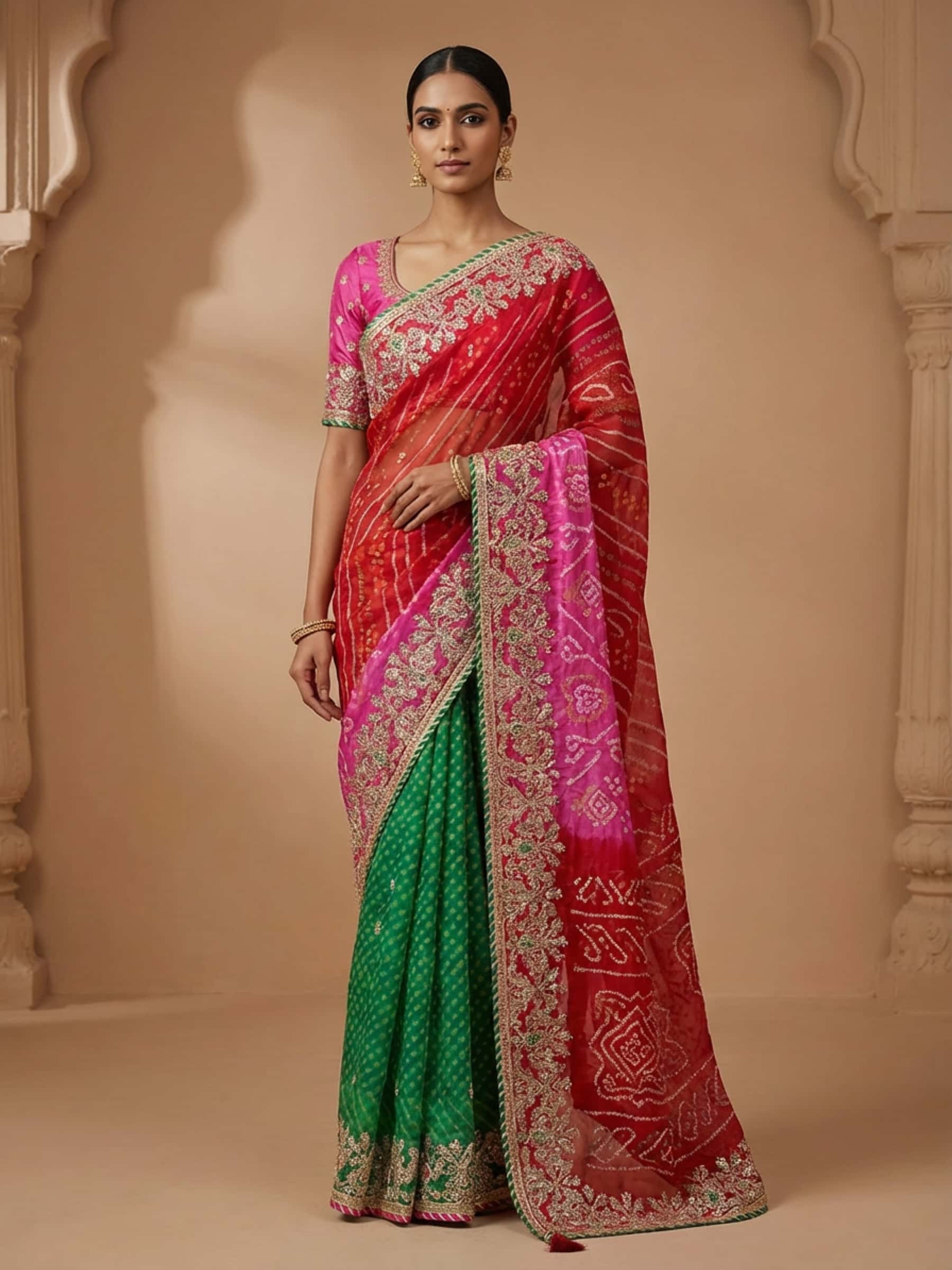
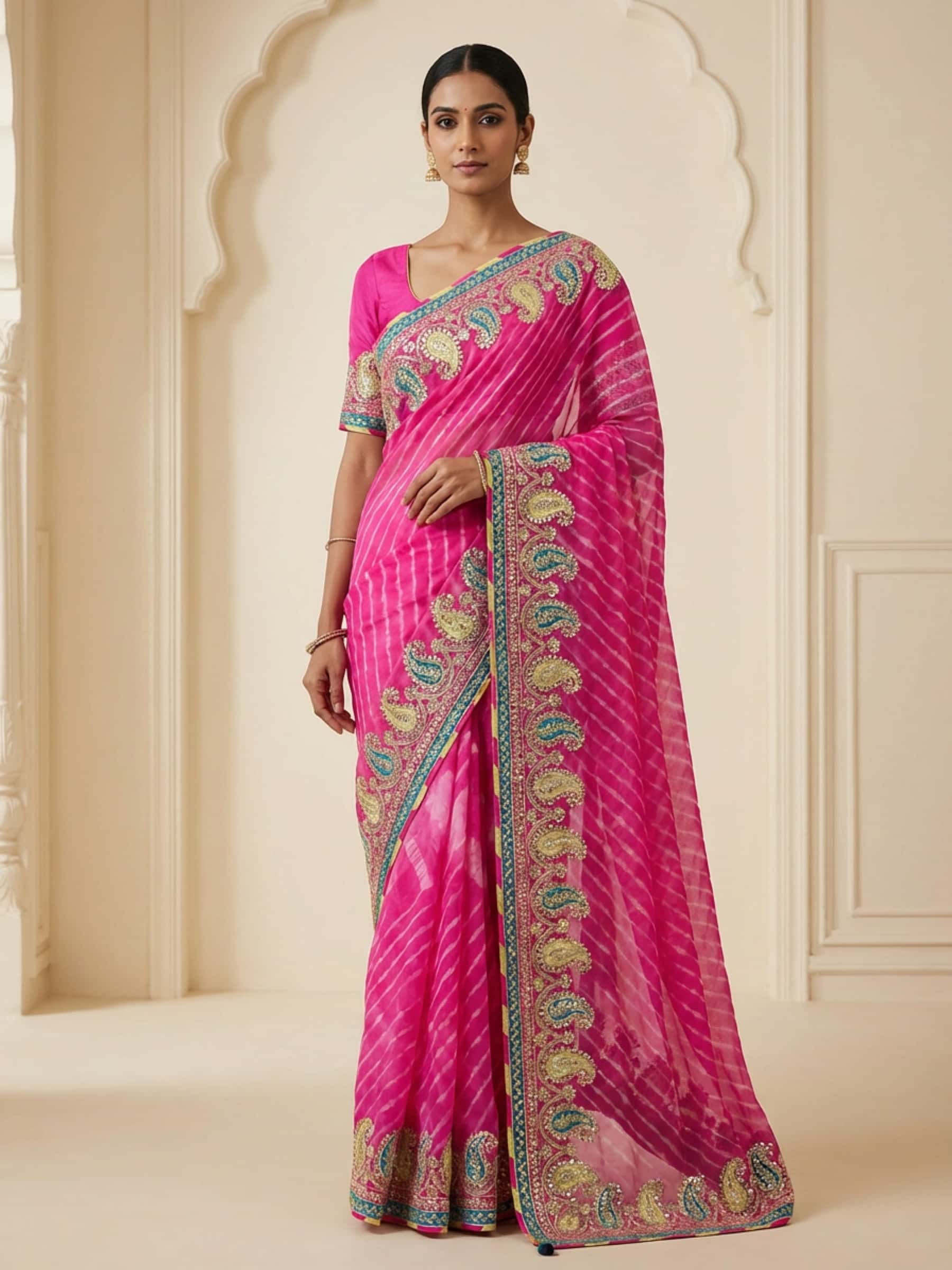
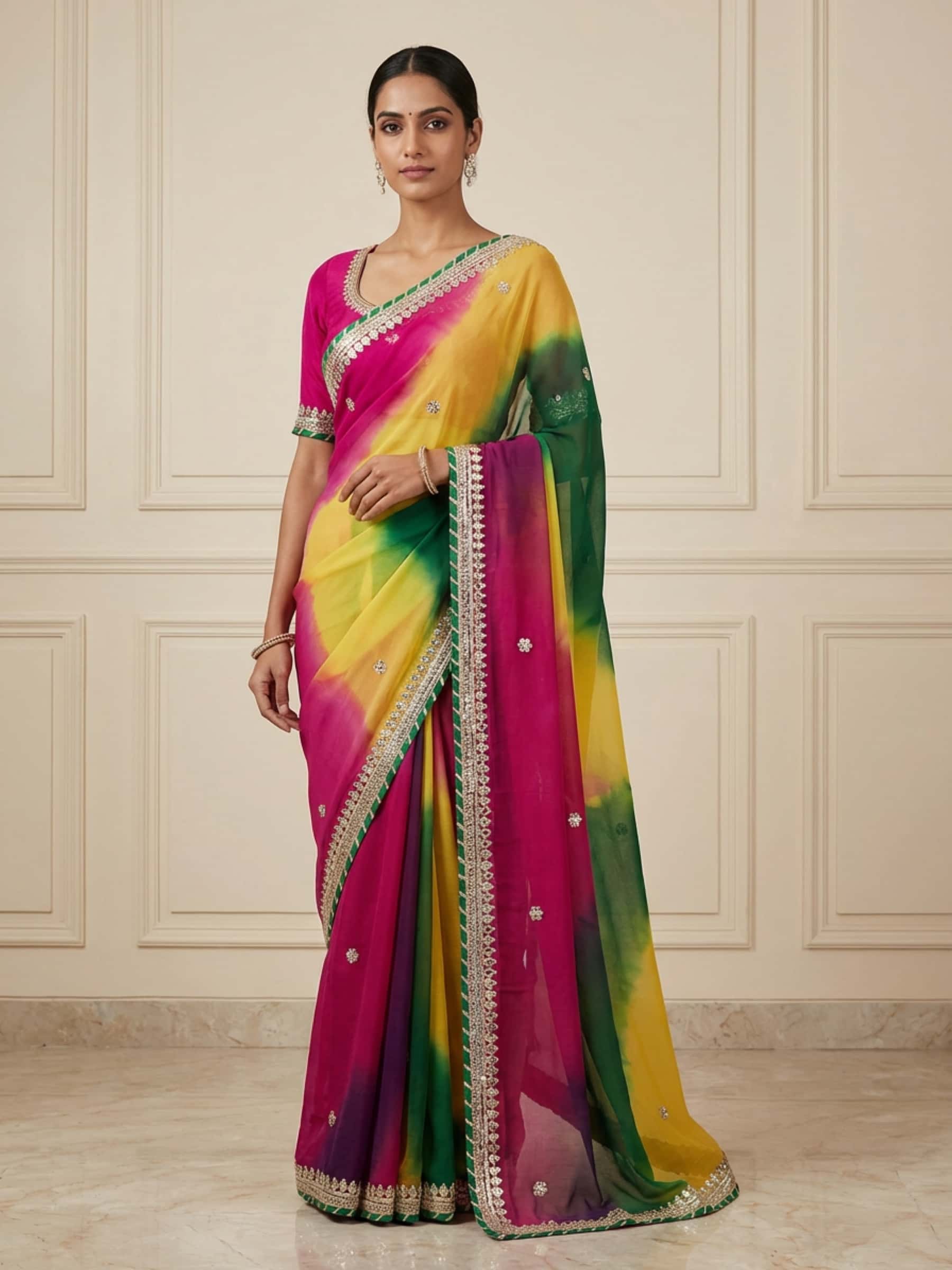
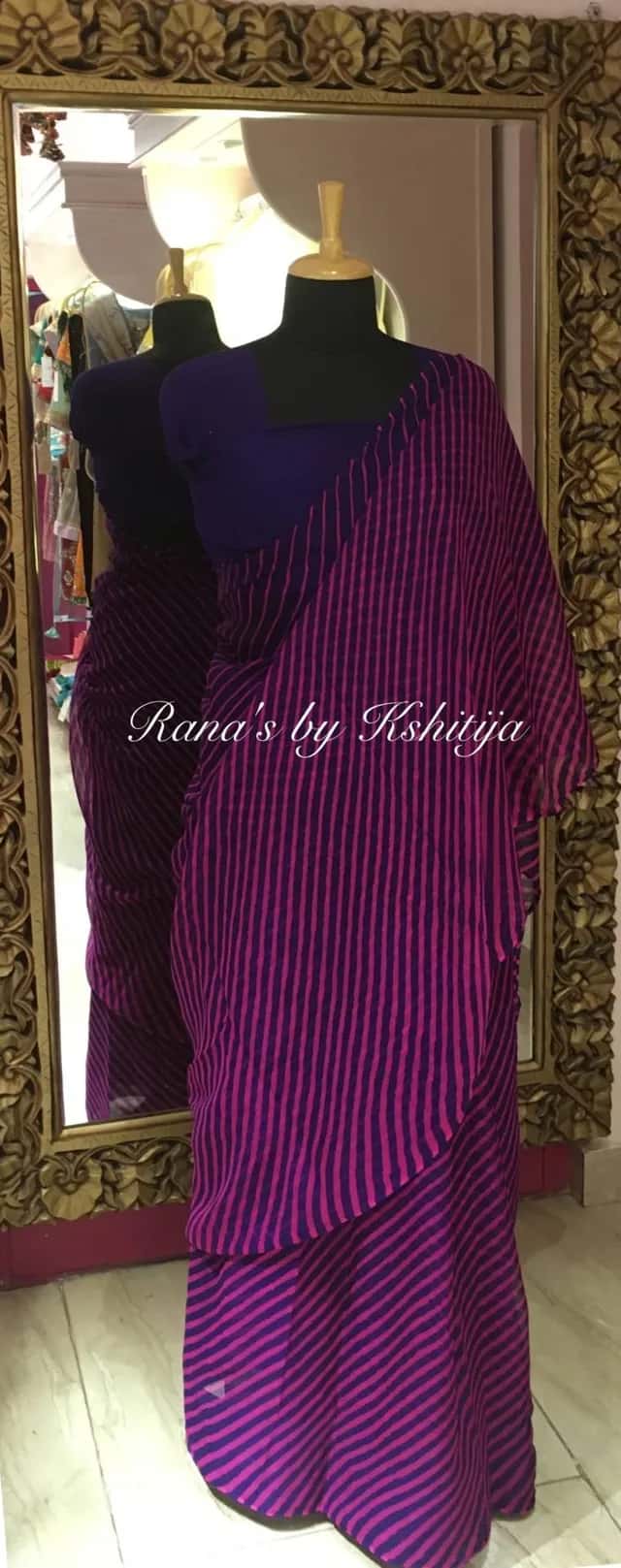
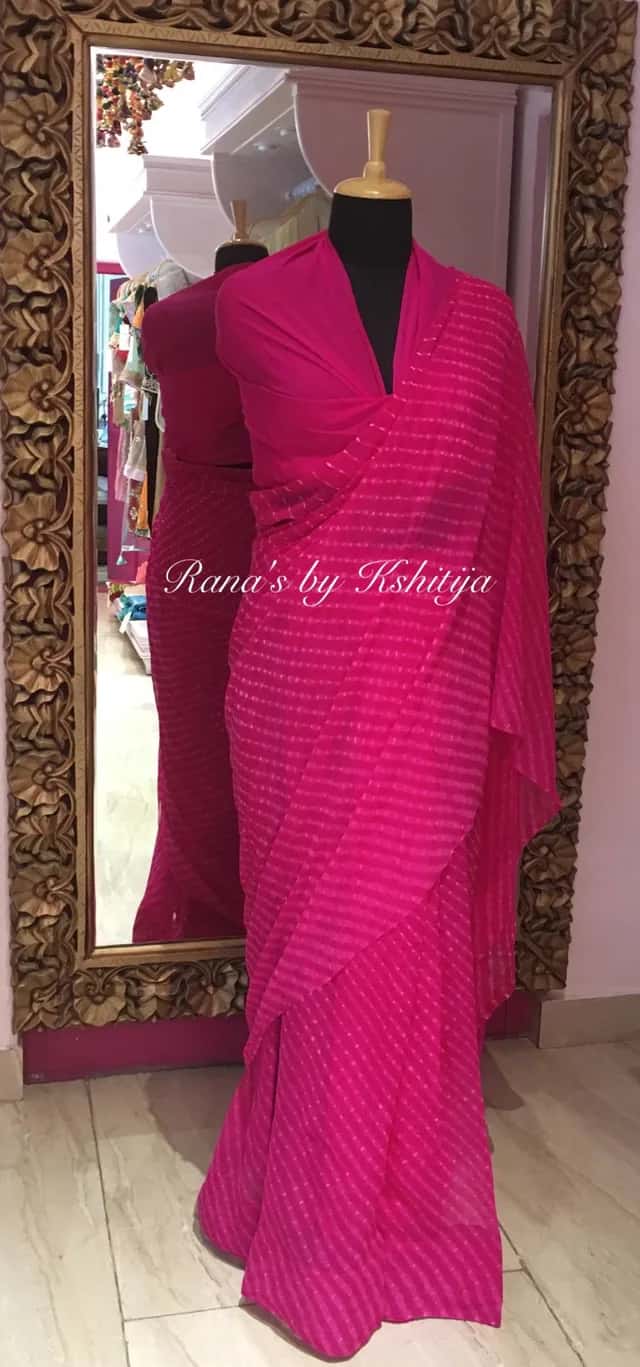
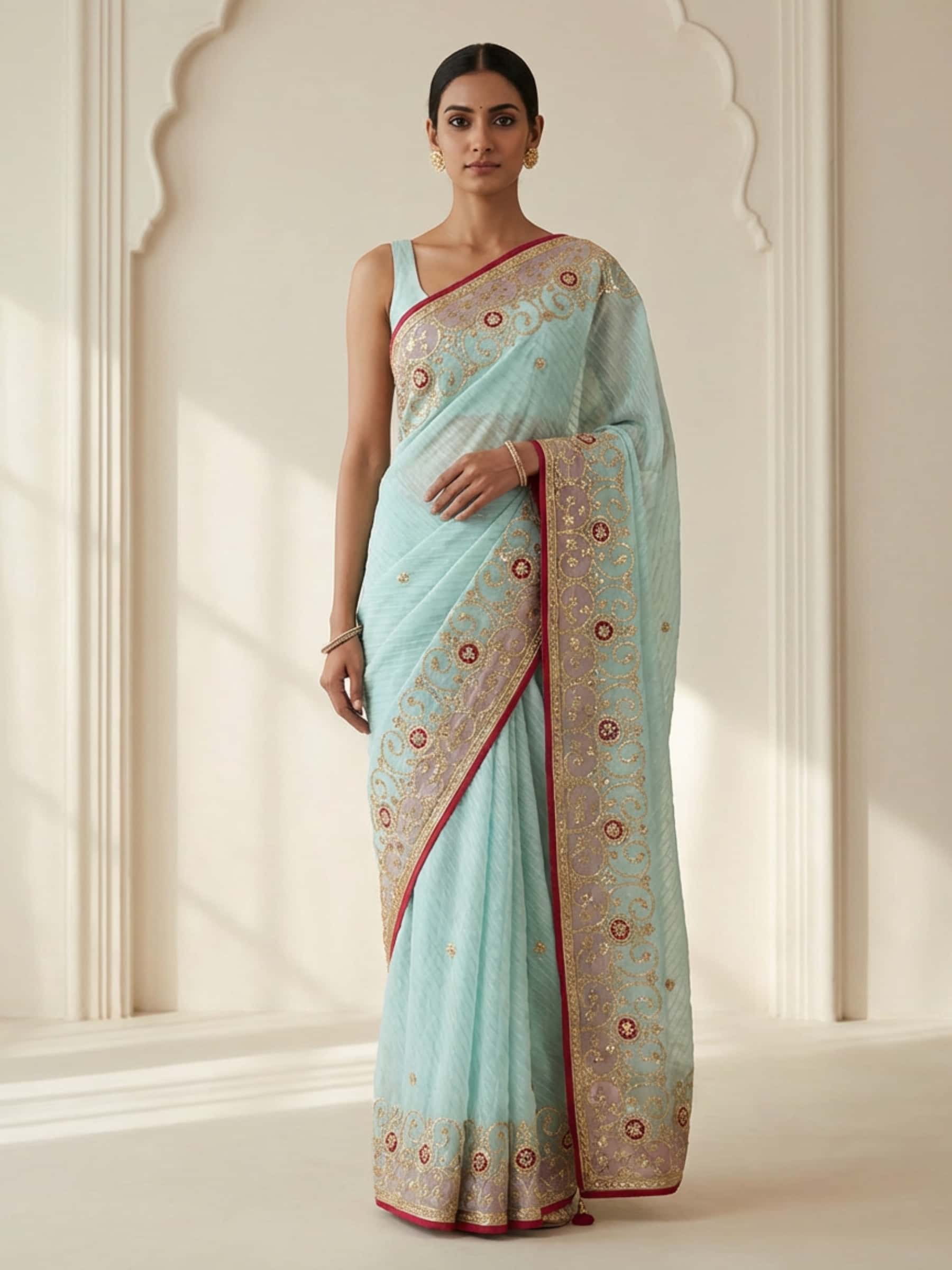
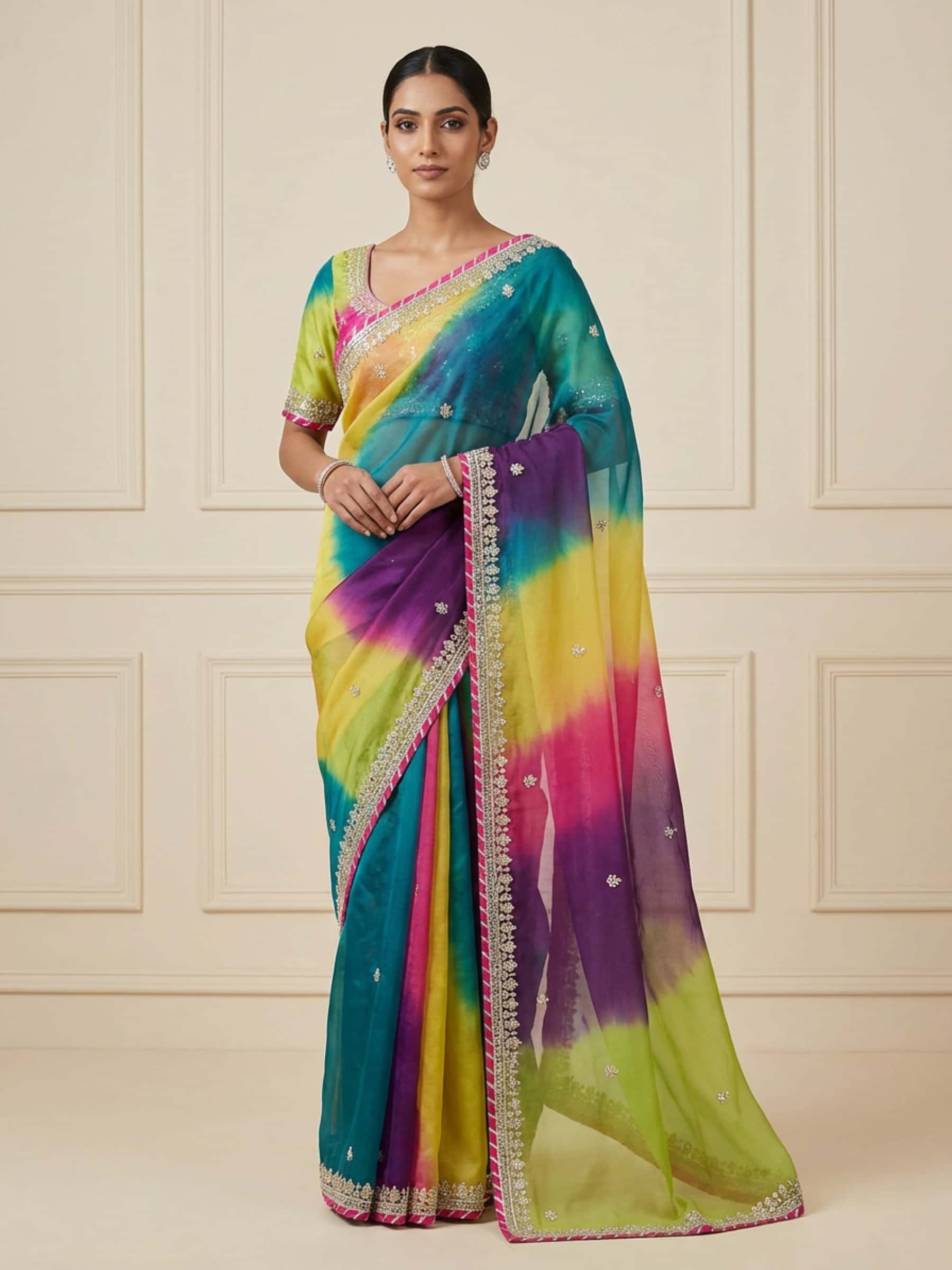
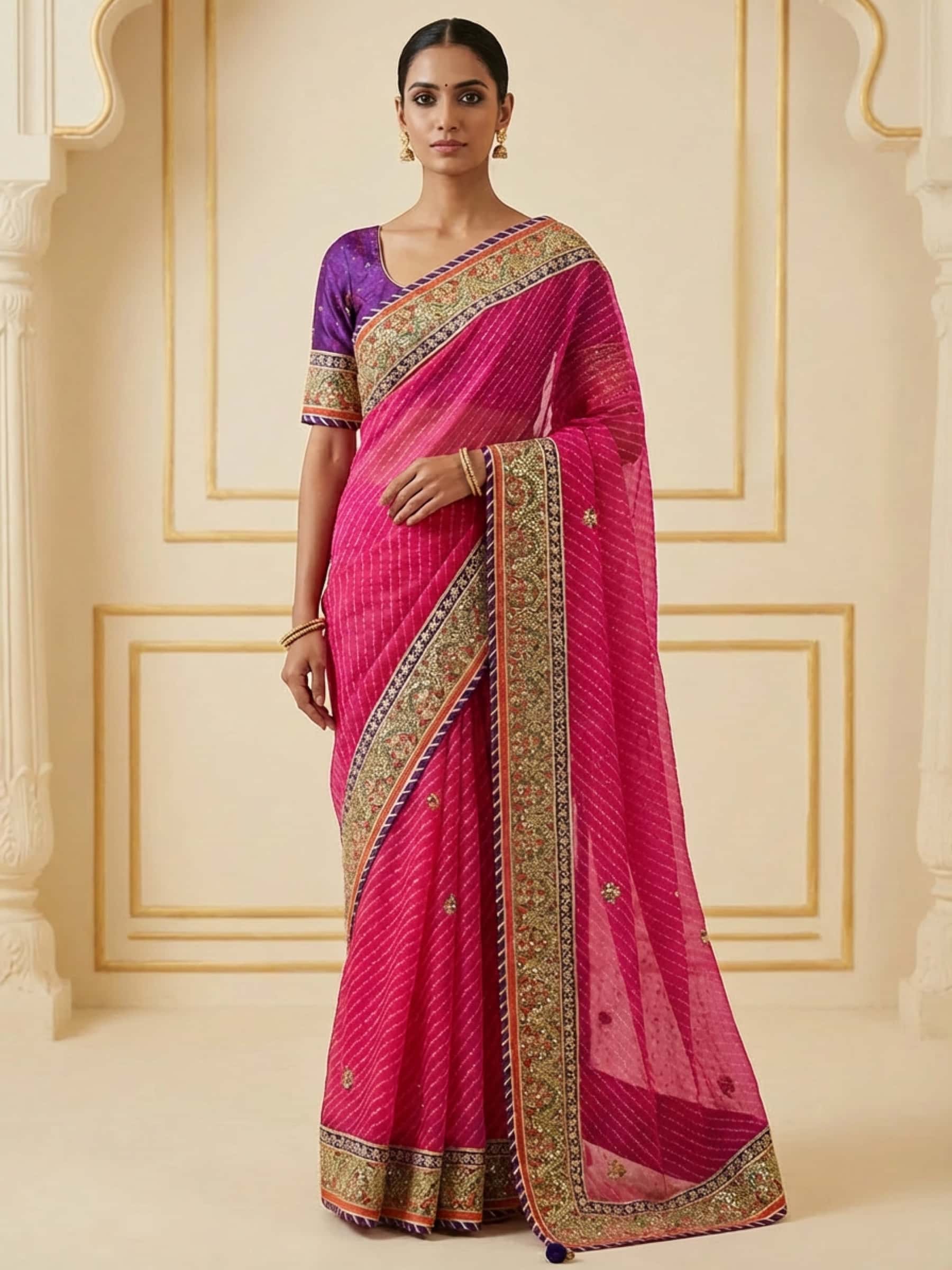
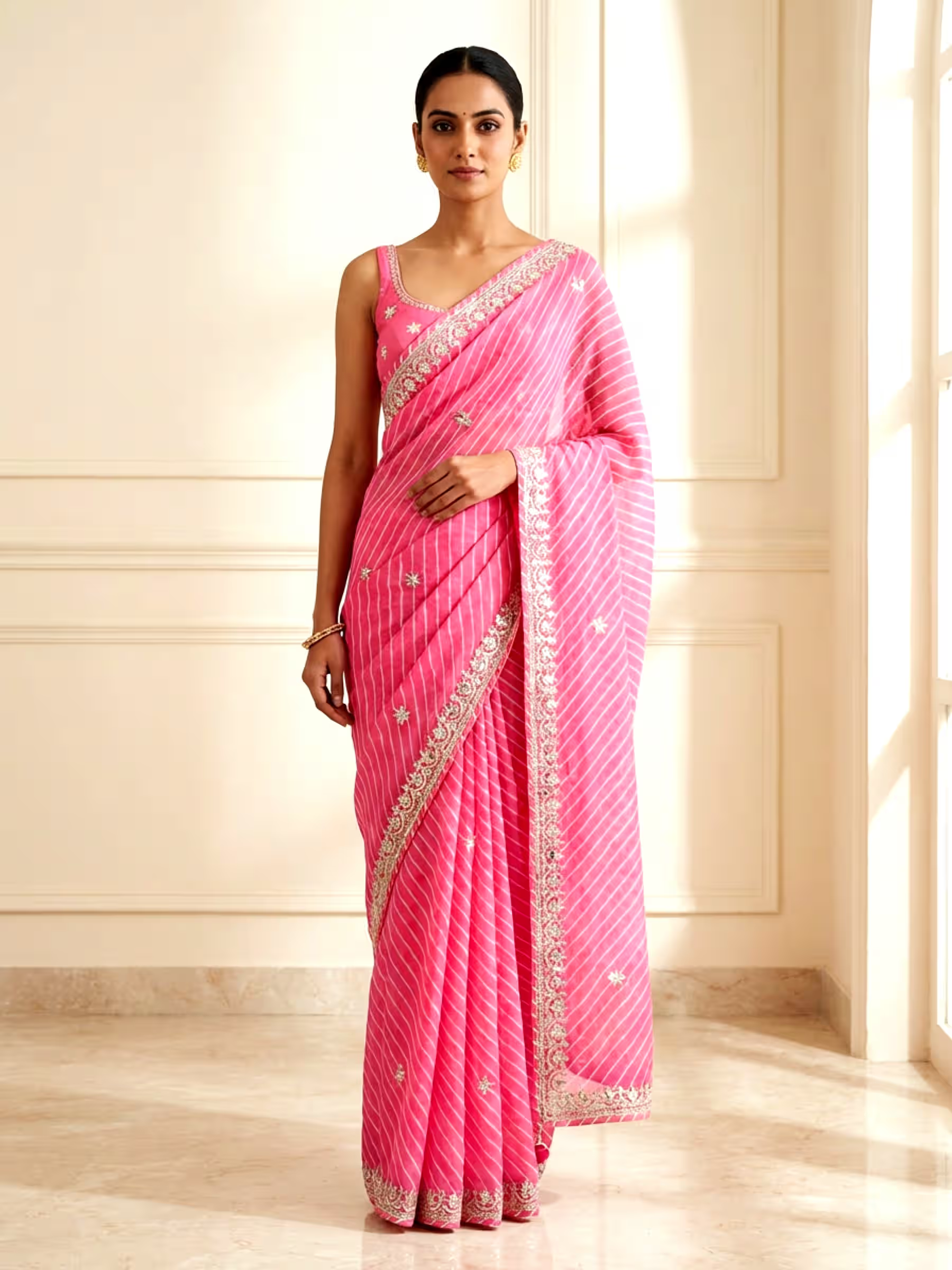
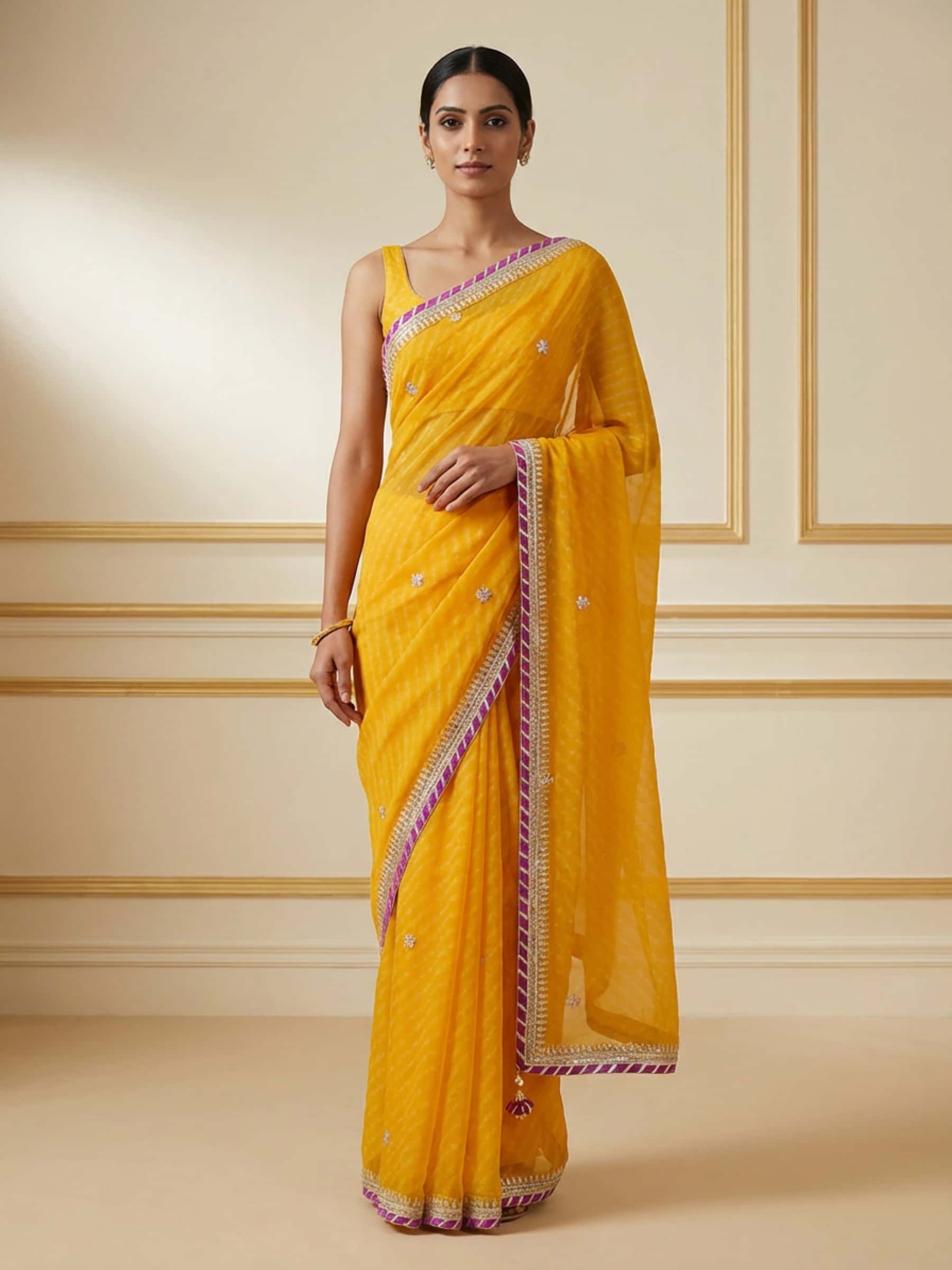
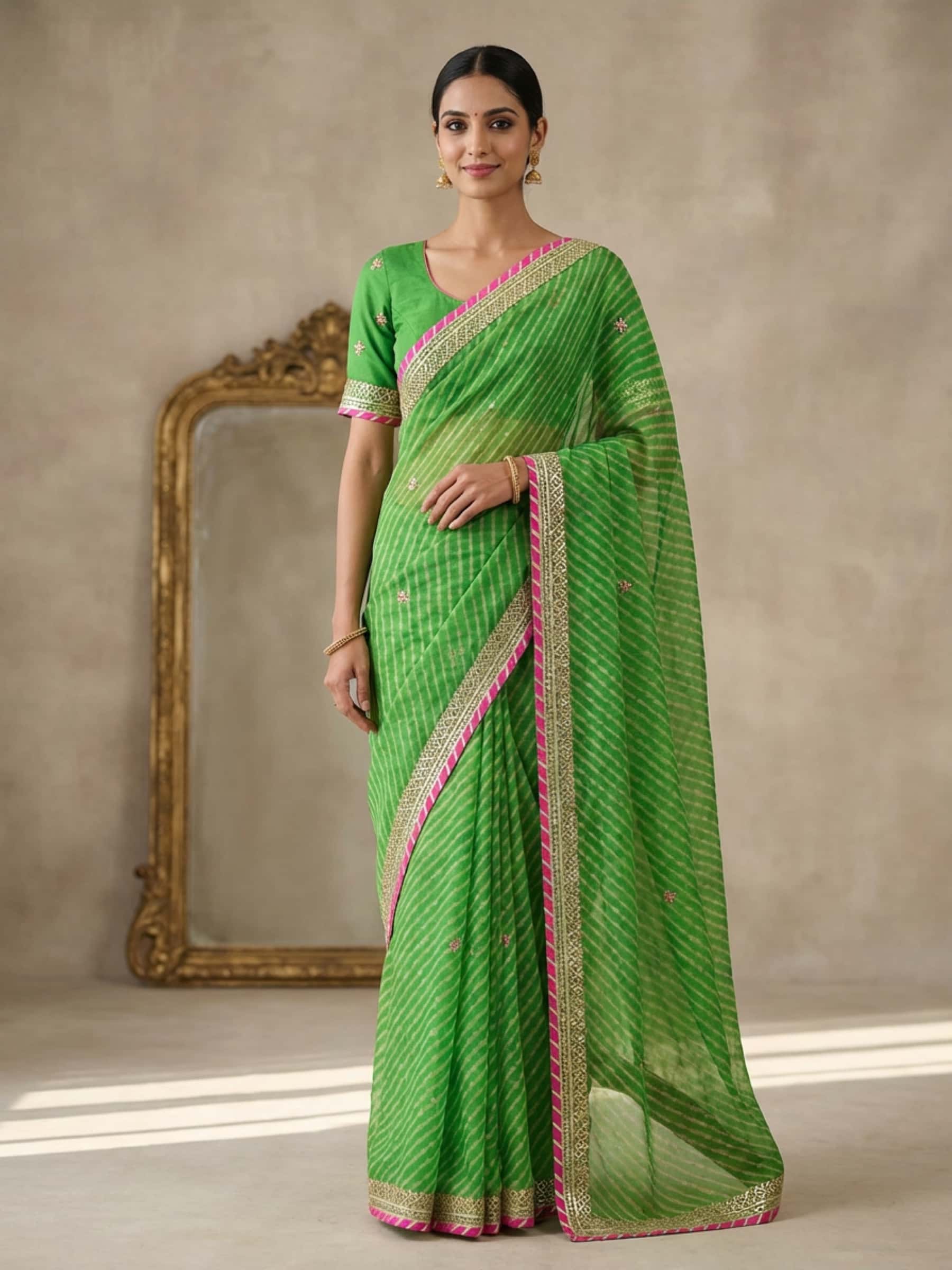
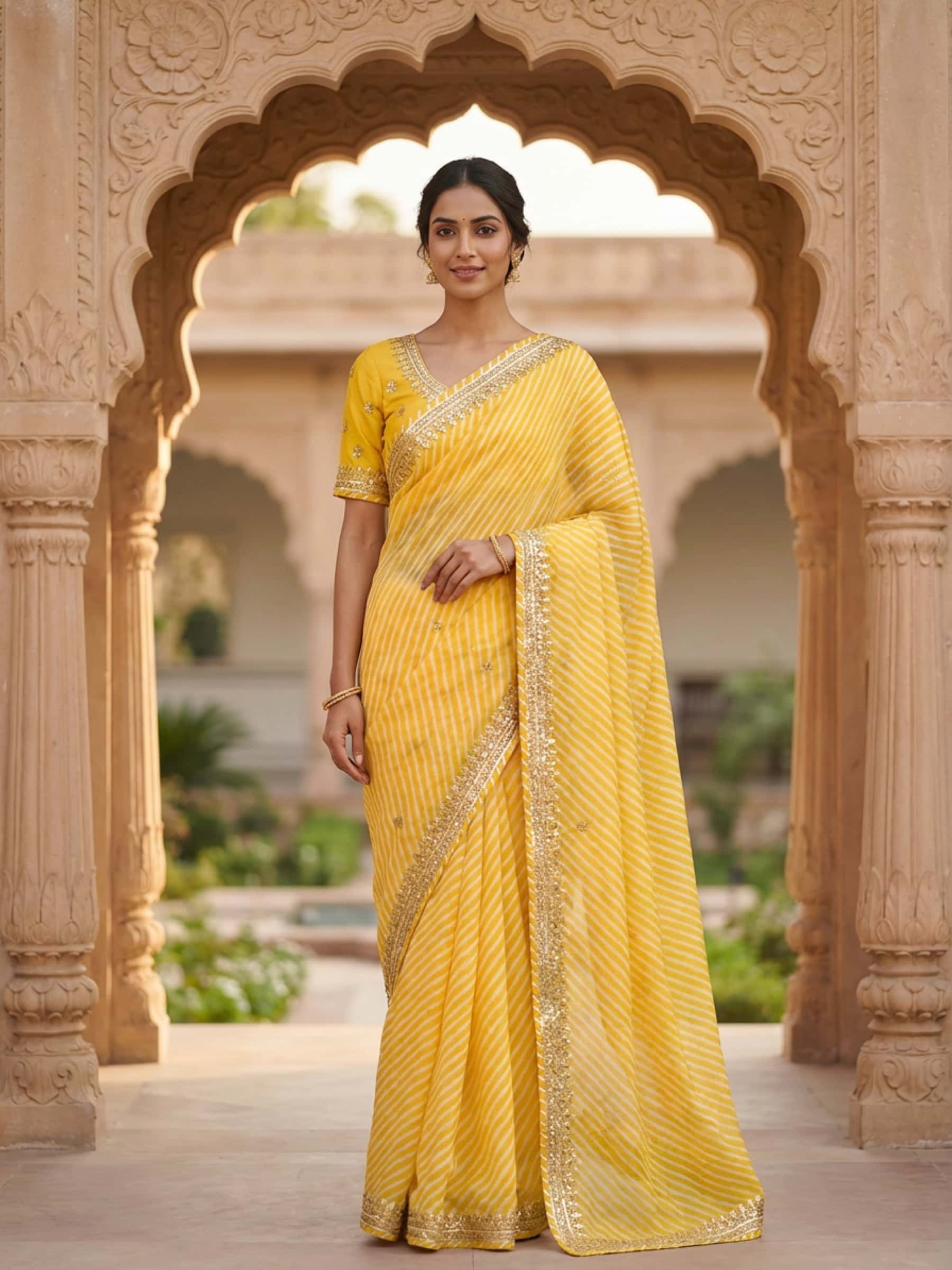
A pure Leheriya saree is the visual signature of Rajasthan in a single drape. Its diagonal stripes — sharp, vivid, and unmistakable — were not invented by a designer. They are the natural consequence of a 16th-century resist-dye technique unique to the region: the fabric is tightly rolled on the diagonal, tied with thread at regular intervals, and dipped in dye. When the thread is removed, the dye has reached only the unbound sections, leaving the iconic diagonal wave pattern. The Rajasthani word leher means wave. Every Leheriya saree carries the rhythm of the rolling, tying, and dipping process in its surface. Our Leheriya saree collection above is sourced from Jaipur and Jodhpur artisan workshops where the craft has been continuously practised since the 1600s.
How real Leheriya is made
Leheriya is a deceptively simple technique that takes years to master. The process:
- Stage 1 — Fabric preparation. The undyed fabric (georgette, cotton, silk, or chiffon) is dampened to make it easier to roll.
- Stage 2 — Diagonal rolling. The artisan rolls the fabric from one corner to the opposite corner, on the diagonal, until it becomes a long, tight cylinder. The angle and tightness of this roll determines the angle and clarity of the eventual stripes.
- Stage 3 — Thread tying. The rolled fabric is tied at regular intervals with strong cotton thread, binding the cloth at exactly the points where the artisan wants to resist the dye.
- Stage 4 — Dyeing. The bound cylinder is dipped in dye. The thread-bound sections resist the dye; the exposed sections take the colour.
- Stage 5 — Repeat for multi-colour. For a panchrangi (5-colour) or satrangi (7-colour) Leheriya, the fabric is rolled and tied again from a different direction, then dyed in the next colour. Each colour requires a fresh roll-tie-dip cycle.
- Stage 6 — Untying. The threads are cut, the fabric unrolled, and the diagonal wave pattern emerges.
A simple two-colour Leheriya takes 3–5 days of artisan work. A panchrangi or satrangi Leheriya can take three to six weeks.
How to tell real Leheriya from a printed imitation
Most "Leheriya" sarees sold online for under ₹2,000 are not Leheriya at all. They are screen-printed georgette with the diagonal pattern printed flat onto the surface. Three tests:
- Check the back of the fabric. Real Leheriya is dyed through — the diagonal pattern appears on both sides of the fabric with similar clarity. Printed Leheriya shows only on the front, with the reverse either blank or faded.
- Look at the stripe edges. Hand-resist Leheriya stripes have slightly fuzzy, organic edges where the dye crept past the tied thread. Printed Leheriya has razor-sharp digital edges.
- Examine stripe regularity. Hand-tied Leheriya stripes vary slightly in width along the length of the saree — the artisan ties by feel, not by ruler. Printed Leheriya stripes are mathematically identical.
A genuine handcrafted Leheriya saree from a Jaipur or Jodhpur artisan starts around ₹6,000 for a simple two-colour georgette and goes past ₹80,000 for a satrangi Leheriya in pure silk with Gota Patti border.
Pattern vocabulary
Leheriya patterns are categorised by the number of colours and the geometry of the diagonal lines:
- Two-colour Leheriya — the base form. Most often a vivid colour against white or natural fabric.
- Panchrangi — five-colour Leheriya. The classic Rajasthani festive pattern, traditionally worn for Teej and Gangaur. The most photographed Leheriya style.
- Satrangi — seven-colour Leheriya. The most labour-intensive standard Leheriya pattern; each additional colour roughly doubles the production time.
- Mothara — a Leheriya variant where the stripes intersect to form a diamond grid pattern. Created by tie-dyeing the fabric in two perpendicular directions.
- Samudri-leher — "ocean wave" Leheriya, where the wave pattern is wider and more flowing. Associated with monsoon and Sawan festival wear.
- Pratapshahi — a heritage Leheriya from the Mewar courts, featuring specific colour combinations and stripe widths historically associated with the Pratap dynasty.
For a deeper visual breakdown of these patterns, see our guide to popular Leheriya patterns and designs.
Choosing the right Leheriya
The fabric base determines drape, formality, and price tier:
- Pure georgette Leheriya — our most popular base. Light, drapes fluidly, the diagonal pattern photographs with crisp definition. The default for festive and reception wear.
- Pure silk Leheriya (Gajji silk, Banarasi silk) — heavier, more formal, suits bridal and ceremonial occasions. The diagonal stripes take on a luminous sheen on silk.
- Pure cotton Leheriya — traditional daytime and summer wear. Most affordable. Easy to drape.
- Chiffon Leheriya — lightest option, ideal for evening cocktail wear and warm-weather events.
Avoid synthetic-blend Leheriya. Polyester does not absorb resist-dye evenly, so the colour gradient at the stripe edges is flat and chemical-looking rather than the soft natural fade of real Leheriya.
Occasion mapping
Leheriya is deeply tied to specific Rajasthani festivals and seasonal celebrations:
- Teej (July–August) — the signature Leheriya occasion. Married women across Rajasthan wear panchrangi or satrangi Leheriya sarees on Teej. Green and red are the most traditional Teej Leheriya colours.
- Gangaur (March–April) — saffron-yellow and vermilion Leheriya, often worn with traditional Rajasthani jewellery.
- Sawan / monsoon — green Leheriya, sometimes with samudri-leher wave patterns evoking rain.
- Wedding sangeet and mehendi — panchrangi Leheriya in vivid jewel tones; movement-friendly and photographs well under festive lighting.
- Festive / daily wear — two-colour cotton or georgette Leheriya for daytime puja, family functions, and Navratri.
- Bridal — heavier silk Leheriya with Gota Patti border, often in red, maroon, or jewel tones. Less common than Bandhani for bridal wear but striking on the right bride.
For the closely-related Bandhani craft and how to choose between them, read our Bandhani vs Leheriya guide.
Care and longevity
Leheriya dyes are sensitive to direct sunlight. Treated correctly, a Leheriya saree retains its colour brightness for decades.
- Dry-clean only. Every Rana's Leheriya piece is dry-clean only — water flattens the diagonal resist pattern and the vegetable dyes can bleed.
- Dry in shade between dry-cleans. Direct sunlight fades Leheriya dyes faster than most fabrics — the diagonal stripes lose definition under prolonged UV.
- Iron on the reverse, low heat. The high heat needed for crisp pleats can scorch the natural dyes.
- Store folded with acid-free tissue. Avoid plastic bags — Leheriya needs to breathe.
What to look for when buying
- Does the diagonal pattern appear on both sides of the fabric (real) or only one side (printed)?
- Do the stripe edges have a slight organic fuzz (real resist) or a sharp digital line (printed)?
- What is the fabric composition? Pure georgette, pure silk, pure cotton — not "Leheriya-style fabric."
- How many colours, and were they dyed in sequence? (A real artisan will describe the colour-round process.)
- Where was it made? (Jaipur, Jodhpur, Sikar — or vague?)
Every Leheriya saree at Rana's is artisan-attributed, fabric-disclosed, and produced in Rajasthan by known workshops. Read the full guide to popular Leheriya patterns for visual reference, or compare with the Bandhani vs Leheriya guide.
Browse adjacent crafts: our Bandhani saree collection is the closest sister craft to Leheriya and often combined with Leheriya on the same piece; the Gota Patti saree collection includes Leheriya base fabrics with Gota Patti borders; and the Rajputi Poshak collection features Leheriya odhnis as a signature element.